
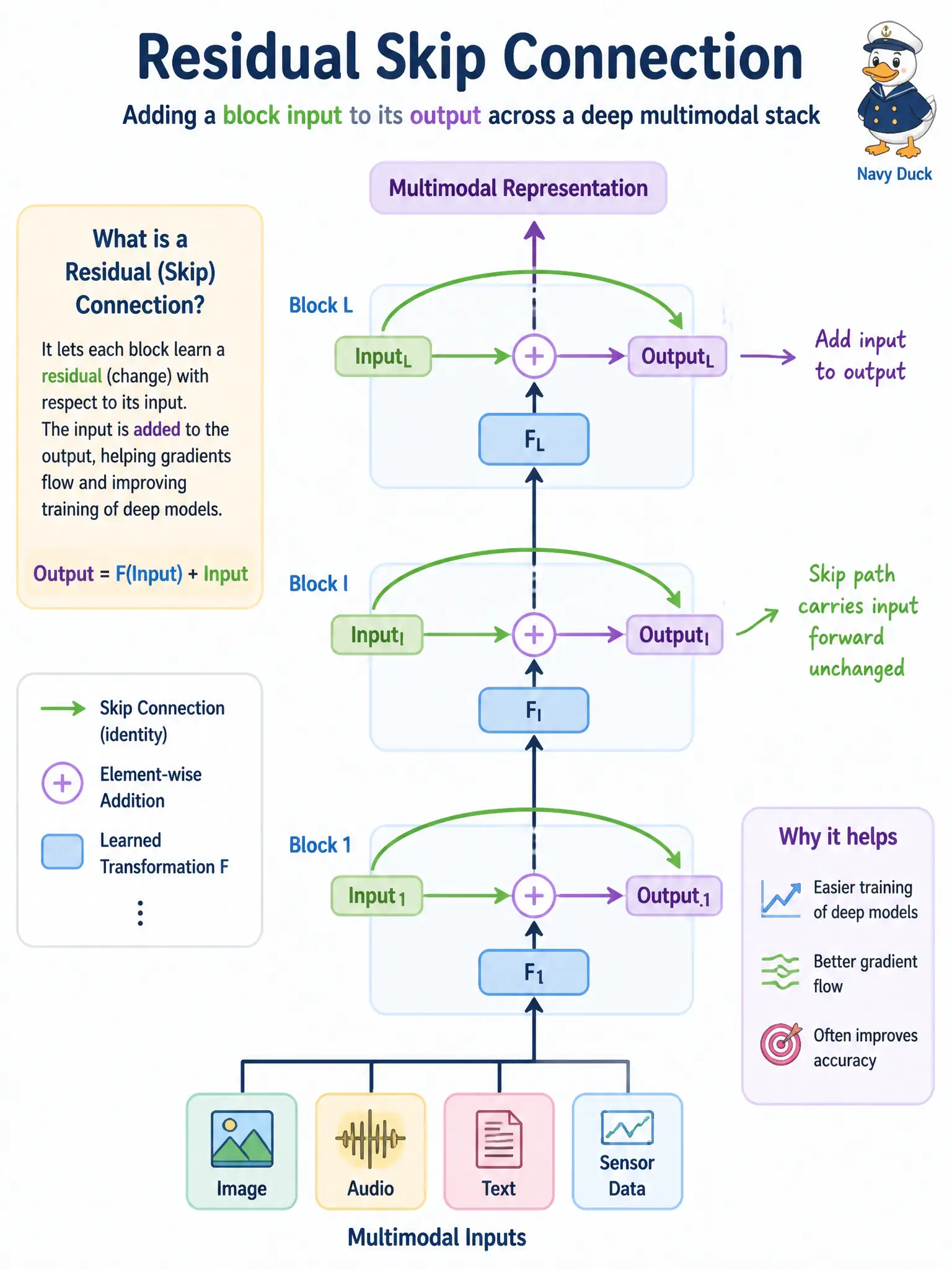
A bookbindery stacks many layers on cover stills plus binder notes and early layers stop receiving a useful error signal. Which architectural idea adds the block’s input back to its output?
Select an answer to reveal the explanation.
Short Explanation
A skip is like stitching a bookmark that jumps past a thick stack of pages so the early chapters still get the message. Residual connections add the block’s input back to its output. That is architecture, not a hyperparameter sweep.
Full Explanation
When many layers on cover stills plus binder notes stop delivering a useful error signal to early layers, a residual or skip connection that adds the block’s input to its output provides a shorter path for gradients and information. That is an architectural remedy for deep-stack trainability. Removing all nonlinearities to make every layer a spreadsheet cell destroys representational power rather than solving depth. Larger batch size or longer epoch names are training hyperparameters, not residual connections. Deleting the held-out split does not restore gradients to early layers. Exam caveat: associate depth recognizes residual/skip intent without deriving ResNet proofs. Operational check: if early bookbindery layers show near-zero gradient flow, introduce residual additions around blocks and re-check that early parameters receive nonzero updates while monitoring holdout performance. Residual links do not remove the need for a sound loss or clean splits; they specifically address depth-related gradient flow on the stacked stills-and-notes network. After adding skips, re-plot early-layer gradient norms on cover-still batches to confirm the error path reopened. Residual additions reopen gradient paths through deep cover-still stacks; they do not replace losses, splits, or held-out monitoring. After adding skips, confirm early-layer gradients are nonzero again.