
A violin shop wants one network that compresses a belly photo into a code, one that writes a condition note from that code, and one that does both. Which role names match those jobs?
Select an answer to reveal the explanation.
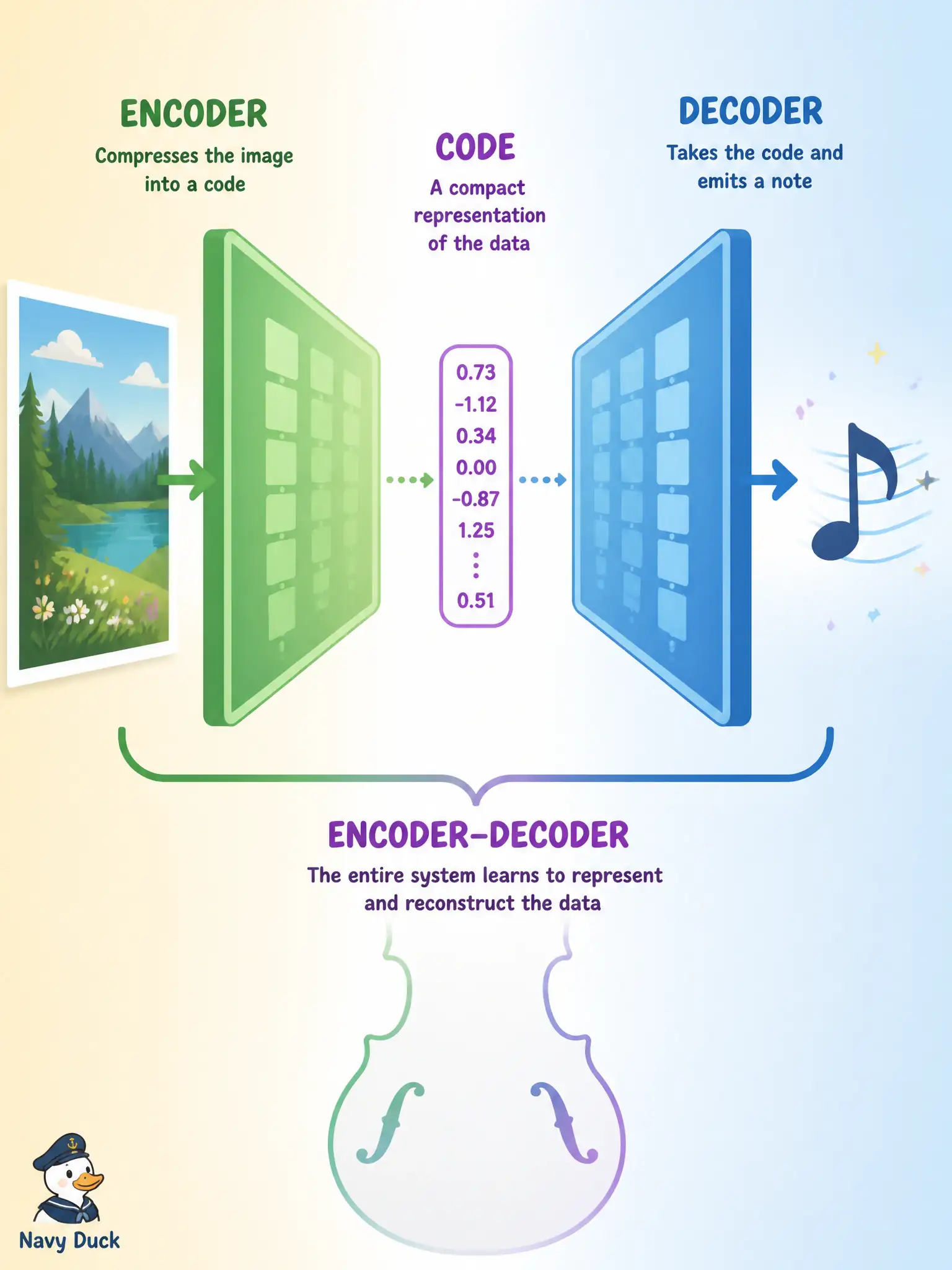
Short Explanation
An encoder packs the belly photo into a compact code; a decoder unpacks a code into a note; the combo does the round trip. Those role names follow what each side consumes and emits. They are not fancy names for a learning-rate dial.
Full Explanation
Role names for a violin shop’s belly-photo and condition-note network follow data flow. An encoder compresses an input (the photo) into a latent code. A decoder emits an output (the note or reconstruction) from a code. An encoder–decoder combines both ends for tasks that need understanding and generation. Reversing those jobs—decoder compresses, encoder only writes—contradicts the names. Encoder–decoder is not a filename shuffler. These roles are not synonyms for a learning-rate schedule. Exam caveat: civic craft stems still expect standard encoder / decoder / encoder–decoder vocabulary. Operational check: sketch what enters and exits each block on the shop’s diagram; label compress-to-code as encoder and emit-from-code as decoder before choosing learning-rate knobs. When reviewing shop diagrams, ask what is compressed and what is emitted; those answers pin the encoder and decoder labels more reliably than informal nicknames. On violin-shop whiteboard reviews, force arrows from photo to code and from code to note before approving role names. Encoder means compress-to-code; decoder means emit-from-code; encoder–decoder means both ends on the violin belly-to-note path. Reject diagrams that swap those arrows or treat roles as learning-rate synonyms.