
An ice-cutter pond house needs English lines and pond stills to live in one comparable space. How does CLIP’s dual-encoder contrastive design work?
Select an answer to reveal the explanation.
Short Explanation
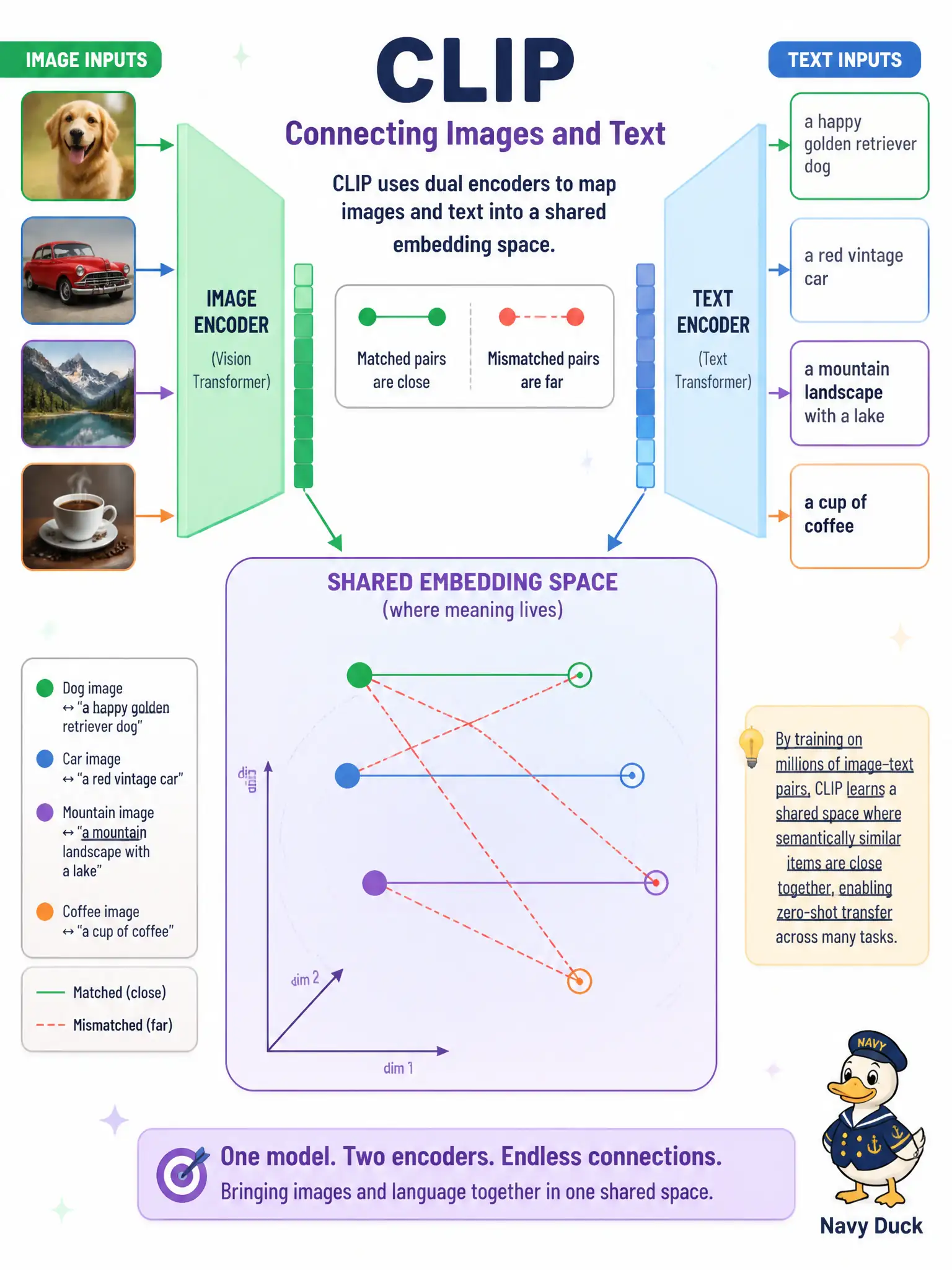
Picture two docks—one for words, one for pond photos—pushing matching cargo into the same warehouse aisle and mismatched cargo apart. That dual-encoder contrastive setup is CLIP’s design. It creates a shared comparable space.
Full Explanation
CLIP’s dual-encoder contrastive design trains separate encoders—for example one for English lines and one for pond stills at an ice-cutter civic house—so matched pairs sit close in a shared embedding space while mismatched pairs sit far apart. That shared space is what makes text and image comparable for retrieval or zero-shot style matching. Designs that delete text in one encoder and images in the other never create a shared space. A single decoder inventing pixel kernels without a contrastive pairing objective is a different generative story, not CLIP’s contrastive dual-encoder setup. CLIP is not a Helm chart for speech models and does embed images (and text) rather than ignoring vision. Exam caveat: associate items test the dual-encoder contrastive idea, not training recipes with invented product SKUs. Operational check: for a civic pond-and-caption pilot, encode a held-out matched pair and a mismatched pair and confirm cosine similarity is higher for the true match before claiming the shared space works. Evaluate CLIP-style retrieval on held-out pond/caption pairs with hard negatives from nearby civic sites. Contrastive dual encoders create a shared pond/text space; evaluate with matched versus mismatched pairs, not Helm or speech-only charts. Similarity should rank true civic matches above hard negatives.