
A tannery hide loft must choose an architecture that reads grain photos and later a short grade note. Which pairing best matches common architecture strengths?
Select an answer to reveal the explanation.
Short Explanation
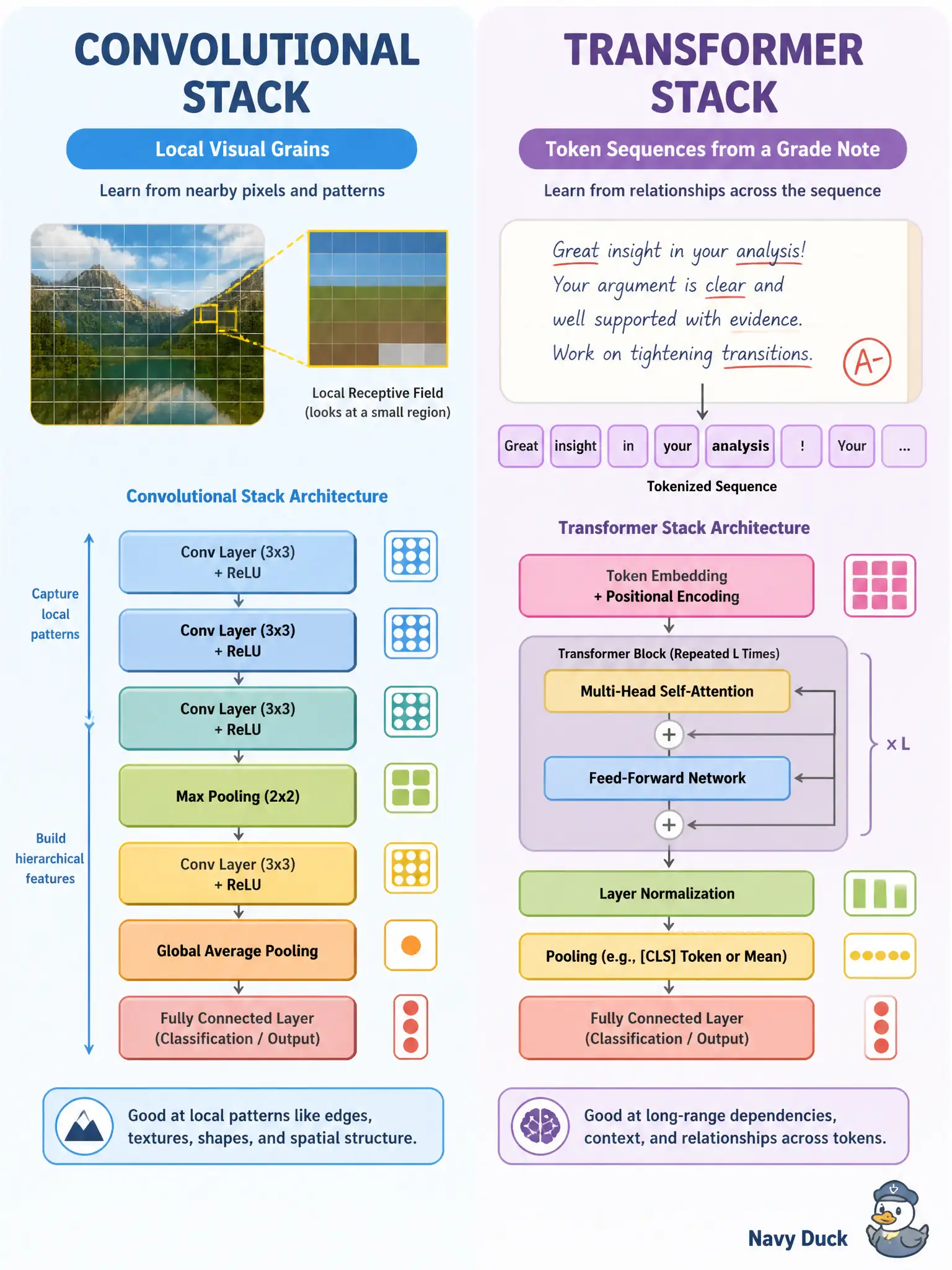
Grain close-ups reward filters that notice local texture; grade notes reward models that handle token sequences. Convolutional stacks suit local visual structure. Transformers suit sequence-like tokens as a design choice.
Full Explanation
Architecture pairing for a tannery hide loft commonly matches strengths: convolutional stacks excel at local visual patterns in grain photos, while transformer stacks excel at sequence-like tokens in grade notes. Claiming transformers are only for raw pixels and convolutions only for spoken audio kernels misassigns both families. Handwritten spreadsheet update loops are not architecture substitutes. It is false that convolutional stacks cannot read stills or that transformers cannot read token sequences. Exam caveat: associate answers stay at this design-choice level; they do not require inventing product SKUs. Operational check: for grain stills, start from a convolutional or vision-transformer visual encoder; for grade notes, use a text transformer path; fuse later as the multimodal design requires—do not force a spreadsheet training loop. Multimodal systems often keep both stacks and fuse them later; the pairing question is about inductive bias, not about forbidding one modality. Keep a short architecture ADR noting CNN-for-grain and transformer-for-notes as inductive biases, not absolute bans. Inductive bias pairing—convolutions for local grain, transformers for grade-note tokens—guides the tannery design without forbidding later fusion. Capture that pairing in a short architecture decision record.