
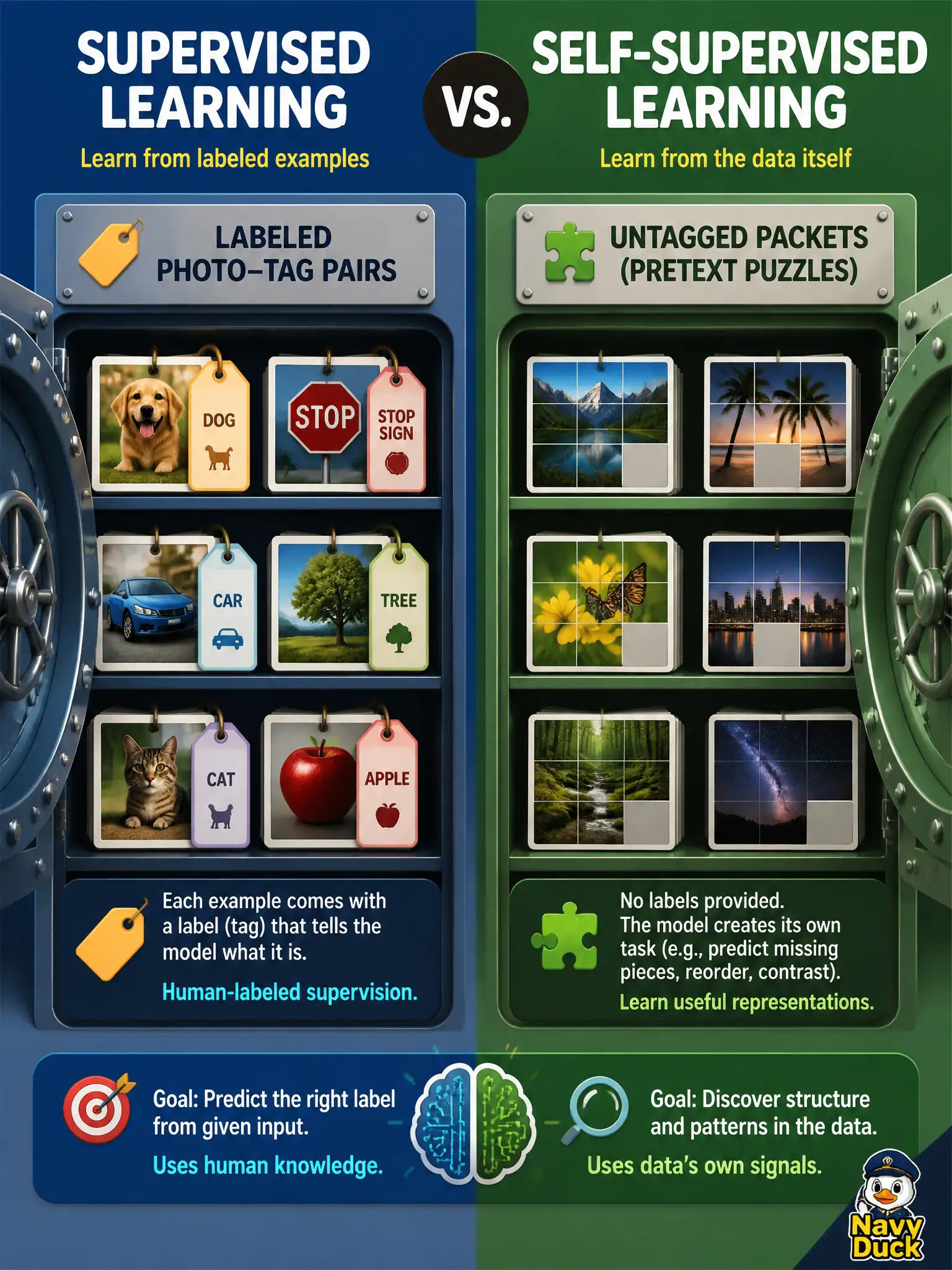
A seed-vault has a few hundred packet photos with species tags and many more untagged packets. How do supervised labeled-pair training and a self-supervised pretext differ?
Select an answer to reveal the explanation.
Short Explanation
Tagged packets are like jars with handwritten species stickers guiding the lesson; a pretext invents a puzzle from the photos themselves when stickers are scarce. Supervised learning leans on those labels. Self-supervised learning builds a signal without fresh human tags.
Full Explanation
Supervised labeled-pair training at a seed-vault uses human tags (species labels on packet photos) as the direct learning signal. A self-supervised pretext instead invents a learning signal from the data itself—masked prediction, contrastive views, and similar tasks—so structure can be learned when fresh human labels are scarce. Self-supervised training does not require a human tag on every packet before any learning starts. Supervised training does not ignore tags. Photos always need some training signal; the approaches differ in where that signal comes from. Exam caveat: civic vault metaphors still map to standard supervised versus self-supervised definitions. Operational check: if tagged pairs are few, prototype a pretext on untagged packets, then fine-tune or evaluate with the scarce labels—do not claim self-supervision needs universal human tags. Many civic vaults combine both: pretext pretraining on abundant untagged packets, then supervised fine-tuning on the scarcer tagged species pairs. Track how many seed-vault packets are tagged versus untagged to decide when pretext pretraining is warranted. Self-supervised pretexts invent signals from untagged seed packets; supervised fine-tuning then consumes the scarce species tags. Report labeled versus unlabeled counts when choosing the mix.