
A charcoal-kiln camp stacks a very deep stills-and-notes network. In one recipe the error signal becomes tiny after a few layers; in another the numbers explode. What failure modes are those?
Select an answer to reveal the explanation.
Short Explanation
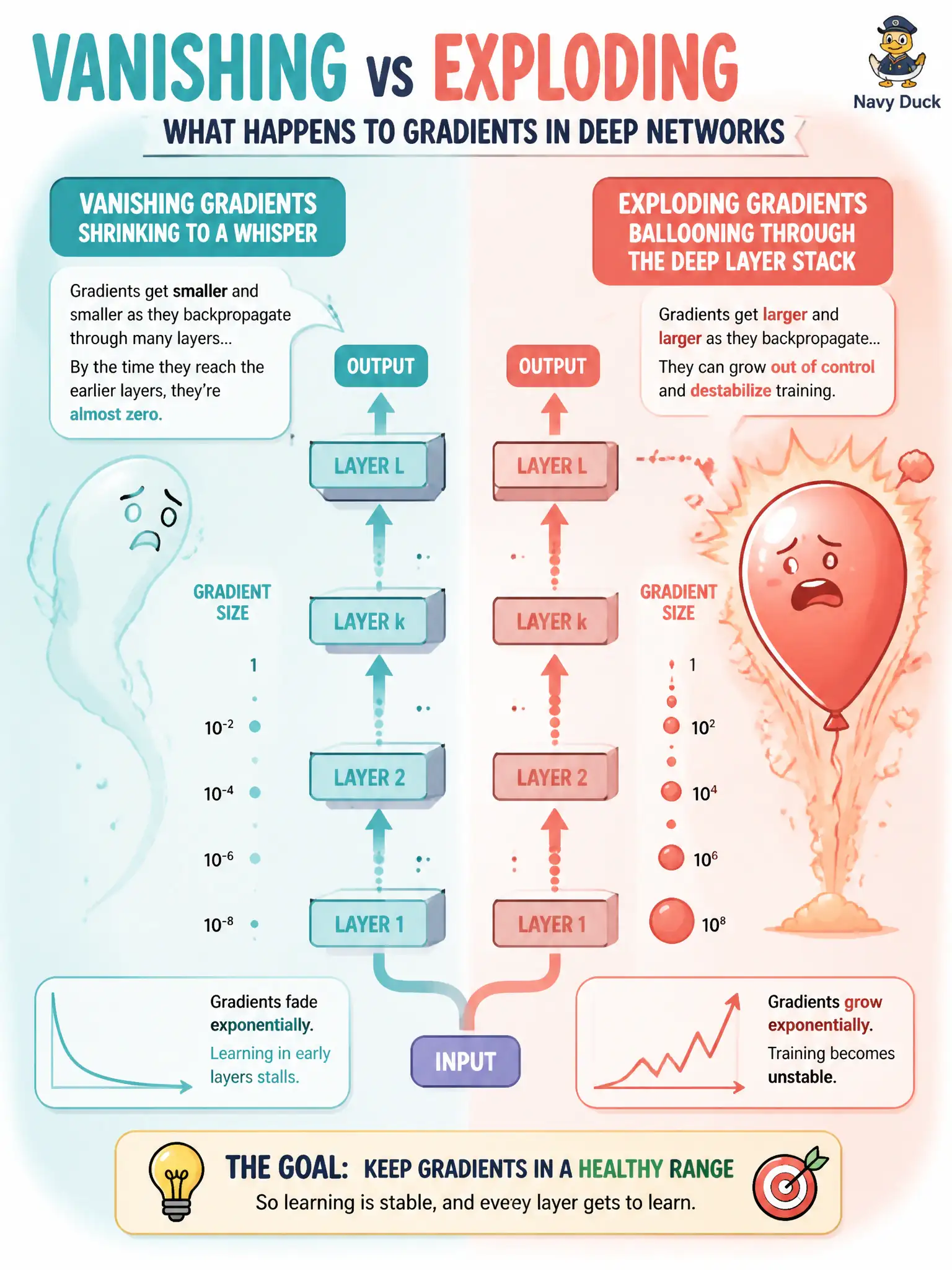
Deep stacks can whisper the error so quietly it vanishes, or shout so loudly the numbers blow up. Those vanishing and exploding update stories are classic deep-training failure modes. They are conceptual diagnoses, not a call to author kernels.
Full Explanation
Deep multimodal stacks on charcoal-kiln stills-and-notes can suffer vanishing updates, where the error signal shrinks so much through many layers that early weights barely move, or exploding updates, where gradients grow without bound and training becomes numerically unstable. These are classic deep-training failure modes tied to depth, activation scaling, and initialization—not proof that multimodal inputs cannot be trained without NCCL. They are not healthy convergence that demands rewriting CUDA kernels at associate level. Dataset shuffling bugs that only rename epoch counters are a different class of issue and do not explain vanishing or exploding gradients. Exam caveat: recognize the names and symptoms; residual connections and careful initialization appear as related architecture awareness elsewhere, without kernel authorship. Operational check: watch gradient norms and loss scale across layers on the kiln run; if norms collapse toward zero in early blocks or explode to NaNs, diagnose vanishing versus exploding updates before changing civic KPIs or inventing product names. Residual connections, careful initialization, and activation choices are the architectural levers associates should name before proposing low-level kernel work. Name vanishing versus exploding updates from gradient-norm behavior in the kiln stack before proposing NCCL or kernel work outside associate scope. Architecture remedies such as residuals belong in the next design discussion after the diagnosis.