
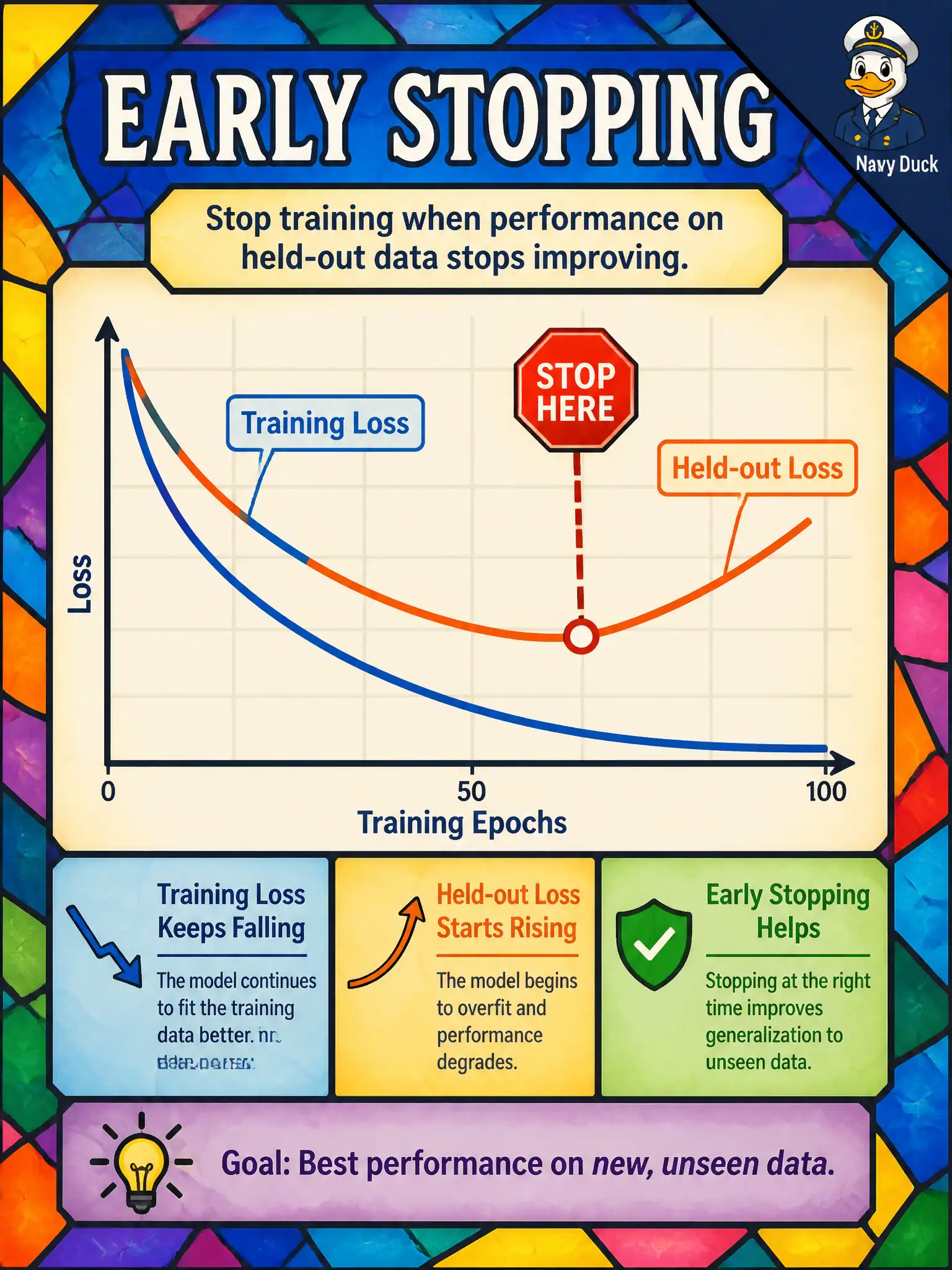
A stained-glass studio watches training loss keep falling while the held-out loss turns upward. What training-loop idea fits ending the run when the unused split no longer improves?
Select an answer to reveal the explanation.
Short Explanation
When practice keeps getting easier but the spare pane set gets worse, it is time to put the tools down. Early stopping ends the run using that held-out signal. It is a training-loop guardrail, not a metric-shopping exercise.
Full Explanation
Early stopping ends training when a held-out signal—typically validation loss or a related metric—stops improving, even if training loss on the stained-glass studio’s panes continues to fall. That practice limits overfitting by refusing to keep fitting noise after generalization peaks. Doubling the learning rate whenever holdout loss rises usually worsens instability rather than acting as early stopping. Deleting the held-out split removes the very signal early stopping needs. Shopping for a new civic KPI unrelated to the training loop is metric distraction, not a training-loop guardrail. Exam caveat: stems may mention civic studios; the mechanism remains monitor-holdout-then-halt. Operational check: maintain a held-out pane set, log its metric each epoch, set a patience counter, and restore or keep the checkpoint from the best held-out epoch when patience expires. Persist the best held-out checkpoint rather than the final training-loss minimum when the unused split has already turned upward. Store the patience setting and best-epoch id with the stained-glass checkpoint so operators know why training halted. Early stopping saves the best held-out stained-glass checkpoint; continuing solely because training loss falls is the failure mode it prevents. Record patience and the winning epoch id with the promoted artifact.