
A honey-house desk trains on comb photos with harvest notes. One volunteer calls every single comb “an epoch,” and another calls a shuffled tray of sixteen pairs “the whole dataset.” Which assignment is correct?
Select an answer to reveal the explanation.
Short Explanation
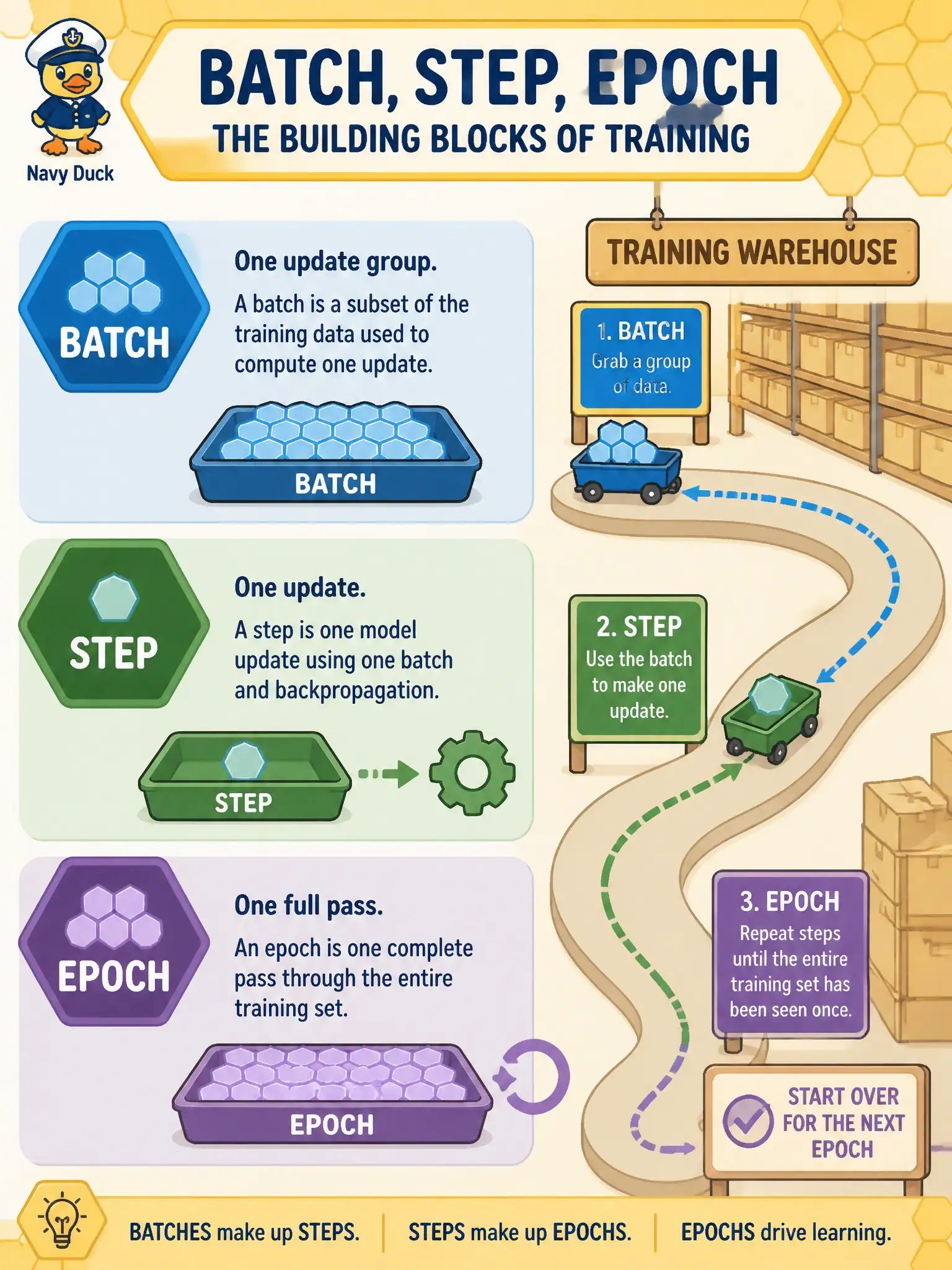
A batch is a tray the shop processes before adjusting the recipe; an epoch is walking the whole warehouse once. One photo is not an epoch, and sixteen shuffled pairs are not automatically the full dataset. Keep batch, step, and epoch in those everyday sizes.
Full Explanation
In a honey-house or other municipal multimodal desk, training vocabulary must stay sized correctly. A batch is the set of pairs (comb photos with harvest notes) used for one optimizer update. An epoch is one complete pass through the training set. A step is typically one batch update. Calling a single comb photo an epoch inflates one example into a full dataset pass. Calling a shuffled tray of sixteen pairs “the whole dataset” confuses a batch with the archive; sixteen may be a convenient batch size, not proof of coverage. Treating batch and epoch as identical names for one unlabeled still collapses three distinct concepts into one. Exam caveat: exam stems often use civic trays and warehouses as metaphors; the definitions remain standard deep-learning sizing, independent of craft vocabulary. Operational check: count how many pairs are in the training archive, choose a batch size, and verify that one epoch equals ceil(N/batch_size) update steps (accounting for drop-last settings) rather than equating one photo or one tray with an epoch. Clear logs that print batch size, steps per epoch, and samples seen help municipal stewards audit whether a tray was a mini-batch or a claimed full pass. Write N, batch size, and steps-per-epoch on the honey-house whiteboard each run so “tray” never silently means “epoch.” Auditors should be able to recompute epoch boundaries from those three numbers alone.