
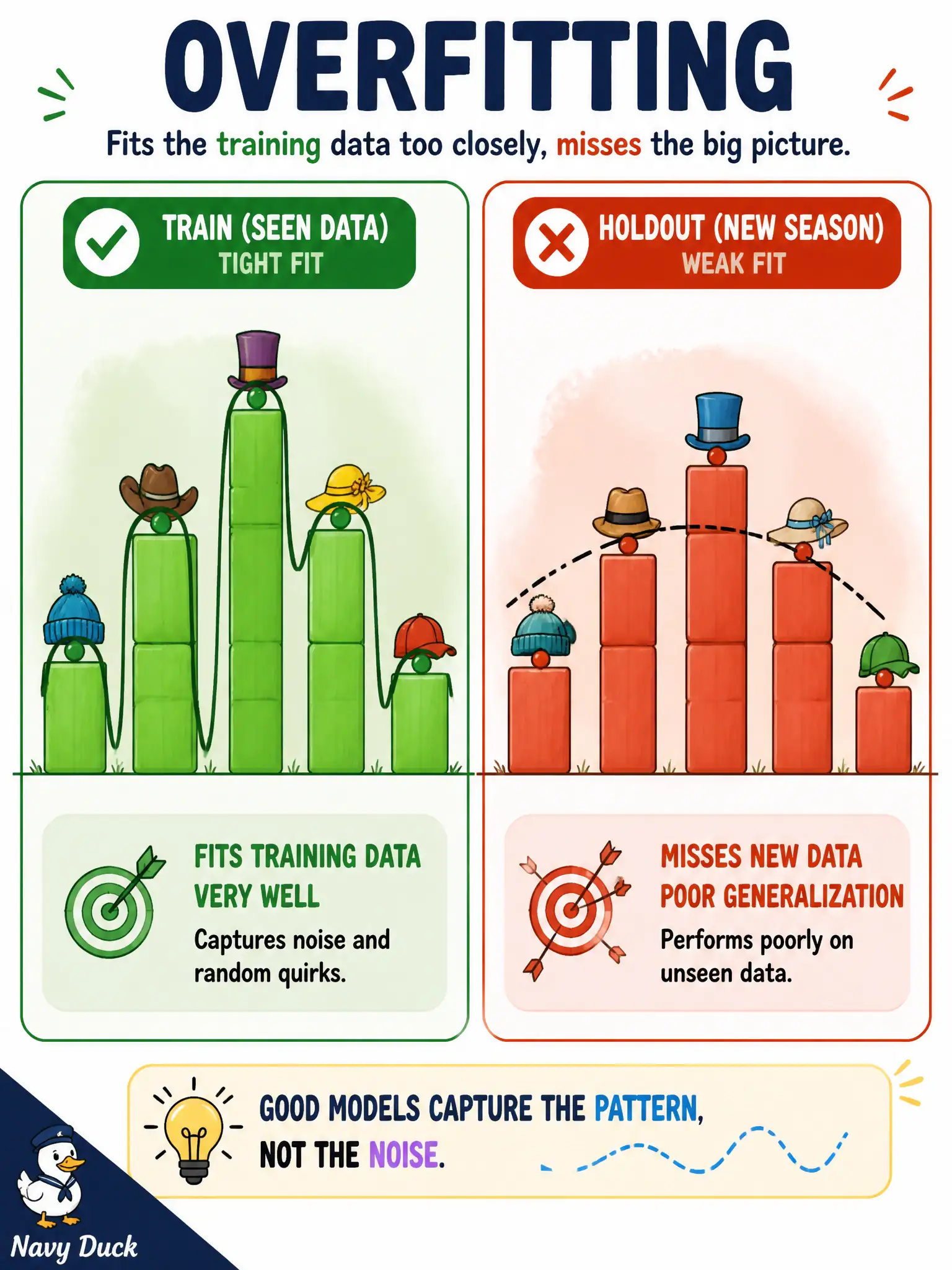
A milliner’s loft fits every training still and label perfectly, then misses next season’s new hat blocks. What pattern does that describe?
Select an answer to reveal the explanation.
Short Explanation
Memorizing this season’s blocks is like cramming flashcards and then blanking on a new style. Great training scores with weak performance on unseen items is overfitting. It is not proof the camera failed.
Full Explanation
When a milliner’s loft (or similar civic fitting room) achieves excellent performance on every training still and label yet fails on next season’s unseen hat blocks, the pattern is overfitting: the model memorized training idiosyncrasies instead of learning generalizable structure. Underfitting would show poor performance on both training and holdout, not excellent train fit. A broken camera that never delivered pixels would prevent any meaningful training fit. Calling memorization “healthy generalization” inverts the definition—generalization is success on new blocks, not perfect recall of the loft’s current inventory. Exam caveat: multimodal civic scenarios still use the classic train-versus-holdout diagnosis; pretty previews do not override the split metrics. Operational check: track training loss or accuracy alongside a held-out loft split drawn from new styles or seasons; if train metrics keep improving while holdout degrades, treat the run as overfitting and apply regularization, more diverse data, or early stopping. Regularization, more diverse seasonal blocks, and early stopping are typical remedies once the loft metrics show the train–holdout split. When next-season blocks arrive, score them as a true holdout before celebrating loft memorization as readiness. Prefer holdouts drawn from new seasons or suppliers; in-distribution loft copies will understate overfitting on hat blocks. Promotion criteria must cite holdout metrics on genuinely unseen blocks, not only training fit.