
A lighthouse lens room walks through one training step on a cracked-prism still plus a short keeper note. Which statement correctly separates the two halves of that step?
Select an answer to reveal the explanation.
Short Explanation
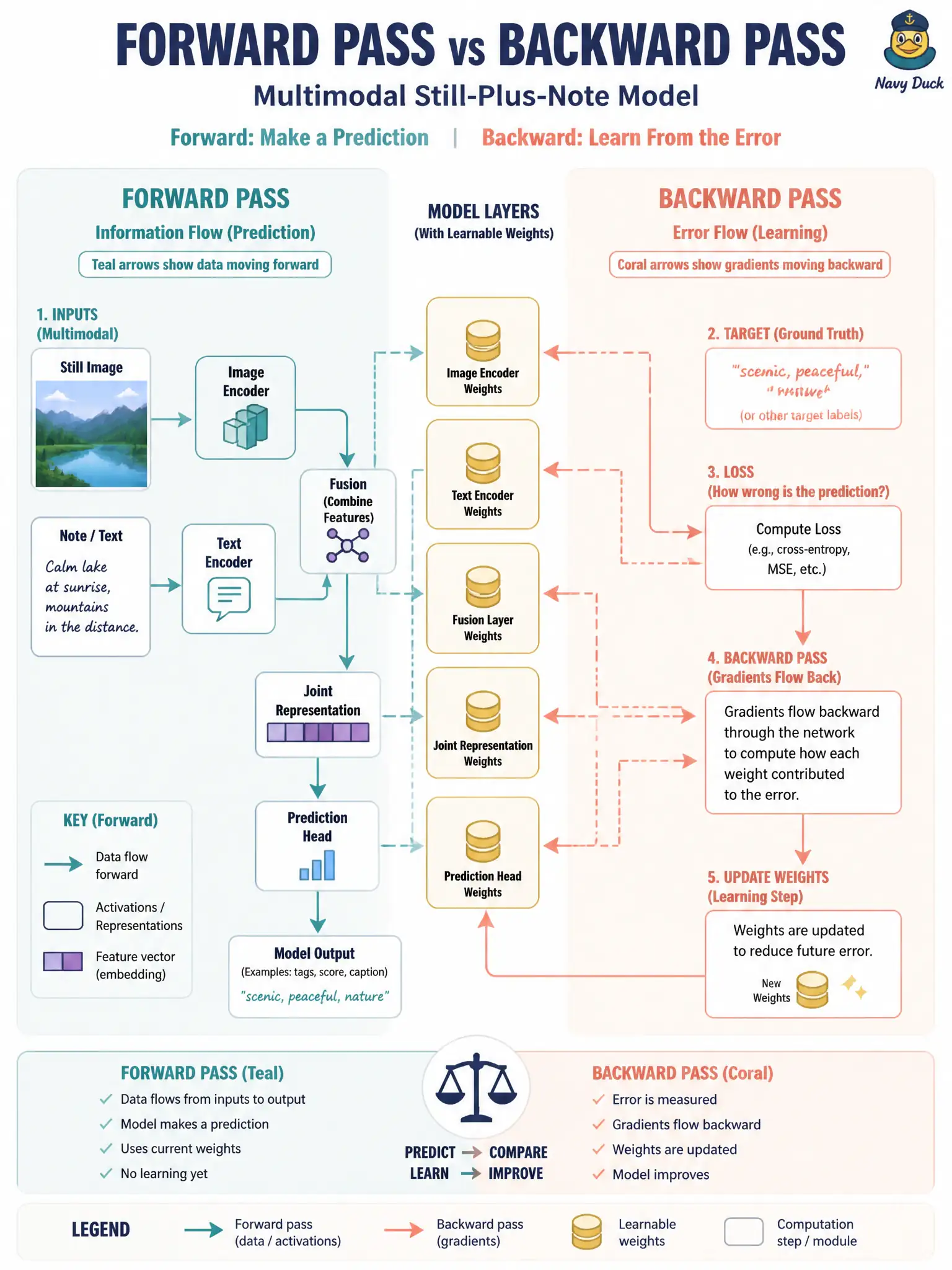
Picture a two-way street: outbound traffic is the guess, inbound traffic is the correction. The forward pass only predicts; the backward pass sends the error home so weights can shift. Mixing those jobs muddles how one training step works.
Full Explanation
One training step on a multimodal civic example—cracked-prism still plus keeper note—has two conceptual halves. The forward pass runs the network on the batch and produces a prediction (classification logits, reconstructed features, embeddings, and so on). The loss compares that prediction with the target. The backward pass propagates error derivatives so weights can move; without that backward signal, parameters do not learn from the mismatch. Claiming the backward pass only draws a nicer preview reverses the jobs: visualization is not backpropagation. Saying both halves only shuffle photo and note without computing a prediction erases the model’s role entirely. Asserting that the forward pass updates every weight while the backward pass only loads the next batch swaps the update path with data loading. Exam caveat: NCA-GENM expects this forward-predict / backward-update separation at associate depth without requiring hand-written CUDA autograd. Operational check: after one civic batch, confirm a prediction exists before the step, a loss is computed, and parameter tensors change only after the backward-plus-optimizer phase—not after the forward alone. Keeping prediction, loss, and gradient application in that order also prevents apprentices from treating data shuffling or batch loading as if they were learning updates. Treat prediction, scoring, and gradient application as an ordered contract for every lighthouse batch so apprentices cannot relabel visualization or dataloading as learning. A step report should show prediction tensors, loss value, and nonzero parameter deltas in that sequence.