
A cooperage trains a network on stave photos paired with stave notes. An apprentice says the run succeeded because the preview “looks nice.” What quantity actually drives the weight updates during training?
Select an answer to reveal the explanation.
Short Explanation
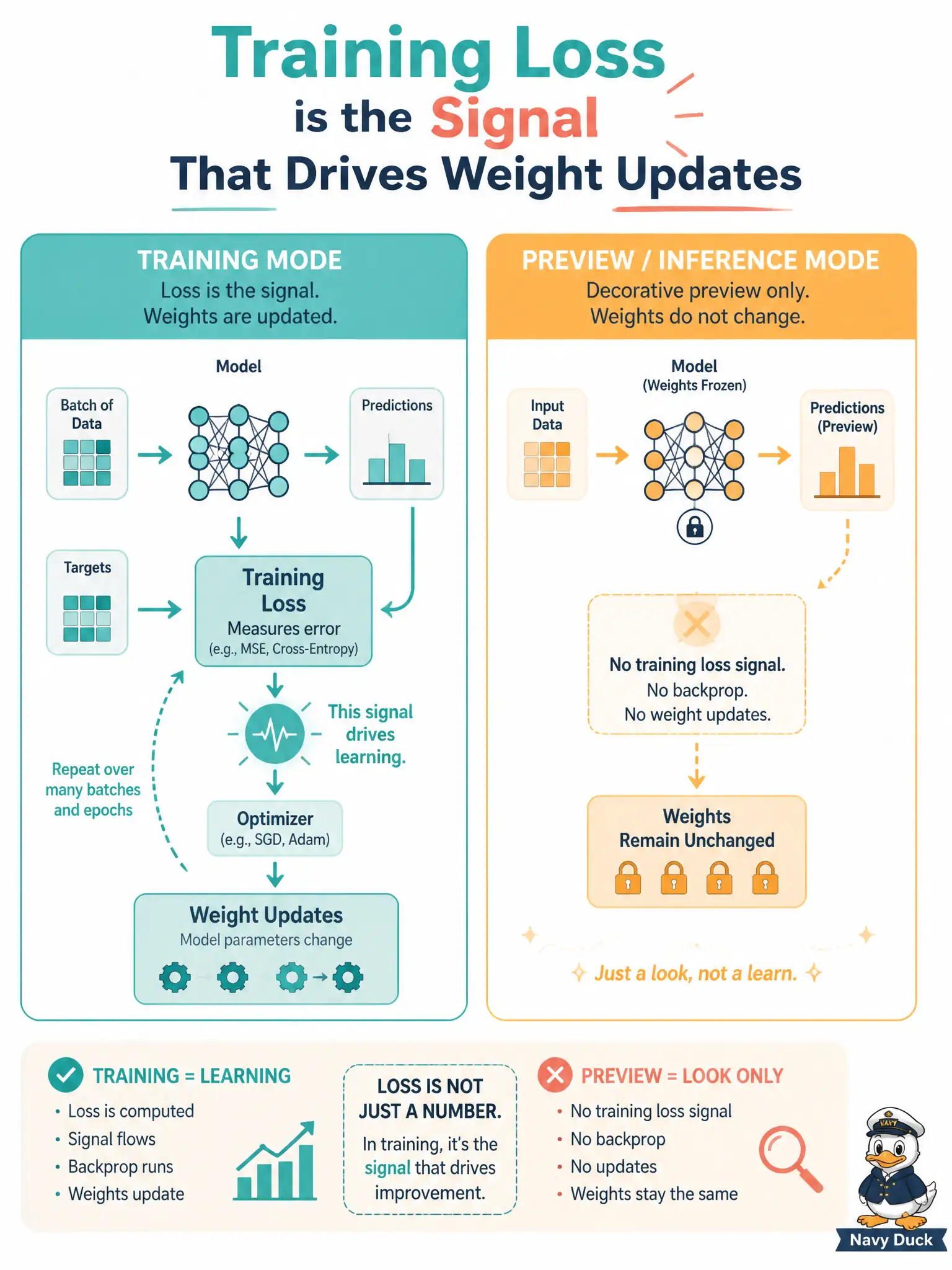
Think of the loss as the shop’s grading rubric the model must chase—pretty pictures are just a side glance. Weight updates follow that scored error, not whether someone likes the preview. Looking nice is not the training signal.
Full Explanation
In municipal multimodal training—such as a civic cooperage pairing stave photographs with stave notes—the quantity that actually drives parameter updates is the training loss the optimizer follows on each step. The forward pass produces predictions; the loss scores how far those predictions miss the target labels or reconstruction objective; backpropagation turns that scalar (or structured) loss into gradients; and the optimizer applies those gradients to the weights. Visual pleasantness of a casual preview is not the training signal: a render can look nice while the loss remains high, or look rough while the loss is improving. Checkpoint file size on disk is an operational artifact of serialization, not a gradient. Wall-clock time of a single forward pass measures latency, not the objective being minimized. Exam caveat: associate-level questions may mention civic workshops and preview screens, but success criteria remain the defined loss and held-out metrics, not aesthetics. Operational check: log batch loss (and a held-out loss) each step or epoch; confirm the optimizer’s learning-rate and loss definition match the stave-photo / note objective before declaring a run successful. In practice, teams also separate qualitative gallery review from quantitative training signals so civic stakeholders do not confuse a flattering stave preview with optimizer progress. Gallery review remains useful for stakeholder communication, but it is a human qualitative check after or beside training—not a substitute for the loss the optimizer minimizes on stave-photo and note batches. Municipal training governance should therefore require logged loss curves in every cooperage model-promotion packet.