
A 45-year-old woman with angioedema requires oral endotracheal tube exchange for a damaged cuff. She has limited mouth opening, anterior larynx, and a Cormack-Lehane grade III view on direct laryngoscopy with desaturation on prior attempts. Which tube exchanger, video laryngoscope, and bougie strategy best ensures safe tube exchange?
Select an answer to reveal the explanation.
Short Explanation
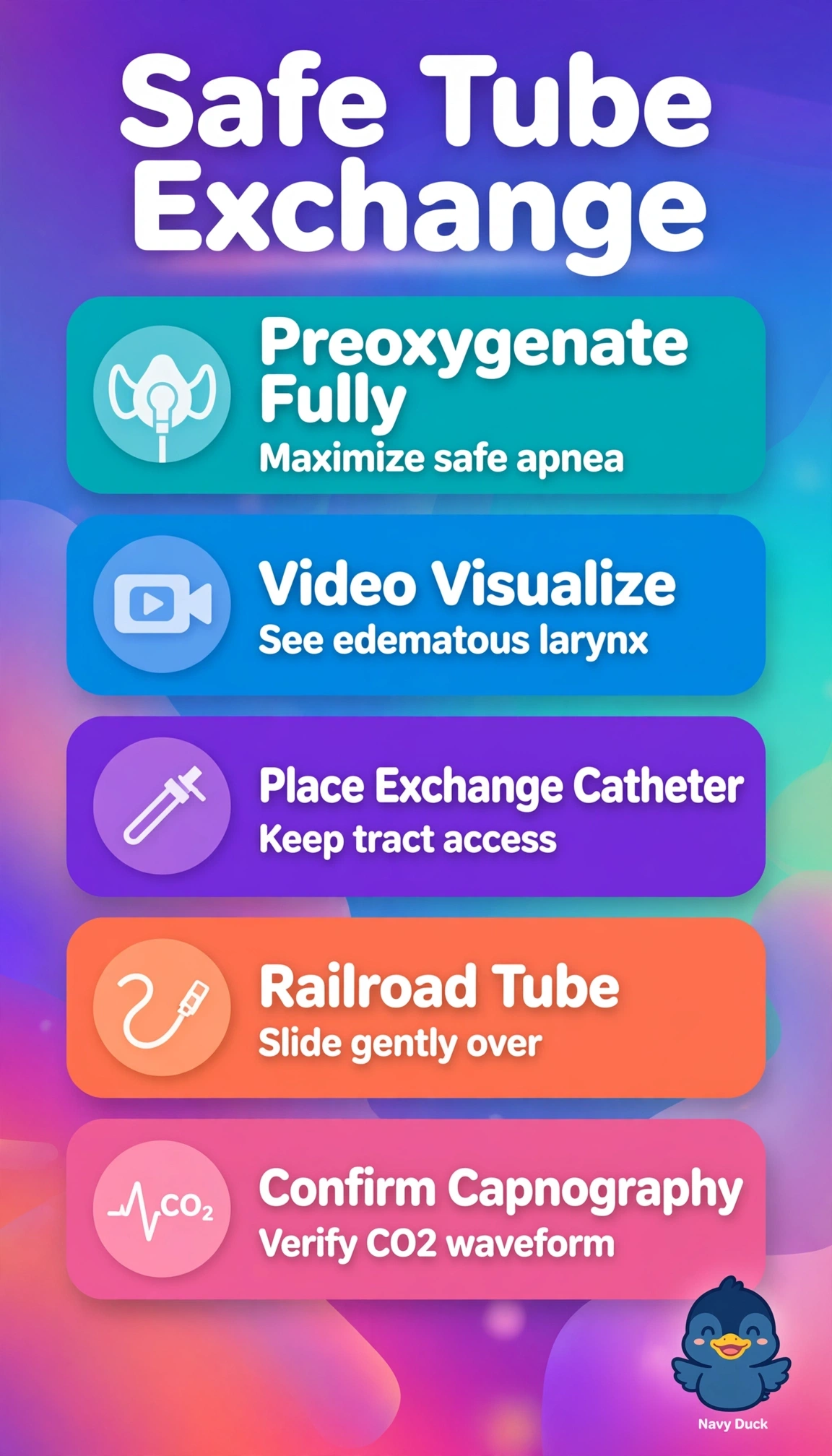
Never trade a working airway for a hope. Keeping oxygen flowing while you see and slide over a catheter keeps you safe. Visualize, oxygenate, then exchange with a lifeline in place.
Full Explanation
The correct strategy is required because this patient combines angioedema with limited mouth opening, anterior larynx, prior grade III direct view and desaturation, so safe exchange demands continuous oxygenation throughout apnea risk, improved glottic visualization beyond direct laryngoscopy, and a hollow airway exchange catheter that permits insufflation and jet ventilation plus capnographic confirmation of tracheal placement before and after railroading the new tube. An approach that maintains oxygenation and uses an exchange catheter with capnography but relies on optimized direct laryngoscopy fails by visualization concept because video laryngoscopy is specifically needed to overcome anterior anatomy and prior poor direct view in edema. An approach that preoxygenates then pauses oxygen delivery during video-guided exchange fails by oxygenation concept because intermittent apnea is unsafe after prior desaturation and edematous airway closure risk requires uninterrupted delivery. An approach that maintains oxygenation and video visualization but uses a solid gum-elastic bougie fails by conduit concept because only a hollow exchange catheter provides a ventilation lumen and compatibility with capnography and oxygen insufflation during the tubeless interval. Exam caveat is that bougie and airway exchange catheter are not interchangeable on tests despite similar appearance, with length, hollow lumen, and ventilation adapters distinguishing them for high-risk exchange. Practical check is to confirm depth markings, secure the catheter, verify continuous capnography and oxygen saturation, test the new cuff before insertion, and never advance or remove against resistance without visualization.