
An adult on assist-control ventilation shows double-triggered breaths with two stacked ventilator cycles per effort, high tidal volumes and patient distress. Sedation is light, inspiratory time is short, and flow demand is high. Which ventilator adjustment best corrects this patient-ventilator dyssynchrony?
Select an answer to reveal the explanation.
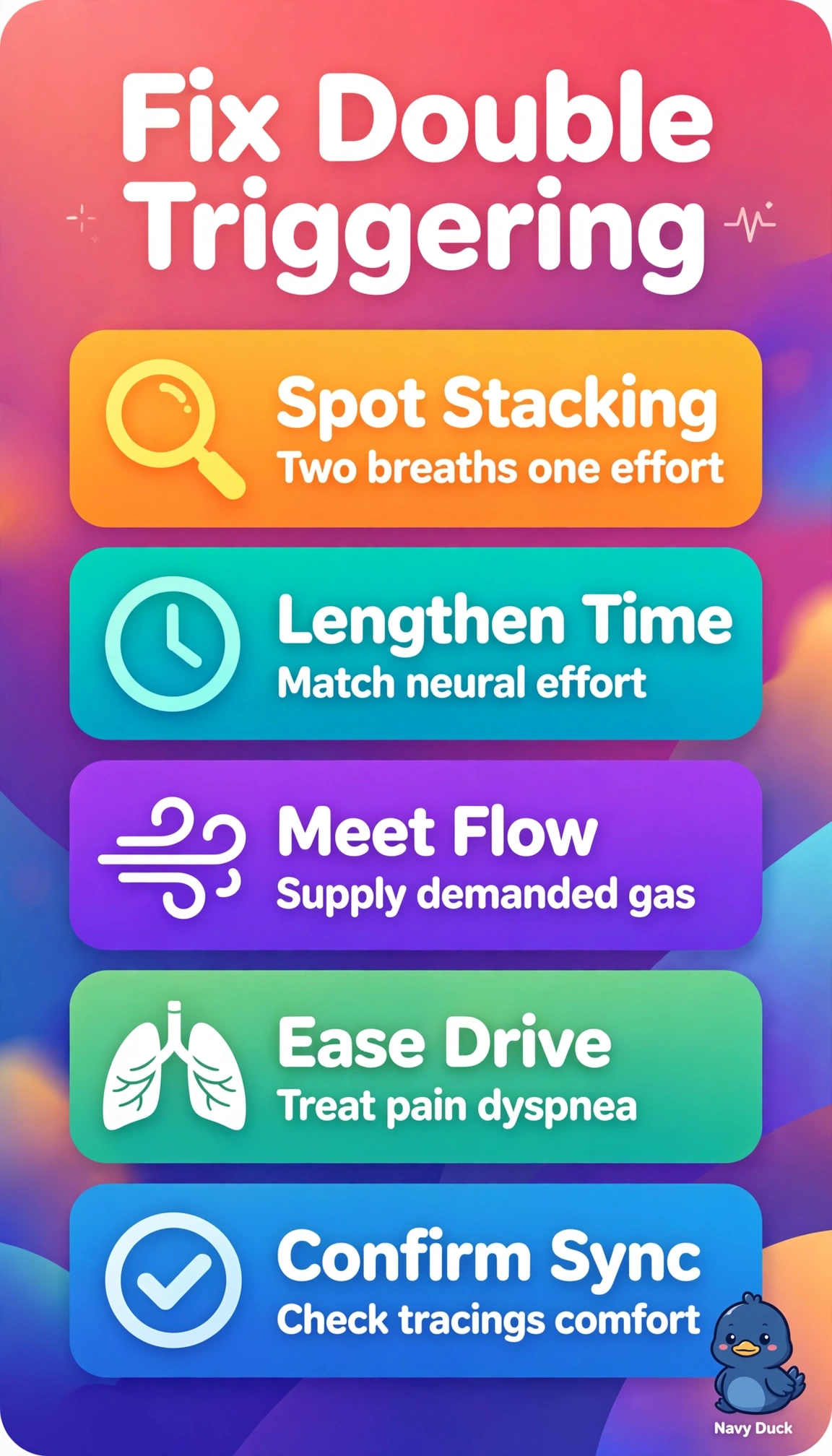
Short Explanation
You are dancing with the patient, not against them. Matching breath length to effort restores sync, like rowing in rhythm instead of splashing.
Full Explanation
Double-triggering in assist-control occurs when neural inspiratory effort outlasts mechanical inspiratory time, so the still-inspiring patient triggers a second stacked cycle that raises tidal volume and causes distress, a pattern favored by light sedation, short set inspiratory time, and unmet high flow demand; lengthening inspiratory time aligns mechanical inflation with neural timing, adjusting flow to meet demand reduces air hunger and work of breathing, and treating pain or dyspnea lowers excessive drive, together restoring synchrony while preserving spontaneous effort. Lengthening time and treating pain but keeping flow low fails by flow starvation because persistent hunger prolongs effort and preserves retriggering despite better timing and analgesia, and limiting volume in this way does not correct dyssynchrony when demand remains unmet. Raising flow and deepening sedation while retaining short inspiratory time fails by timing mismatch because sedation does not sufficiently shorten neural inspiration to fit a brief cycle, so effort still continues past cycling and triggers stacking. Lengthening time and raising flow while relying on extra PEEP instead of addressing drive fails by confusing trigger load with drive because PEEP may offset auto-PEEP but does not relieve pain- or dyspnea-induced prolonged effort that sustains double-triggering. An exam caveat is to distinguish true double-triggering with two delivered cycles for one effort from autotriggering or ineffective efforts by inspecting flow and pressure waveforms for back-to-back breaths without full exhalation. A practical check is to reassess waveforms, exhaled tidal volumes, comfort, and underlying cause after each change, confirming that stacking resolves, volumes normalize, and distress improves without oversedation or new dyssynchrony.