
An obese adult with suspected sleep apnea arrives obtunded with loud snoring, SpO2 86%, chin falling to chest in a supine flat bed, and no cervical trauma. The nurse has an oral airway and positioning aids ready, and the physician requests optimal positioning before assisted ventilation. Which patient positioning technique to optimize the airway best relieves this obstruction?
Select an answer to reveal the explanation.
Short Explanation
You're lifting a heavy airway out of its own shadow to let air pass. Alignment is your fix here, like stacking blocks so the tunnel stays wide open.
Full Explanation
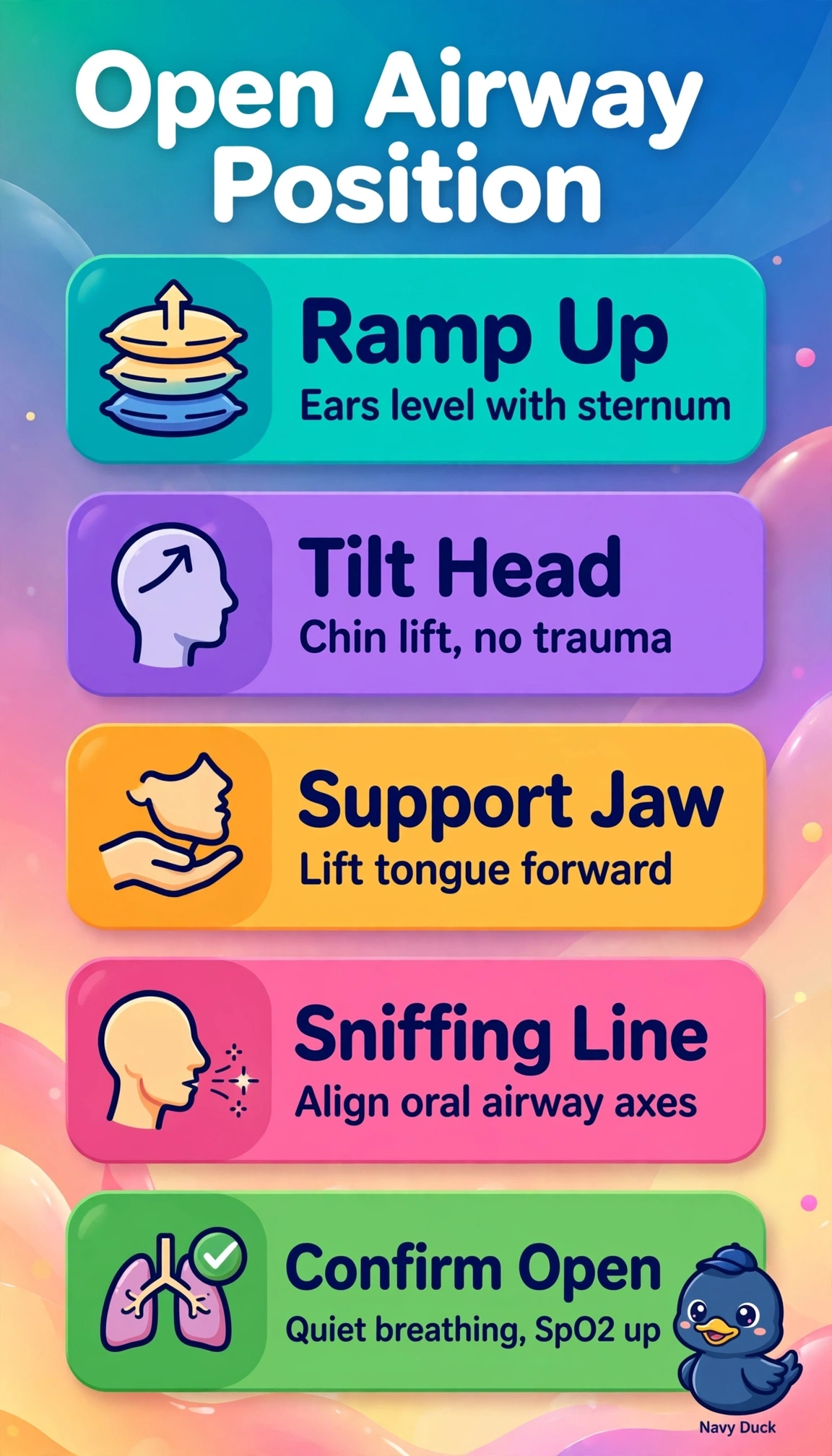
The correct technique succeeds because obtundation with loud snoring in supine obesity indicates tongue and soft palate collapse, and ramping shoulders and torso to align ears horizontally with sternum restores airway axes while head tilt-chin lift with anterior jaw support lifts the tongue off the posterior pharynx for assisted ventilation. Maintaining supine flat with head tilt-chin lift applies correct extension mechanics but misses obesity physiology, since chest and neck mass keeps the chin flexed toward the chest and preserves pharyngeal crowding common in sleep apnea, so hypoxemia persists despite an open mouth. Using ramped elevation with neutral jaw thrust without extension applies correct bariatric lifting and trauma-safe technique but misses the stated absence of cervical trauma, forgoing permitted extension that is needed to fully open the pharynx in this anatomy. Turning to lateral recovery posture applies correct protection for an unconscious spontaneously breathing patient to allow drainage and prevent aspiration but misses the requirement for supine positioning before assisted ventilation, preventing effective mask seal, oral airway use, and ventilation assessment. An exam caveat is to separate lean-adult sniffing with a small pillow from obese ramping requiring torso elevation to ear-sternal alignment and to separate trauma neutral precautions from nontrauma extension. A practical check is to sight from the side for ear-sternum horizontal alignment, confirm reduced snoring with rising SpO2 and easy bag compliance, and size and insert the oral airway only if gag reflex is absent.