
A 58-year-old with pneumonia is on volume control with FiO2 0.60, PEEP 10 cm H2O, PaO2 72 mm Hg and bilateral opacities not explained by effusion or collapse after fluids. The team asks for ARDS severity to guide prognosis and referral. Which Berlin severity classification best fits this oxygenation defect on PEEP?
Select an answer to reveal the explanation.
Short Explanation
You get severity by doing quick math at the bedside. Dividing PaO2 by FiO2 lands in the middle band, and that ratio drives next steps and expectations.
Full Explanation
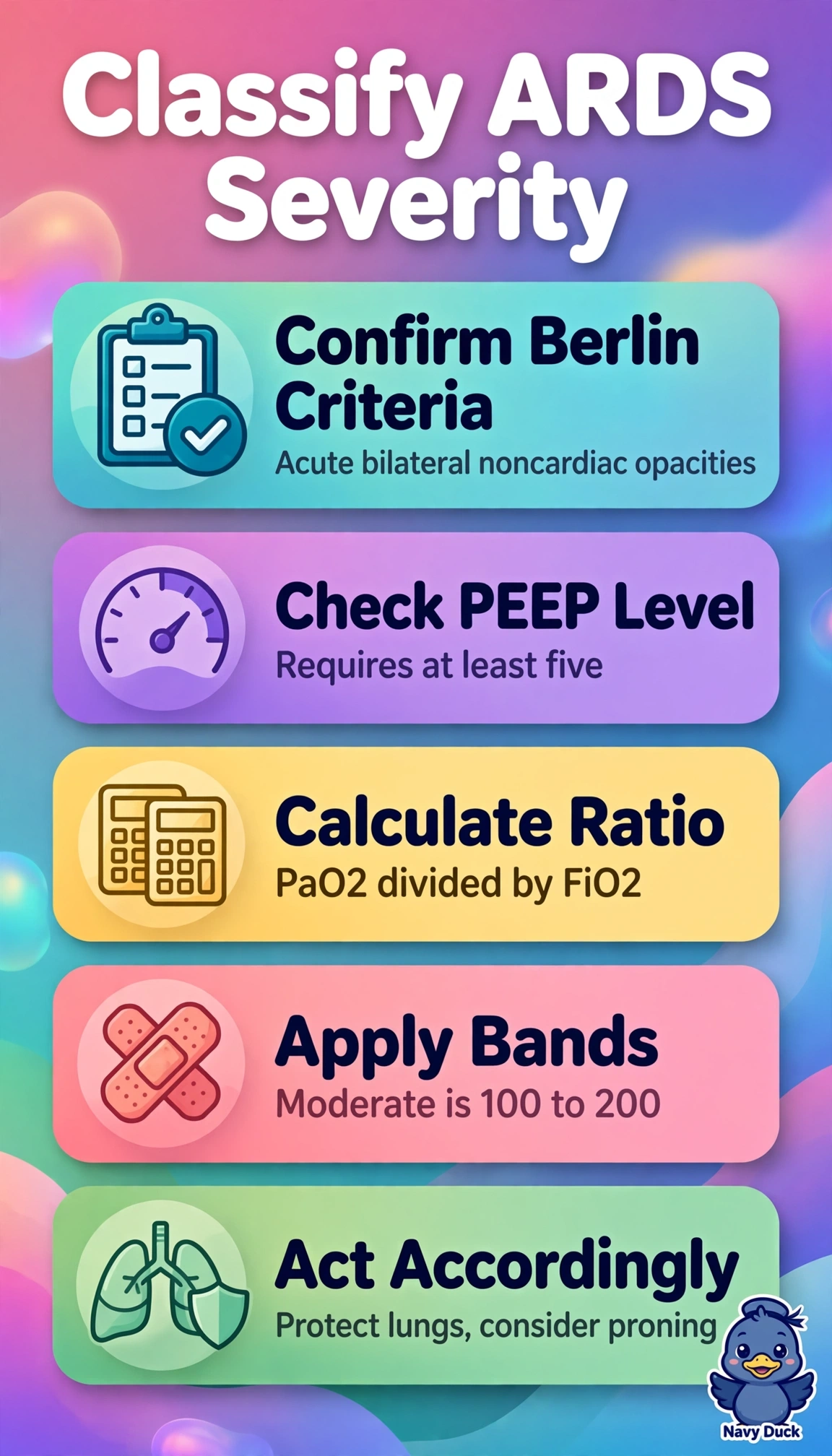
Berlin criteria require acute onset, bilateral opacities, noncardiogenic edema and PaO2 to FiO2 ratio on PEEP at least 5 cm H2O, with mild 200 to 300, moderate 100 to 200 and severe 100 or less, so 72 divided by 0.60 equals 120 on PEEP 10, meeting moderate ARDS and signaling higher mortality and need for lung-protective ventilation, proning consideration and possible ECMO referral evaluation. Mild classification misapplies the threshold because 120 falls below 200 despite qualifying PEEP and imaging. Severe classification misuses FiO2 and PEEP levels alone without calculating the ratio, which remains above 100. No ARDS ignores that hypoxemia severity is defined by the ratio on positive pressure, not by an absolute PaO2 above 60. Exam caveat: always calculate the ratio and confirm PEEP and timing before selecting severity. Practical check: verify ABG and ventilator FiO2 simultaneously, confirm chest imaging and echo to exclude cardiogenic edema, and reassess after 24 hours of optimized settings.