
A pulmonary lab performs morning quality control on a portable spirometer using a 3-L calibration syringe, with repeated volumes reading 2.68 L despite correct technique, proper connections, and stable room temperature. Patients are scheduled for pre-operative testing. Which quality-control action should the therapist take for the spirometer before patient use?
Select an answer to reveal the explanation.
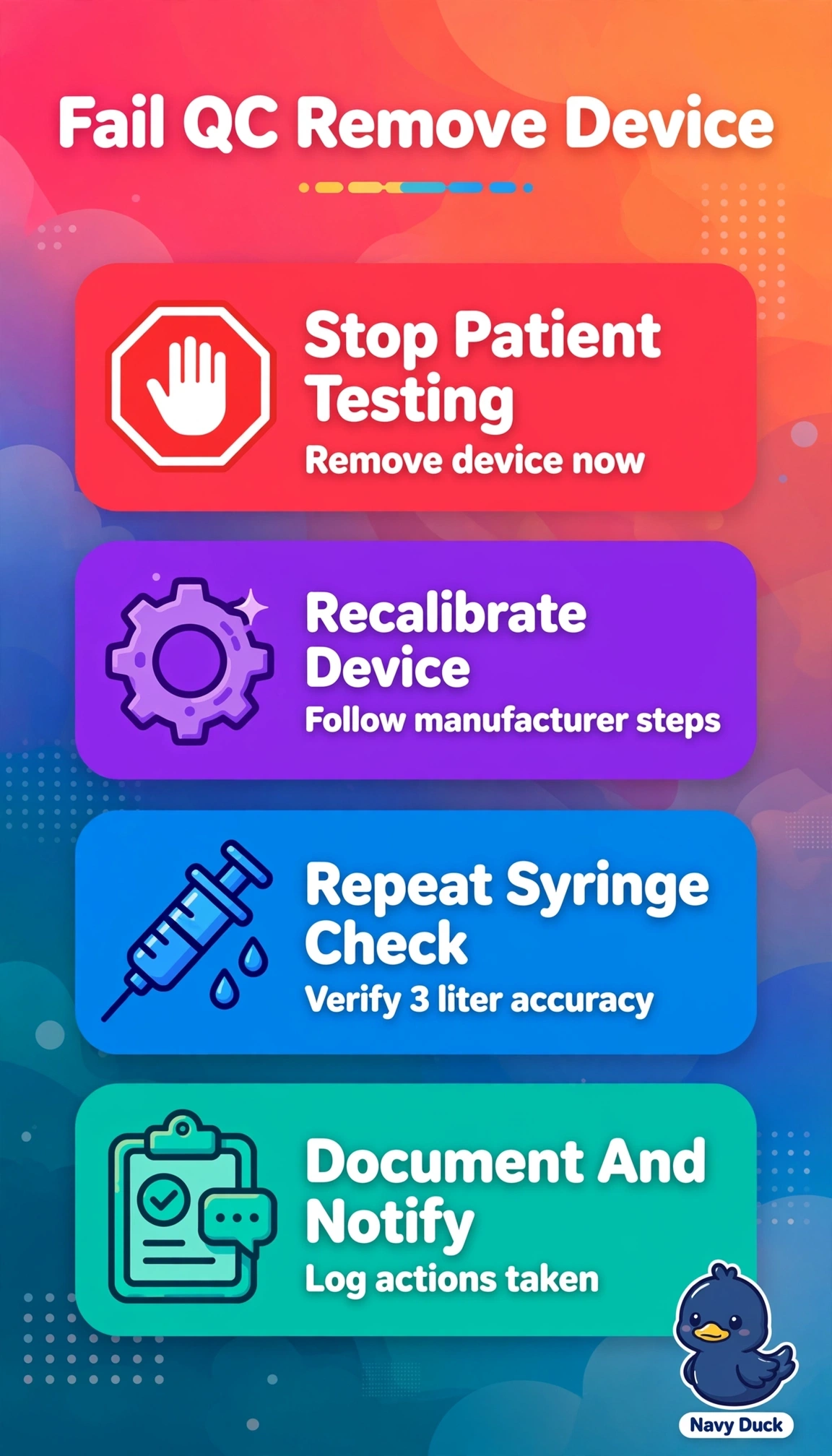
Short Explanation
You're keeping bad numbers from steering surgery decisions. Pulling the device until it proves accurate is like grounding a faulty scale, so calibration protects patients and your credibility.
Full Explanation
The 2.68-L reading is 0.32 L or about 10.7% below 3.00 L, far outside the ATS/ERS verification tolerance of ±3% or 0.09 L, and with correct technique, secure connections, and stable temperature excluding artifact, the repeatable bias proves systematic under-reading that would invalidate pre-operative evaluation, requiring removal from service to prevent use, recalibration per manufacturer, repeat verification proving restored accuracy, and documentation for traceability. The alternative with removal, varied-flow verification, and documentation but no recalibration fails on correction because extra testing only characterizes linearity and cannot remedy confirmed bias. The alternative with removal, recalibration, and documentation but no repeat verification fails on assurance because adjustment without post-adjustment proof leaves accuracy unconfirmed before high-stakes testing. The alternative with recalibration, verification, and documentation while keeping the unit available fails on isolation because a known-inaccurate device must be quarantined and tagged until cleared. An exam caveat is that reproducibility and proper technique never override tolerance math, so calculate percent error rather than assuming consistency means accuracy. A practical check is to tag and quarantine the device, recalibrate, inject 3 L at slow, medium, and fast flows confirming 2.91 to 3.09 L, and log date, flows, volumes, actions, and initials before release.