
In a NICU a 28-week preterm infant at 2 hours of life develops grunting, nasal flaring, retractions, tachypnea, and hypoxemia on CPAP, with chest radiograph showing granular ground-glass appearance and air bronchograms and no pneumothorax. The team prepares for intubation and has surfactant available with cardiorespiratory monitoring. Which management approach best addresses neonatal respiratory distress syndrome and surfactant therapy for this infant?
Select an answer to reveal the explanation.
Short Explanation
Tiny lungs need soap for the bubbles, fast. You're coating stiff alveoli before exhaustion sets in, so early surfactant with gentle support prevents collapse.
Full Explanation
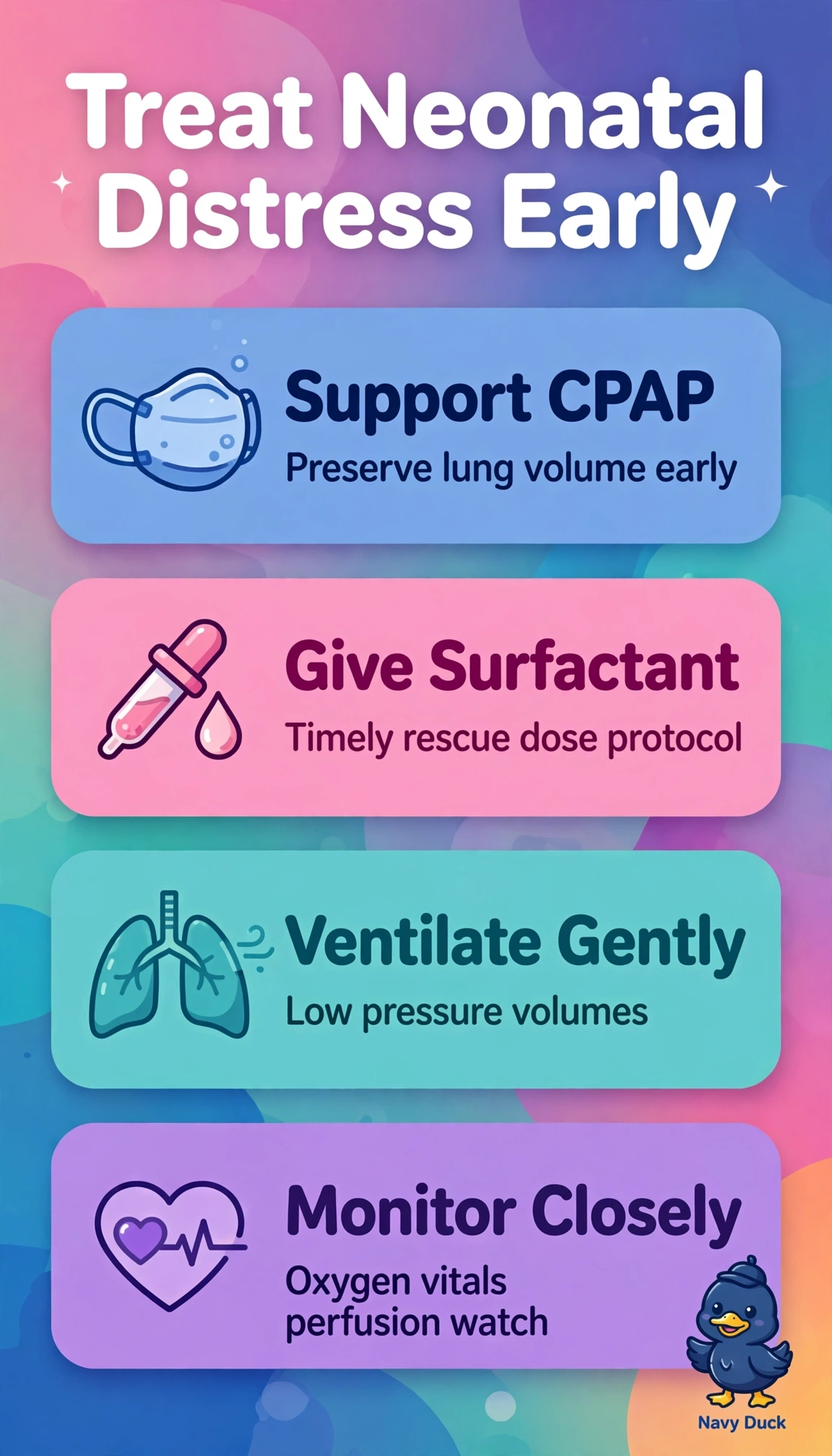
The findings define surfactant-deficiency RDS: 28 weeks, distress at 2 hours with hypoxemia despite CPAP, granular ground-glass lungs with air bronchograms and no pneumothorax, so early CPAP to preserve residual capacity plus timely rescue surfactant to restore compliance plus gentle lung-protective ventilation plus continuous oxygen and hemodynamic monitoring directly corrects pathophysiology while limiting volutrauma and instability. The immediate primary-intubation strategy fails on initial support because current care favors early CPAP with selective rescue intubation for surfactant when deterioration occurs on CPAP, so routine bypass of CPAP adds invasive risk without indication. The CPAP-with-observation-without-surfactant strategy fails on replacement because classic clinical-radiographic RDS in extreme prematurity reflects primary deficiency that distending pressure alone cannot resolve, so withholding rescue prolongs atelectasis, shunt, and injury. The intermittent-checks strategy fails on surveillance because RDS evolves rapidly during intubation, surfactant delivery, and ventilation titration with risk of desaturation, hyperoxia, hypotension, and tube displacement requiring continuous oximetry and cardiorespiratory monitoring. An exam caveat is to use age plus onset plus film: RDS has reticulogranular density with air bronchograms responsive to surfactant, distinct from transient tachypnea or pneumothorax with pleural air. A practical check is to verify intubation preparation, tube position, target saturation ranges, serial gases, chest excursion, and blood pressure before, during, and after surfactant while maintaining gentle volumes and appropriate PEEP.