
A 48-year-old patient with moderate ARDS from pneumonia has PaO2/FiO2 145 on FiO2 0.7 and PEEP 10 cmH2O, plateau pressure 28 cmH2O, driving pressure 18 cmH2O, and bilateral infiltrates with no pneumothorax or hypotension. The team considers lung recruitment for refractory hypoxemia. Which lung recruitment and lung-protective ventilation strategy best balances oxygenation and safety?
Select an answer to reveal the explanation.
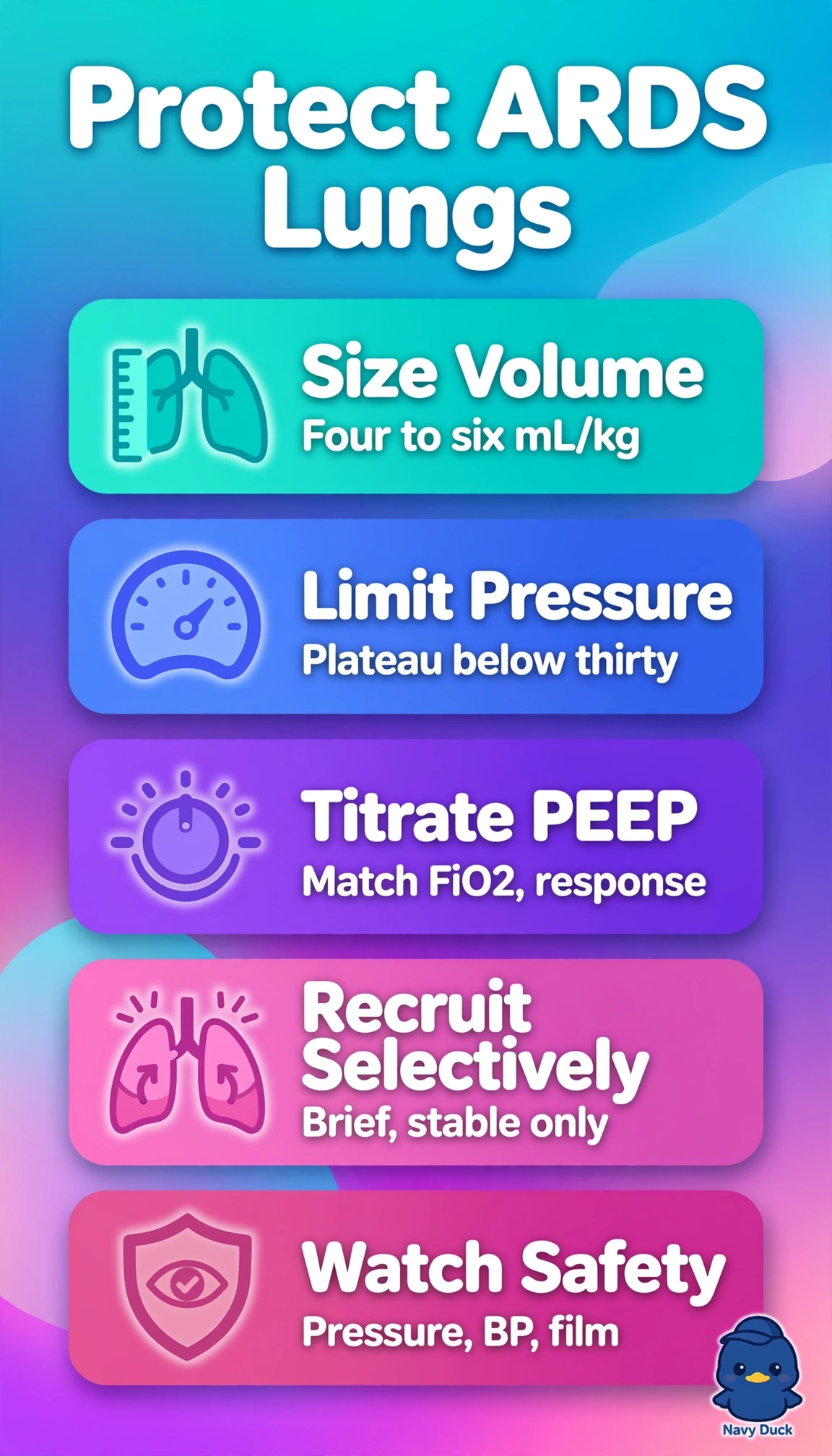
Short Explanation
Low stretch wins in ARDS, and you kept safety front and center. Guarding plateau while titrating PEEP beats heroic inflations every time.
Full Explanation
The correct strategy reflects lung-protective ventilation for moderate ARDS with PaO2/FiO2 145, where 4-6 mL/kg predicted body weight limits volutrauma while PEEP titrated to oxygenation, compliance, plateau pressure and hemodynamics balances recruitment against overdistension, and brief recruitment is reserved for stable patients without pneumothorax or hypotension because high intrathoracic pressure can impair venous return. With plateau 28 cmH2O near the 30 cmH2O limit and driving pressure 18 cmH2O above the preferred under 15 cmH2O target, lower strain is needed rather than aggressive opening. One plausible approach using scheduled prolonged recruitment fails because routine repeated holds increase barotrauma and hypotension without proven benefit and violates selective brief use with monitoring. Another approach keeping PEEP fixed at 10 cmH2O fails by omitting individual titration, since optimal PEEP depends on recruitability, mechanics and tolerance, and fixed PEEP risks persistent atelectasis or occult overdistension. A third approach accepting driving pressure of 18 cmH2O fails because driving pressure reflects lung strain and predicts injury even when plateau is below 30, so it should prompt lower volume or PEEP reassessment. An exam caveat is that absent hypotension and pneumothorax permit cautious recruitment but do not mandate prolonged maneuvers. A practical check is to reassess plateau, driving pressure, oxygenation, blood pressure and compliance before and minutes after any change, aborting for instability or worsening mechanics.