
A 60-year-old man on volume-controlled ventilation suddenly triggers repeated high-pressure alarms at 45 cm H2O with delivered volume falling from 450 to 210 mL. The circuit shows dependent water pooling, the patient is biting the tube, and suction yields thick plugs. Which ventilator-circuit troubleshooting sequence best resolves these high-pressure alarms?
Select an answer to reveal the explanation.
Short Explanation
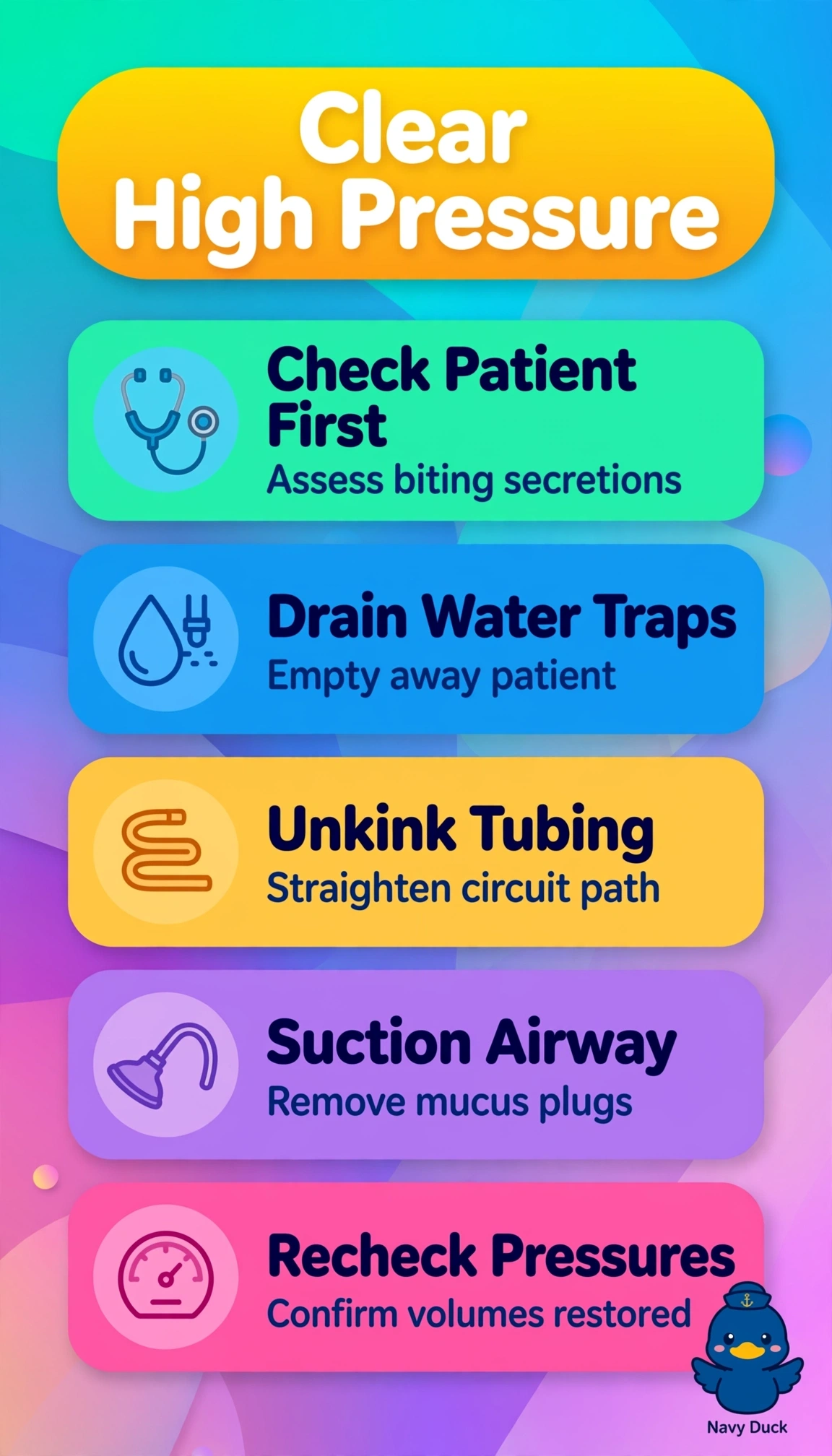
You’ve got several reversible obstructions acting like a kinked garden hose, so drain the water, ease the bite with a block, and suction those plugs before trusting the numbers. Once you’ve cleared the blockage, your pressures should settle and you can reassess what’s happening with the lungs.
Full Explanation
Clearing condensation and kinks, placing a bite block, suctioning thick plugs, and then reassessing is appropriate because a peak pressure of 45 cm H2O with delivered volume falling from 450 to 210 mL on volume control signals sharply increased resistance from simultaneous, reversible obstructions. Restoring circuit patency, preventing biting-related tube occlusion, and removing plugs narrowing the artificial airway should reduce resistance; reassessment confirms whether pressures and volumes recover and helps identify persistent obstruction. Draining water, straightening the circuit, suctioning plugs, and then raising tidal volume fails because adding volume into a high-resistance system can further elevate peak and alveolar pressures and increase barotrauma risk, while biting may continue to retrigger alarms. Suctioning, placing a bite block, giving bronchodilators, and reassessing without draining condensation fails because dependent water and kinks continue to create resistance that bronchodilators cannot bypass. Placing a bite block, draining condensation, unkinking tubing, and deepening sedation without suctioning fails because sedation improves tolerance but does not remove inspissated plugs, so airway obstruction can sustain high pressures and volume loss. Exam caveat: avoid simply raising pressure limits, increasing volume, or sedating while reversible causes remain; use systematic circuit, tube, and secretion checks. Practical check: compare peak with plateau pressure, inspect for water and kinks while draining traps away from the patient, confirm bite-block position and suction effectiveness, then verify that pressures fall and exhaled volumes return toward baseline.