
A 900-g preterm infant on high-frequency oscillatory ventilation has decreasing chest wiggle, SpO2 82% and a low mean airway pressure alarm. The piston is running, but the circuit shows a leak at the humidifier and the endotracheal tube is mid-trachea. Which high-frequency ventilation response best restores oxygenation and ventilation?
Select an answer to reveal the explanation.
Short Explanation
You protect the bounce that keeps lungs open. Sealing leaks restores pressure, like patching a balloon before judging how hard to squeeze.
Full Explanation
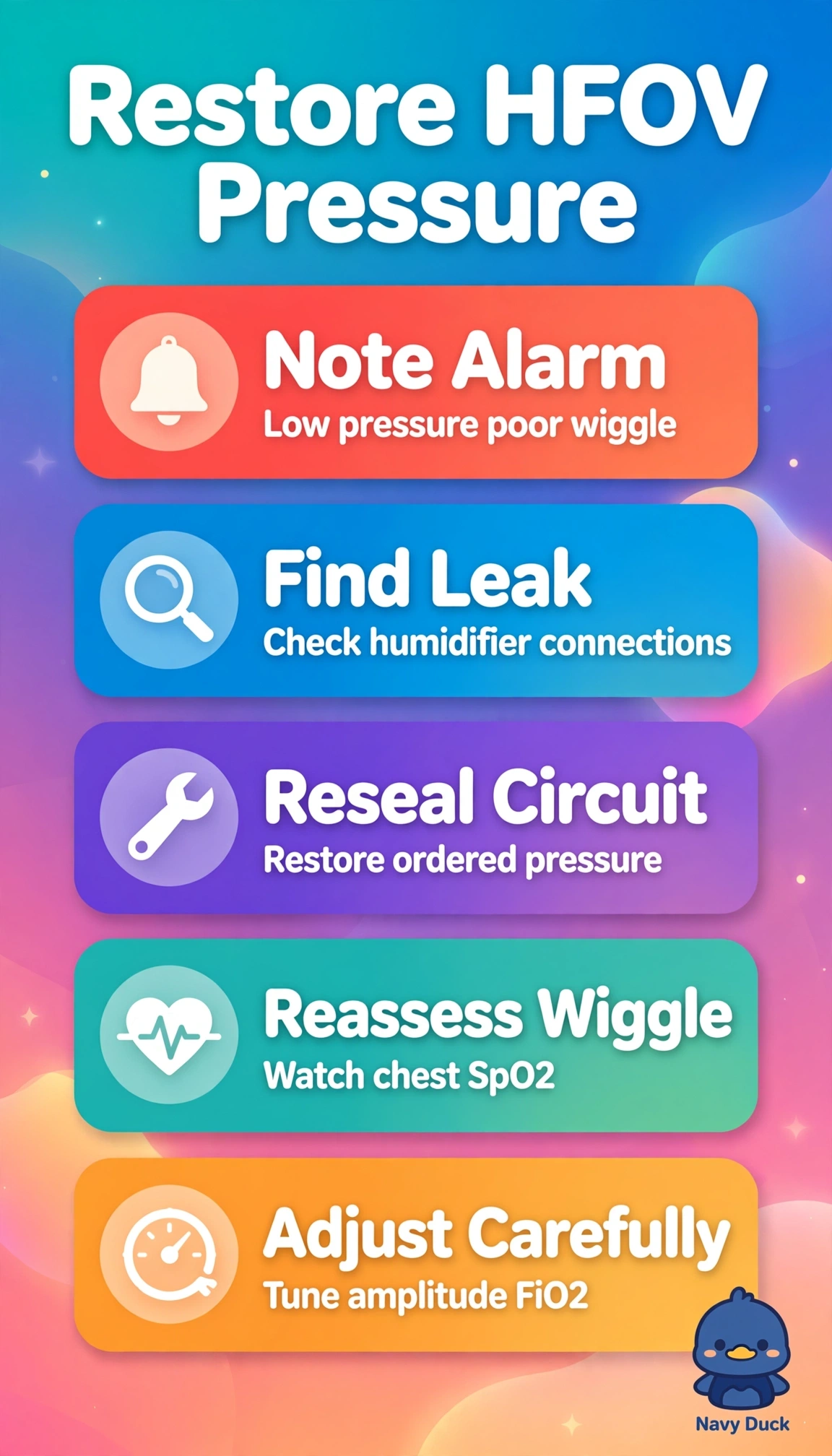
In HFOV oxygenation depends on mean airway pressure and lung volume while ventilation depends on amplitude and frequency, so falling wiggle, SpO2 82% and low mean airway pressure alarm with piston running, visible humidifier leak and mid-tracheal tube identifies loss of delivered distending pressure as the cause. Resealing humidifier and circuit connections removes the leak so ordered pressure reaches the infant, restoring functional residual capacity, oxygenation and wiggle, with reassessment confirming recovery. Increasing inspired oxygen and raising ordered pressure is standard for hypoxemia with derecruitment but fails by concept here because pressure continues to escape through the unsealed leak, so recruitment cannot be sustained and hypoxia persists despite higher settings. Increasing amplitude and lowering frequency is standard to improve chest wiggle and carbon dioxide removal but fails here because the dominant defect is low lung volume and hypoxemia from pressure loss, not isolated hypoventilation, and greater power does not restore mean pressure. Performing a transient recruitment maneuver with higher continuous distending pressure is standard for atelectasis but fails here because without sealing the leak the circuit cannot hold pressure, so reopened alveoli rapidly recollapse. An exam caveat is to address low-pressure alarms by verifying circuit integrity, humidifier seal and tube position before adjusting oxygen, pressure, amplitude or frequency. A practical check is to confirm ordered and delivered mean pressure match without audible leak, then observe symmetric wiggle, rising SpO2, stable blood pressure and equal breath sounds without overdistension.