
A 55-year-old with ARDS is on FiO2 0.60 with PaO2 90 mm Hg, PaCO2 45 mm Hg, SpO2 93% and PEEP 10 cm H2O. The team needs a standardized oxygenation metric to track severity and ventilator response over the next day. Which calculation of P/F ratio, oxygenation index or related index best quantifies oxygenation impairment?
Select an answer to reveal the explanation.
Short Explanation
You're turning two numbers into one clear severity signal for the team. Division does the trick here, like miles per gallon telling you efficiency at a glance.
Full Explanation
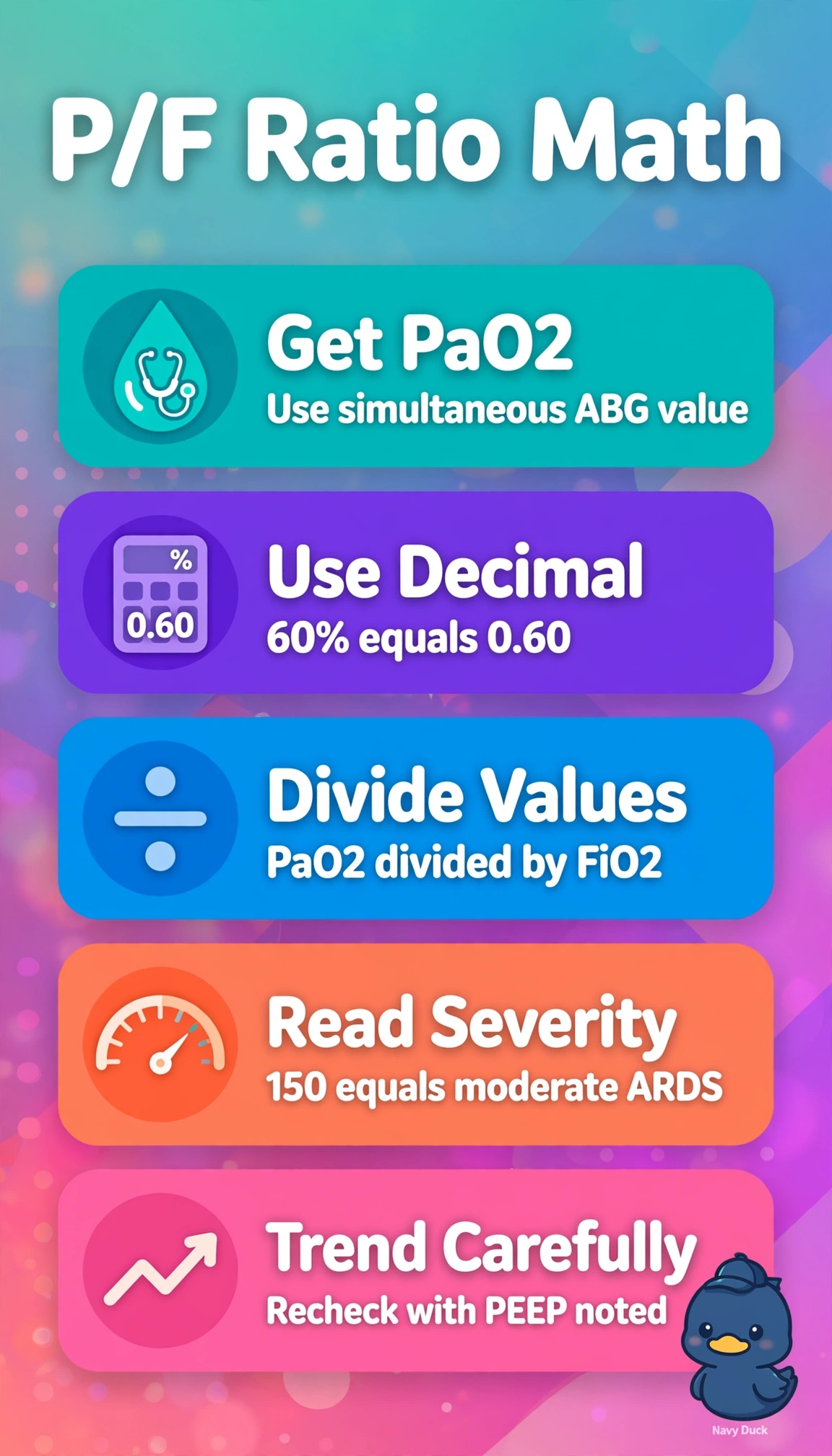
PaO2 divided by FiO2 expressed as a decimal standardizes oxygenation across different oxygen concentrations and directly maps to the Berlin definition, where with PEEP at least 5 cm H2O a value of 150 falls in the moderate ARDS band of greater than 100 to 200 and therefore quantifies impairment and allows day-to-day comparison of ventilator response. The SpO2 to FiO2 estimate yielding about 155 is a validated noninvasive surrogate that is useful for triage or when arterial blood is unavailable, yet it fails here by concept because pulse oximetry plateaus on the flat portion of the dissociation curve and direct PaO2 is already available, making the invasive standard more accurate. The calculation substituting PEEP for mean airway pressure to yield about 6.7 fails by concept because formal oxygenation index requires mean airway pressure times FiO2 times 100 divided by PaO2 to integrate pressure cost of oxygenation, and PEEP alone ignores inspiratory pressure, rate and waveform so mean pressure cannot be inferred. Interpreting 150 as severe fails by threshold because severe requires 100 or less, with 150 remaining moderate albeit near the lower edge where proning may be considered but not mandated by that number alone. An exam caveat is to always convert FiO2 percent to a decimal and confirm PEEP criteria before assigning Berlin severity, since using 60 instead of 0.60 inflates error by one hundredfold. A practical check is to verify probe perfusion, repeat the arterial sample at steady state without recent suctioning or FiO2 change, and recalculate at the same PEEP to ensure trend reflects lung change rather than measurement artifact.