
A 62-year-old patient with COPD on assist-control ventilation shows scalloped inspiratory pressure-time scalars, concave inspiratory flow with persistent patient effort, and a pressure-volume loop with widened hysteresis, while expiratory flow fails to return to zero with rising intrinsic PEEP. Which ventilator graphics interpretation best identifies the primary problem requiring correction?
Select an answer to reveal the explanation.
Short Explanation
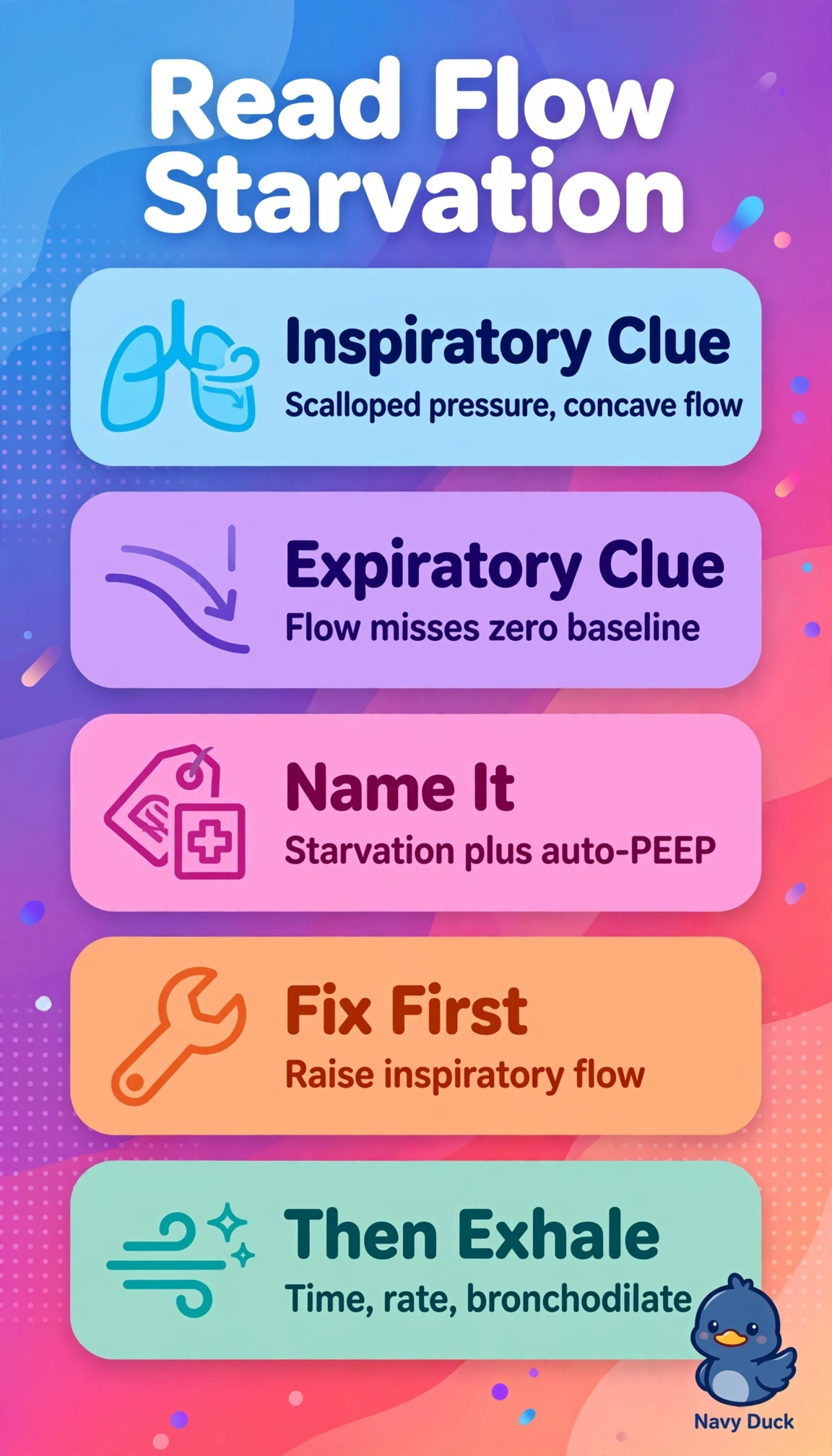
You’re reading the scalloped pressure-time scalar and concave inspiratory flow as signs that demand exceeds delivered flow. Prioritizing flow starvation addresses the inspiratory mismatch while recognizing the coexisting trapped air.
Full Explanation
Scalloped pressure-time scalars and concave inspiratory flow during inspiration signal flow starvation: patient demand exceeds the set flow. Expiratory flow failing to return to zero before the next breath defines auto-PEEP from inadequate exhalation, a common coexistence in COPD with high demand and prolonged time constants. Increase inspiratory flow delivery first to address starvation; the expiratory pattern separately calls for attention to exhalation. Interpreting widened pressure-volume hysteresis as improved compliance reverses the loop physiology: increased hysteresis reflects higher resistance or recruitment needs, not compliance to pursue with larger tidal volumes, which can worsen hyperinflation. Attributing scalloping to excessive pressure support misreads vigorous effort as over-assistance when it reflects under-delivery; reducing inspiratory pressure can increase work and distress. Reading expiratory non-return as a circuit leak also misreads the graphics: leaks show erratic baseline and volume loss, whereas persistent expiratory flow indicates air trapping; increasing the set respiratory rate shortens exhalation and can worsen auto-PEEP. Exam caveat: distinguish inspiratory starvation from auto-PEEP using their different scalar findings, and correct flow delivery before addressing exhalation time. Practical check: confirm that inspiratory flow meets patient demand, expiratory flow reaches zero, and intrinsic PEEP falls.