
A 67-year-old man with a permanent tracheal stoma after total laryngectomy arrives obtunded and hypoxemic. He has no palpable laryngeal prominence, breath sounds are absent at the mouth, and a fenestrated tracheostomy tube is displaced. Upper airway attempts fail to ventilate. Which airway device management choice best secures ventilation for this laryngectomy anatomy?
Select an answer to reveal the explanation.
Short Explanation
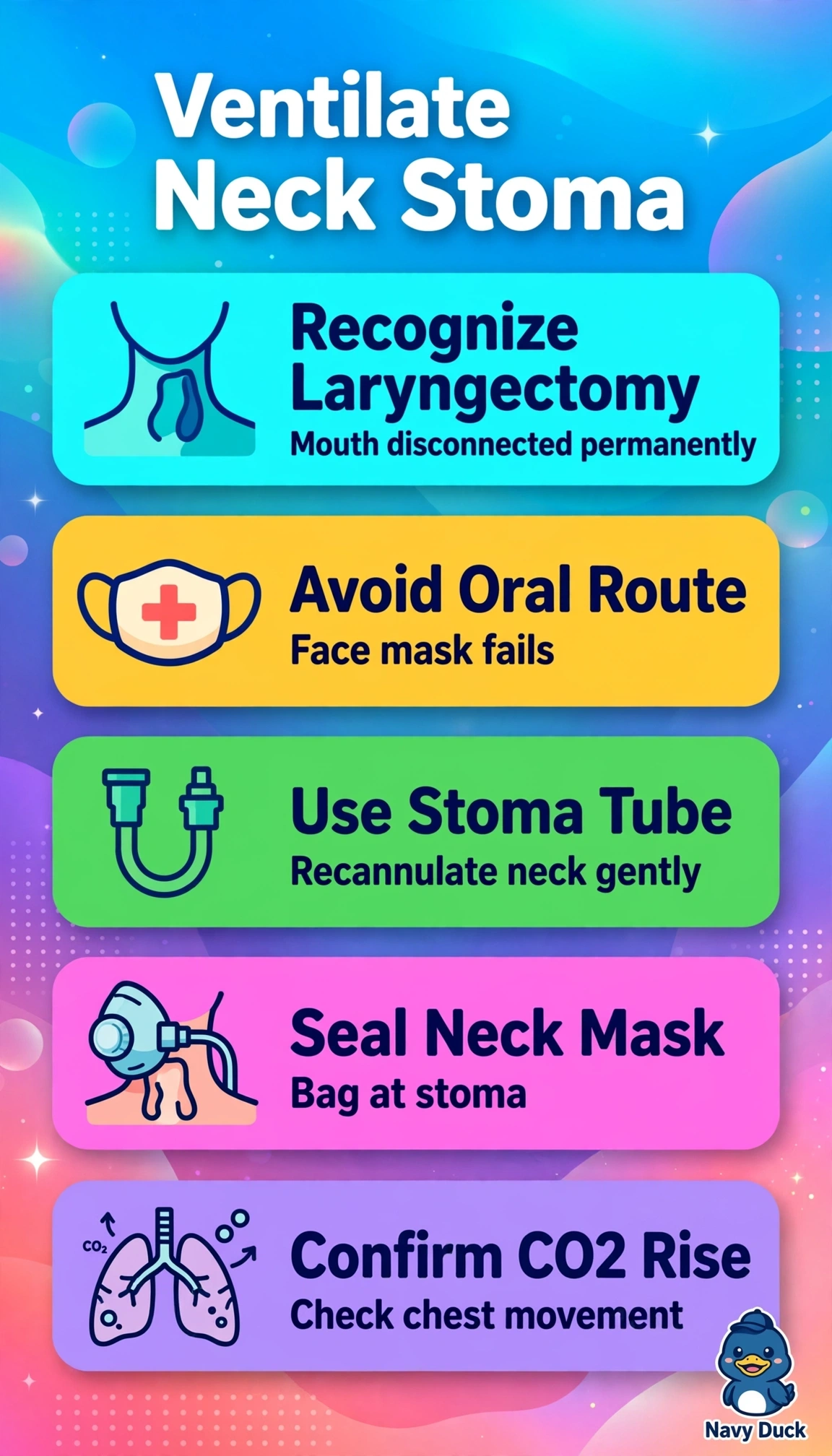
You've got to remember his mouth's a dead end now — it's like a road that's been permanently closed off. You'll save him by bagging the stoma with a cuffed, non-fenestrated tube and skipping the face mask entirely.
Full Explanation
Total laryngectomy creates a permanent end tracheostoma with complete separation of the pharynx from the trachea, so the nose and mouth no longer communicate with the lungs and all oxygenation and ventilation must occur through the neck stoma, which is why prompt recannulation with a cuffed non-fenestrated tube and exclusive stomal ventilation restores a sealed lower airway without wasting effort orally. A cuffed non-fenestrated tracheostomy tube combined with oral attempts correctly seeks a cuff seal but fails anatomically because oral positive pressure cannot reach the trachea after total laryngectomy and only delays effective stomal ventilation while risking gastric insufflation. A cuffed fenestrated tracheostomy tube via the stoma correctly uses the stomal route and a cuff but fails mechanically because the fenestration vents positive pressure into peristomal tissue and the blind upper pouch and prevents a reliable seal, a design intended for spontaneously breathing speaking patients during weaning rather than for an obtunded hypoxemic patient needing controlled ventilation. An uncuffed laryngectomy tube with stomal positive pressure correctly selects stomal anatomy and the proper device family but fails physiologically because without an inflated cuff there is leak with loss of tidal volume and PEEP and no aspiration protection during obtundation and positive-pressure ventilation. The key exam caveat is to distinguish total laryngectomy with absent laryngeal prominence and absent oral breath sounds from a standard tracheostomy where an upper airway connection persists and oral backup may still help. The practical check is to confirm recannulation by continuous waveform capnography, symmetric chest rise, adequate cuff pressure without audible leak, pulse-oximetry recovery, and readiness to suction blood or mucus that commonly displaces tubes.