
A 64-year-old scheduled for open cholecystectomy has a 30 pack-year history, BMI 34 and baseline SpO2 94%, and the surgeon requests preoperative respiratory input to prevent postoperative atelectasis and pneumonia. The patient can follow commands and has no bullous disease. Which pre- and post-operative respiratory care bundle best reduces pulmonary complications?
Select an answer to reveal the explanation.
Short Explanation
You’re building an anti-collapse routine before pain sets in. Upright posture plus coached, splinted breaths keeps alveoli recruited, and steady recruitment outperforms sporadic deep breaths.
Full Explanation
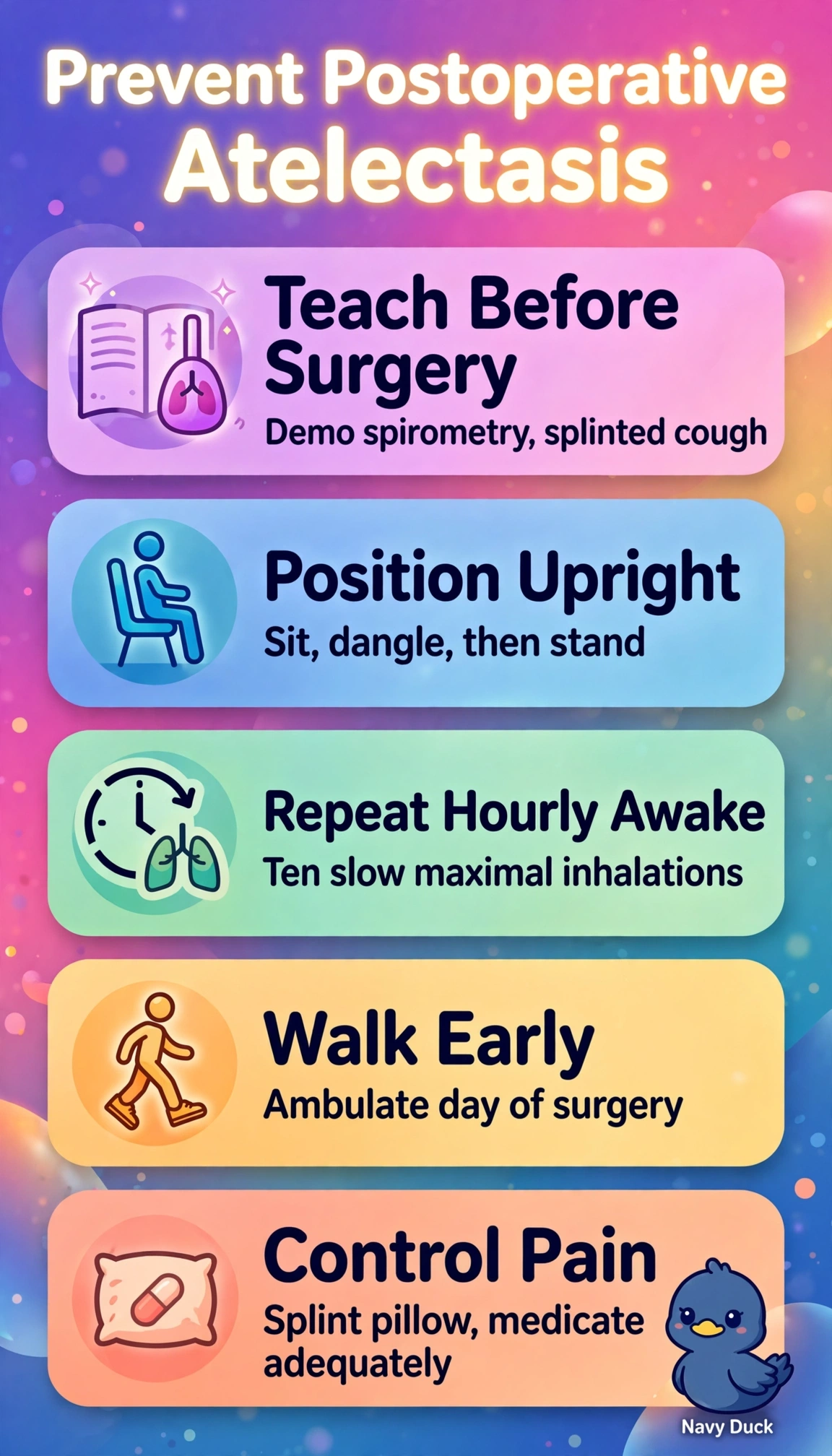
The bundle of preoperative splinted-cough and incentive-spirometry teaching followed by upright posture, hourly use and early ambulation fits open upper-abdominal surgery in an obese 30 pack-year smoker with SpO2 94%. Diaphragmatic splinting, pain-limited inspiration and secretion retention increase atelectasis and pneumonia risk; learning the techniques before surgery, then using them frequently while upright and walking early, supports lung recruitment, ventilation-perfusion matching and clearance. Postoperative-only coaching starts too late: pain, opiates, drowsiness and anxiety can impair new motor learning and effort. Preoperative teaching followed by four-hourly use leaves long gaps in which absorption atelectasis and small-airway closure can progress, particularly with obesity and smoking. Preoperative teaching followed by IPPB instead of incentive spirometry is not the preferred routine for a cooperative patient who can follow commands and has no bullous disease; voluntary spirometry provides controlled sustained inspiration with feedback, while positive pressure is more appropriate when cooperation or respiratory effort is inadequate. Exam caveat: distinguish routine prophylaxis in a cooperative patient from respiratory support needed when the patient cannot perform the taught techniques. Practical check: confirm upright positioning, pillow splinting, a slow spirometer inhalation with a 3- to 5-second hold, hourly adherence and early walking; trend oximetry, auscultation, fever and sputum.