
A 68-year-old with COPD exacerbation is on bilevel noninvasive ventilation for hypercapnic failure with pH 7.30 and PaCO2 68. After two hours pressures were titrated and mask leak is minimal, but accessory use worsens and mentation declines. Which noninvasive ventilation failure sign indicates need to escalate to invasive ventilation?
Select an answer to reveal the explanation.
Short Explanation
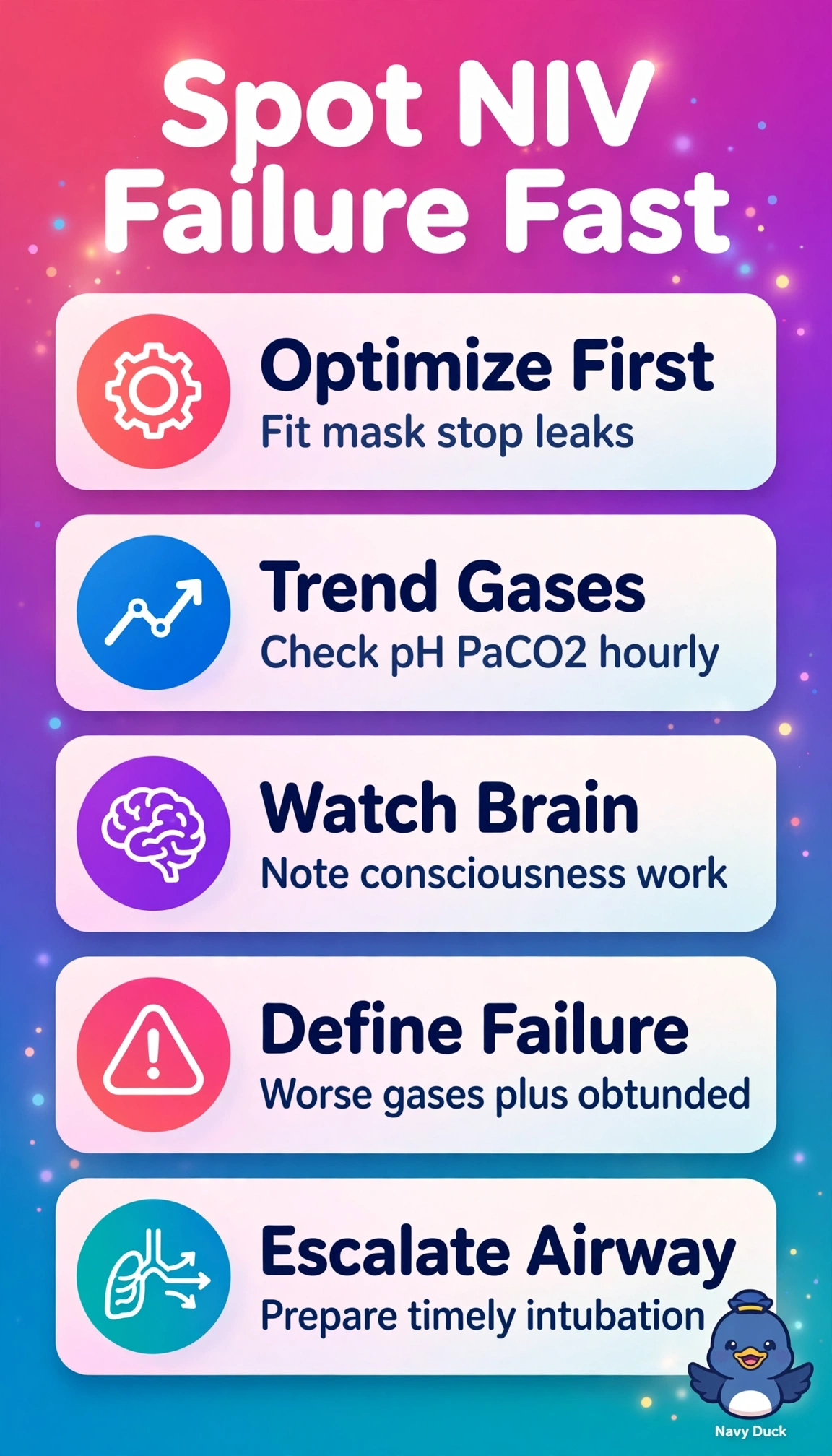
You are reading the trend, not just the machine. Deteriorating gases plus sleepy brain means failure, like a bridge swaying more after tightening cables.
Full Explanation
The correct response recognizes established NIV failure because pH 7.30 with PaCO2 68 after two hours of optimized bilevel and good interface plus worsening accessory use and declining mentation meets criteria for lack of improvement with clinical deterioration mandating timely intubation rather than prolonged trial, since persistent acidosis, refractory hypercapnia and depressed consciousness predict very low success and higher mortality with delay. Continuing optimized bilevel with controlled oxygen, steroids, bronchodilators and serial gases is standard COPD exacerbation care and satisfies medical management but fails the neurologic requirement because depressed consciousness impairs airway protection, secretion handling and synchrony and is itself an escalation trigger that cannot be observed through. Further pressure retitration with coaching, humidification and refitting correctly addresses tolerance, leak and muscle unloading early in NIV but fails the optimization fact here because pressures were already titrated and leak is minimal, so repeated adjustments delay definitive control without correcting worsening acidosis and encephalopathy. Switching to high-flow nasal oxygen appropriately improves comfort, oxygenation and humidification in hypoxemic patients but fails the ventilatory concept because it provides minimal alveolar ventilation and no meaningful CO2 clearance or airway protection for hypercapnic acidosis with depressed consciousness. Exam caveat is to distinguish transient dyspnea or asynchrony that responds to titration from persistent acidosis with worsening fatigue and encephalopathy after 1-2 hours which signals failure. Practical check is to reassess pH, PaCO2, rate, accessory use, Glasgow coma scale, secretions, hemodynamics and synchrony hourly and prepare for intubation when consciousness declines despite best NIV.