
In a medical ICU a therapist assembles a fiberoptic bronchoscope with weak suction and an arterial line monitor showing a damped waveform after flushing, with the transducer leveled at the phlebostatic axis and zeroed to air and all stopcocks closed to air. Bedside check finds no kinked tubing and a small air bubble near the transducer dome. Which troubleshooting sequence best corrects the bronchoscope and arterial catheter monitor performance?
Select an answer to reveal the explanation.
Short Explanation
You've already spotted the culprits, so clearing them resets the system. Air bubbles absorb pressure waves like a sponge in a hose, so removing bubbles restores a crisp waveform and strong suction.
Full Explanation
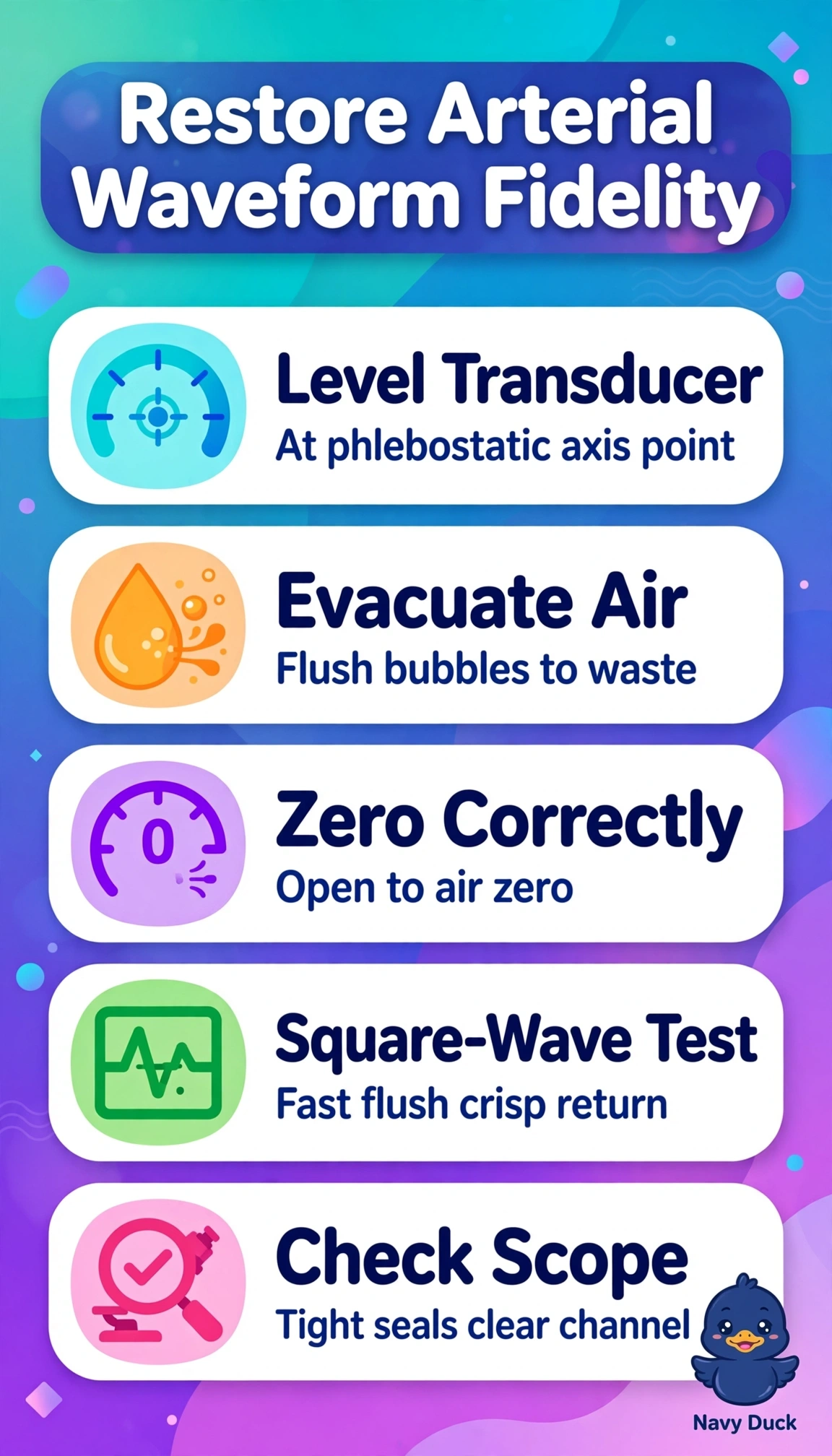
The correct sequence restores both systems at the source because weak bronchoscope suction without obstruction indicates air entrainment from a leak that must be sealed, while damped arterial pressure after flushing with correct leveling, zeroing, closed stopcocks and no kinks plus a dome bubble indicates excess compliance from trapped air. Evacuating the bubble, flushing to restore the fluid column, re-zeroing to reestablish reference and confirming fidelity with a fast-flush square-wave test corrects baseline and dynamic response and verifies suction. The flush, re-zero and square-wave approach with only tightening suction fittings fails on compliance because fluid driven past a retained dome bubble leaves compressible air that continues to absorb energy and damping persists. The bubble evacuation with relevel, re-zero and bronchoscope reassembly approach fails on verification because zeroing corrects static offset only and without post-evacuation flush and square-wave testing residual microbubbles cannot be excluded. The proper bubble evacuation with flush and square-wave testing combined with only increasing bronchoscope vacuum fails on source control because higher vacuum masks rather than seals the leak and leaves poor clearance with injury risk. Exam caveat is persistent damping after flushing with correct level and zero implicates bubbles, clot, kink or loose connections, not height misplacement. Practical check is a crisp square wave with one to two oscillations on fast flush with pressure bag at 300 mmHg plus sustained suction when occluding the scope tip in sterile saline.