
A 30-week preterm infant at 4 hours of age has tachypnea, grunting, nasal flaring, intercostal retractions, FiO2 0.55 on CPAP 6 cm H2O, and chest film shows diffuse ground-glass opacities with air bronchograms and low lung volumes. Which surfactant therapy decision best manages this neonatal respiratory distress syndrome progression?
Select an answer to reveal the explanation.
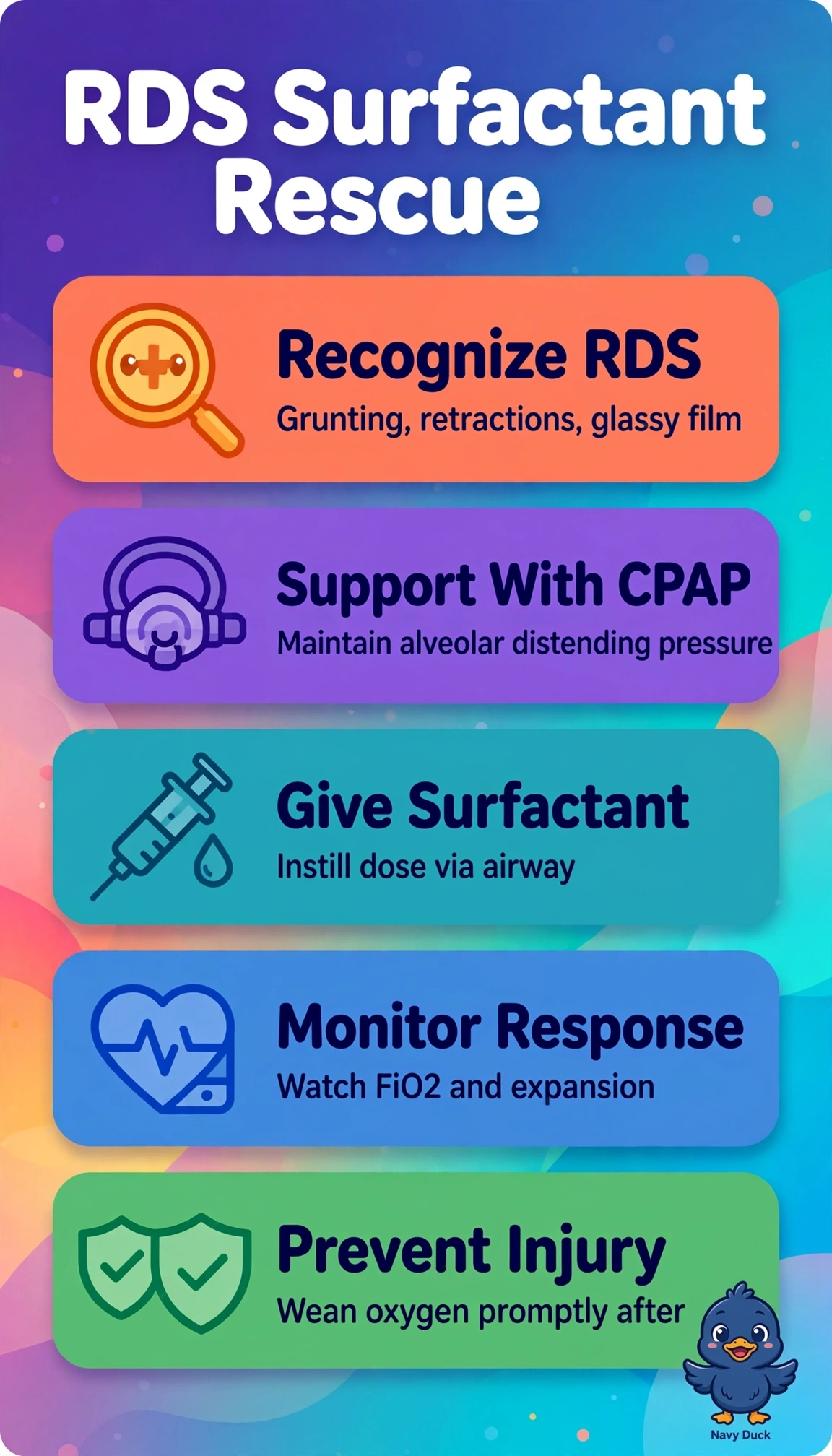
Short Explanation
You’re seeing classic RDS that needs surfactant, not just more pressure. CPAP holds alveoli open but can’t replace what’s missing; exogenous surfactant lowers surface tension and can quickly reduce oxygen needs while you continue CPAP.
Full Explanation
This 30-week infant’s early respiratory distress, FiO2 of 0.55 despite CPAP at 6 cm H2O, and diffuse ground-glass opacities with air bronchograms and low lung volumes indicate surfactant-deficiency RDS with alveolar collapse. Prompt intratracheal surfactant while continuing CPAP restores surface activity, stabilizes functional residual capacity, and can reduce oxygen needs and work of breathing while limiting air leak and ventilator injury. Waiting until FiO2 exceeds 0.60 while optimizing CPAP delays rescue despite significant distress and classic imaging; early selective treatment around an FiO2 of 0.40–0.50 is commonly considered to limit ongoing atelectrauma and oxygen exposure. Intubating for surfactant and then continuing routine mechanical ventilation adds unnecessary support for an infant breathing on CPAP; brief intubation with rapid return to CPAP or thin-catheter administration can deliver surfactant while minimizing ventilation. Giving surfactant and switching to high-flow nasal cannula is not appropriate because high-flow provides less consistent distending pressure than CPAP for recruiting low-volume lungs. An exam caveat is that treatment thresholds vary by guideline, so use the infant’s overall status as well as FiO2. A practical check is to verify the CPAP seal and monitor saturation, heart rate, and chest excursion during dosing, then reassess FiO2, retractions, gases, and lung expansion to guide repeat dosing or escalation.