
A 52-year-old with BMI 51 is admitted with daytime headache, polycythemia and PaCO2 58 on room air after chemotherapy for lymphoma left him neutropenic, and overnight oximetry shows prolonged desaturation with snoring. Morning ABG shows pH 7.32 with hypoxemia that corrects with arousal. Which noninvasive strategy best manages obesity-related hypoventilation with hypercapnic failure?
Select an answer to reveal the explanation.
Short Explanation
You spotted the pattern: severe obesity with daytime CO₂ retention and sleep-related desaturation. Nocturnal bilevel keeps your upper airway open while boosting each breath to improve ventilation.
Full Explanation
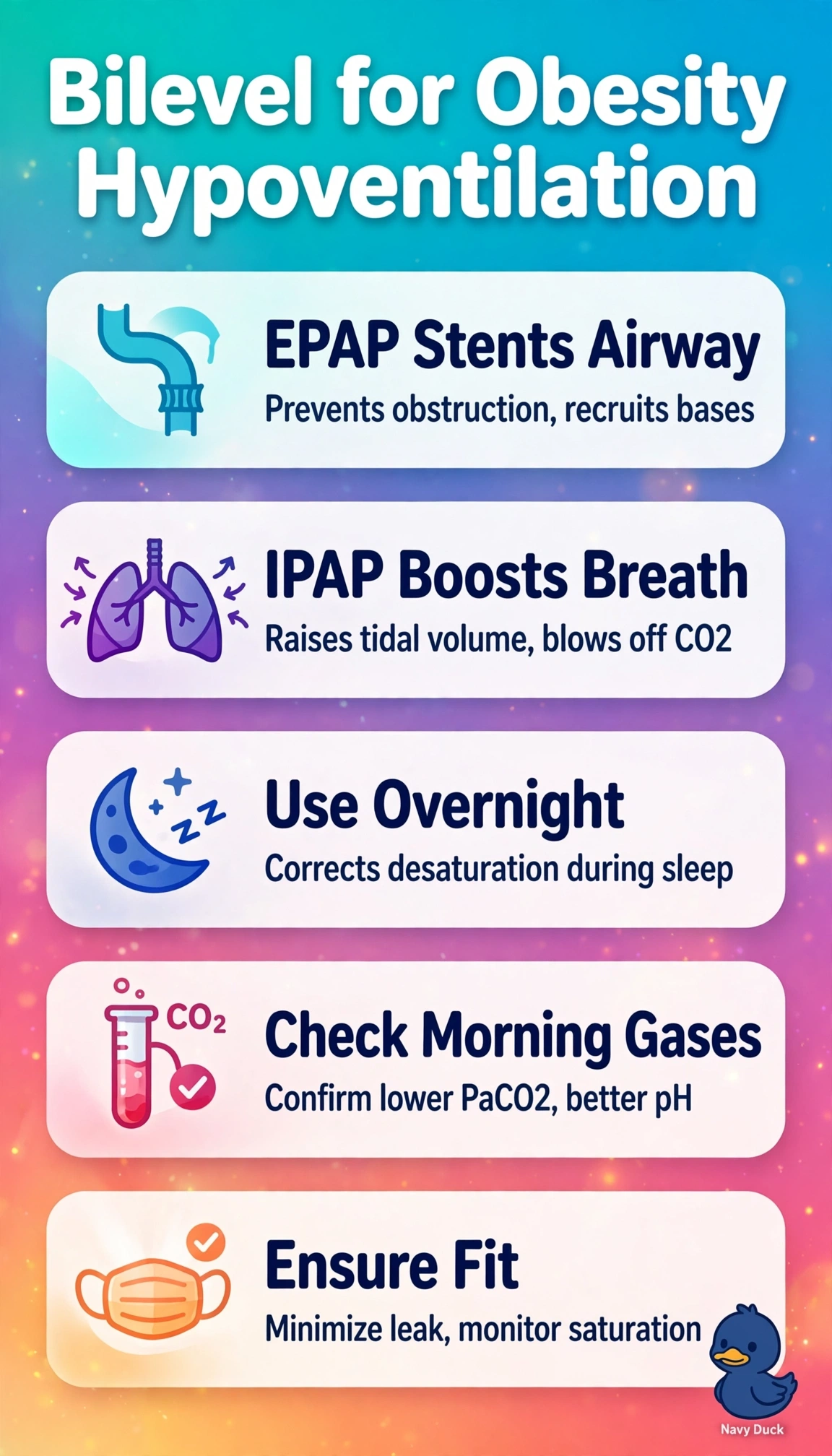
This presentation is obesity hypoventilation with hypercapnic failure and acidosis: severe obesity, daytime PaCO₂ 58, pH 7.32, polycythemia and headache fit chronic CO₂ retention, while snoring and prolonged desaturation suggest coexisting upper-airway obstruction. Improvement with arousal supports sleep-related hypoventilation. Nocturnal bilevel is appropriate because EPAP helps maintain airway patency and IPAP adds pressure support to increase tidal volume and alveolar ventilation, lowering CO₂ and improving gas exchange. Nocturnal oxygen alone corrects the saturation reading but does not augment ventilation, so it can leave hypercapnia untreated or worsen it. CPAP can stent the airway and treat obstructive events, but does not provide the pressure support needed to reverse established daytime hypercapnia and acidemia. Daytime intermittent bilevel may support awake breathing, but leaves sleep-related hypoventilation and prolonged nocturnal desaturation untreated. An exam caveat: hypoxemia that corrects with arousal and chronic polycythemia favor sleep-related hypoventilation over a fixed oxygenation defect as the primary explanation. A practical check is to assess overnight oxygenation and CO₂, morning arterial blood gas, symptoms and device adherence; titrate EPAP for obstruction and IPAP for ventilation, and confirm mask fit.