
A 2-kg infant with respiratory distress syndrome is on high-frequency oscillatory ventilation with FiO2 0.6 and mean airway pressure 14 cmH2O, with persistent hypoxemia and a low-volume chest radiograph. The high-pressure and low-volume alarms sound briefly during suctioning and repositioning. Which alarm management strategy best supports oxygenation during high-frequency ventilation?
Select an answer to reveal the explanation.
Short Explanation
You nailed the core issue here since low lung volume plus hypoxemia calls for more distending pressure. Raising recruitment with stepwise mean airway pressure opens alveoli while alarm checks keep you safe.
Full Explanation
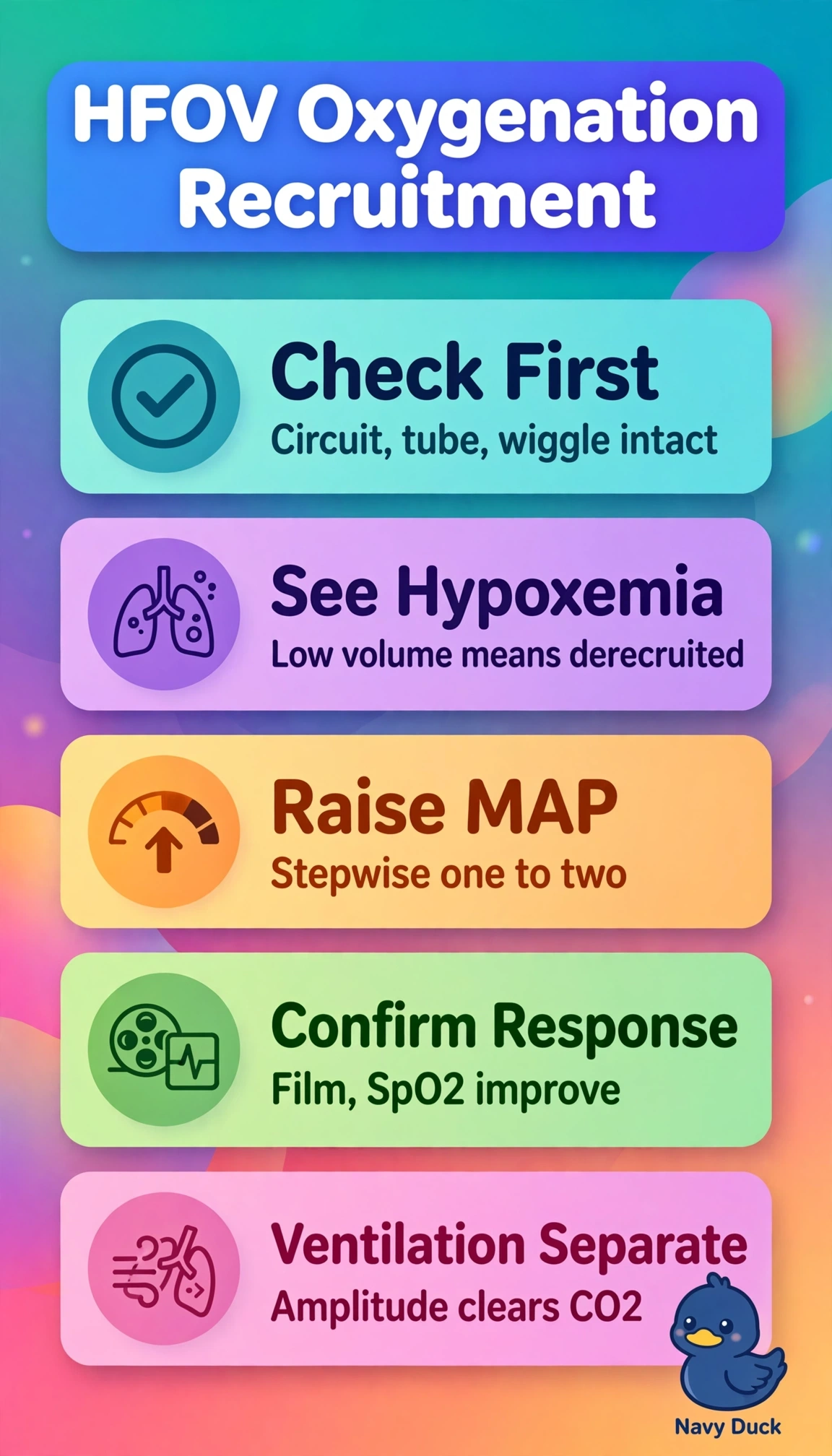
High-frequency oscillatory ventilation oxygenates by mean airway pressure recruiting lung volume and FiO2, while ventilation depends on amplitude and frequency, so persistent hypoxemia with a low-volume film signals derecruitment requiring higher mean pressure after confirming the circuit, endotracheal tube, and chest wiggle are intact and alarms reflect transient disconnect versus true obstruction. Decreasing mean pressure to increase amplitude misapplies ventilation control to an oxygenation problem and will worsen atelectasis and shunt even though amplitude clears CO2. Increasing frequency and shortening inspiratory time misuses frequency for volume delivery because higher frequency actually lowers oscillatory tidal volume and does not recruit lung, leaving hypoxemia uncorrected. Silencing alarms and relying on FiO2 alone ignores lung-volume physiology and alarm safety because oxygen without recruitment perpetuates shunt and masks displacement or blockage. Exam caveat is to link hypoxemia to mean pressure and hypercapnia to amplitude or frequency on HFOV and always rule out ETT obstruction or disconnect first. Practical check is to watch chest vibration to the umbilicus, repeat radiograph and SpO2, and adjust mean pressure in 1 to 2 cmH2O steps per protocol.