
A 68-year-old admitted with fever, productive cough, right lower lobe consolidation, WBC 18,000, PaO2 58 on room air, and increased work of breathing is diagnosed with severe community-acquired pneumonia. Sputum cultures are pending and antibiotics were just started. Which respiratory management strategy best supports treatment of severe pneumonia with hypoxemia?
Select an answer to reveal the explanation.
Short Explanation
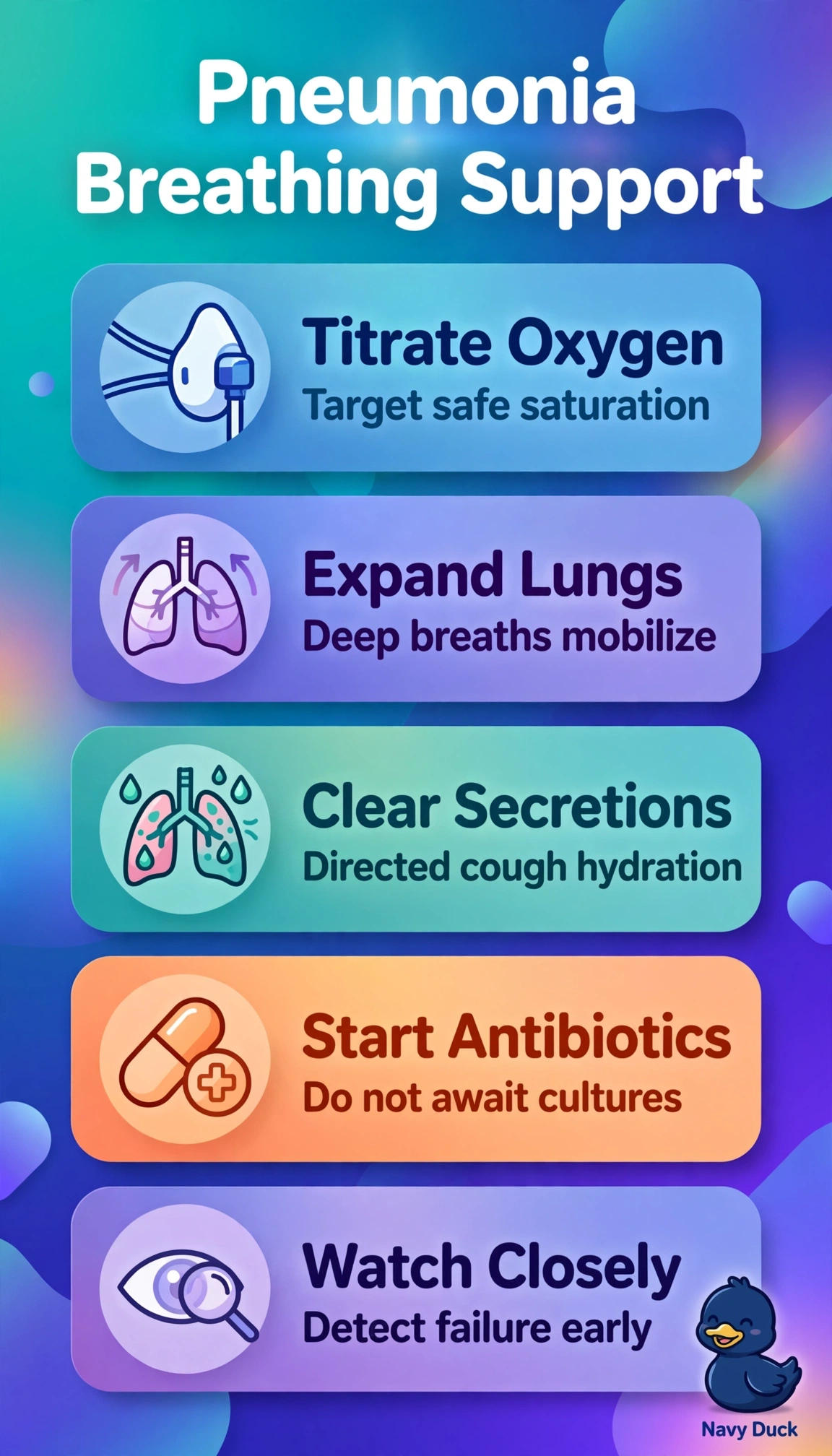
You’re airing out infected sponges while drugs do the killing. Titrated oxygen plus movement and cough keeps gas exchange alive.
Full Explanation
The correct strategy addresses severe community-acquired pneumonia with fever, right lower lobe consolidation, WBC 18,000, PaO2 58 on room air, and increased work of breathing by combining titrated oxygen to target to correct severe hypoxemia without hyperoxia, lung expansion and productive cough clearance to recruit consolidated alveoli and improve ventilation-perfusion matching, and early mobilization with monitoring to limit atelectasis and deconditioning while detecting deterioration, continuing empiric antibiotics without awaiting pending cultures. The titrated oxygen with clearance but strict bed rest approach fails on mobilization because prolonged immobility in a 68-year-old promotes atelectasis, venous thromboembolism, muscle loss, and delayed recovery, whereas tolerated early activity improves outcomes. The routine low-flow oxygen without titration approach fails on oxygen delivery because untitrated flow cannot reliably resolve documented severe hypoxemia or avoid harm from persistent hypoxemia or excess oxygen when work of breathing is increased. The titrated oxygen and mobilization but defer support until cultures return approach fails on timing because it confuses pathogen-specific refinement with urgent physiologic support, withholding needed expansion despite appropriate empiric therapy. Exam caveat: separate antibiotic selection, which cultures refine, from respiratory support, which must start immediately. Practical check: confirm target saturation on titrated oxygen, mobilized secretions with improved effort, and ambulation without worsening desaturation, dyspnea, or fatigue.