
A 36-week infant is delivered after maternal fever and prolonged rupture of membranes, the L/S ratio is 1.4 with absent phosphatidylglycerol, 1-minute APGAR is 5 for tone, color, and reflexes, and gestational age suggests borderline lung maturity. Which perinatal history interpretation best guides immediate neonatal respiratory assessment?
Select an answer to reveal the explanation.
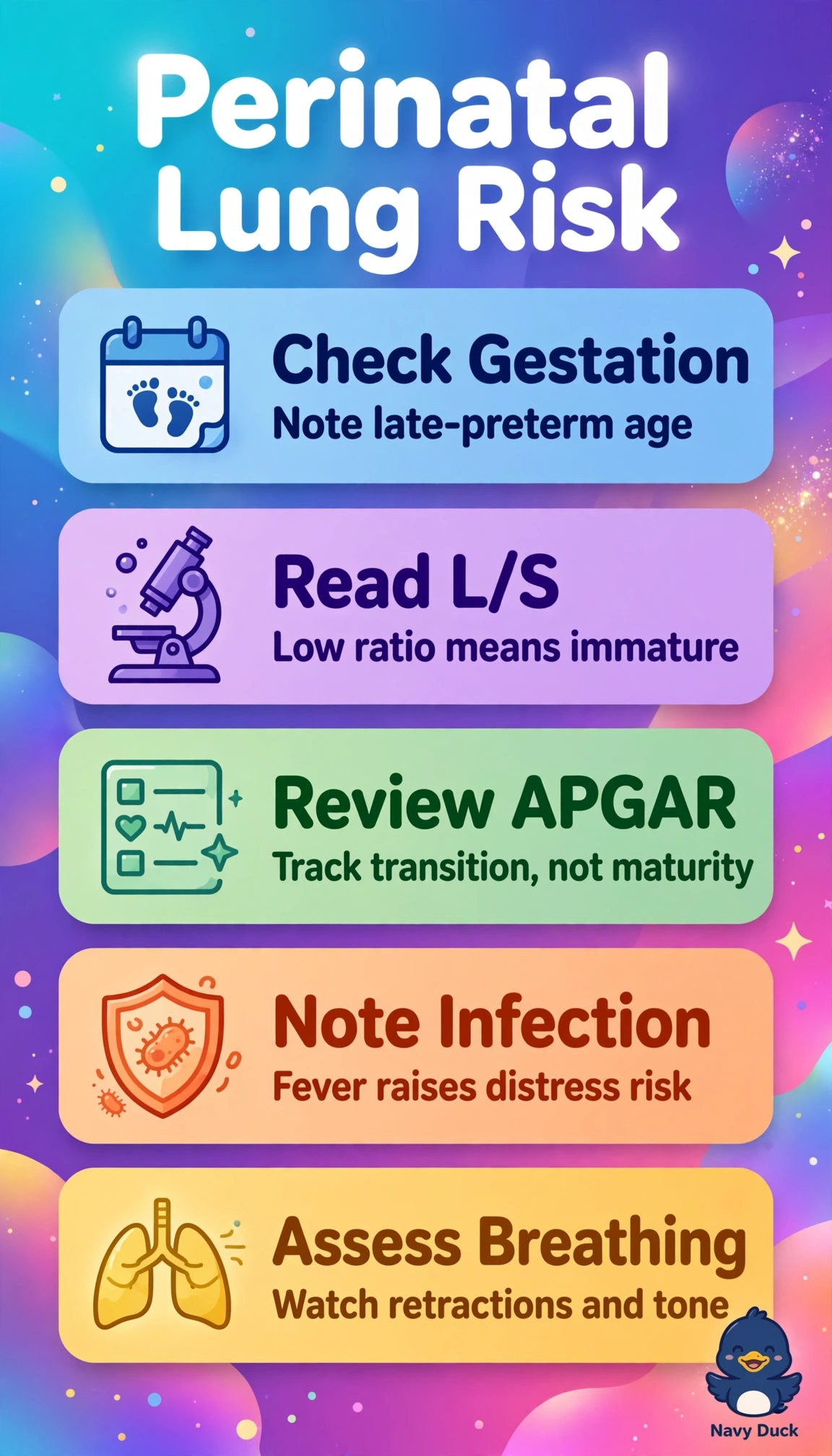
Short Explanation
You're weaving labs, dates, and delivery clues into one risk picture. That immature lipid ratio at 36 weeks shouts stiff lungs. Linking that maturity profile tells you to watch for retractions early.
Full Explanation
The correct interpretation recognizes that an L/S ratio of 1.4 with absent phosphatidylglycerol at 36 weeks indicates biochemical lung immaturity and high risk for surfactant deficiency, so immediate respiratory assessment should anticipate respiratory distress syndrome with tachypnea, retractions, grunting and need for CPAP or surfactant. The sepsis-focused interpretation correctly identifies that prolonged rupture with maternal fever raises early-onset sepsis risk and often triggers cultures and antibiotics, but it fails by clinical priority because the question asks what guides immediate respiratory assessment, and infection risk does not establish surfactant status or ventilatory planning. The Apgar-focused interpretation correctly notes that a one-minute score of five warrants continued resuscitation readiness and vital-sign monitoring, but it fails by predictive validity because the one-minute score reflects transitional status and resuscitation response, not alveolar surfactant pool or subsequent distress trajectory, especially when tone, color and reflexes drive the score. The maturity-sufficient interpretation correctly uses gestational age and L/S context, but it fails by threshold concept because maturity generally requires L/S at or above 2.0 with present phosphatidylglycerol, so the stated low value with absent phosphatidylglycerol remains immature at late-preterm gestation. Exam caveat is to avoid equating late-preterm appearance or a single reassuring element with lung maturity when biochemical markers disagree. Practical check is to correlate L/S, phosphatidylglycerol, gestational age, and evolving work of breathing with blood gases and chest radiograph while preparing respiratory support and avoiding delay for repeat maturity testing.