
A 52-year-old with loud snoring, witnessed apneas and daytime sleepiness undergoes split-night titration with baseline SpO2 88% and transcutaneous CO2 52 mm Hg, with residual events and mask leak on CPAP 8 cm H2O. Which overnight titration and monitoring strategy best optimizes CPAP/NPPV and gas exchange?
Select an answer to reveal the explanation.
Short Explanation
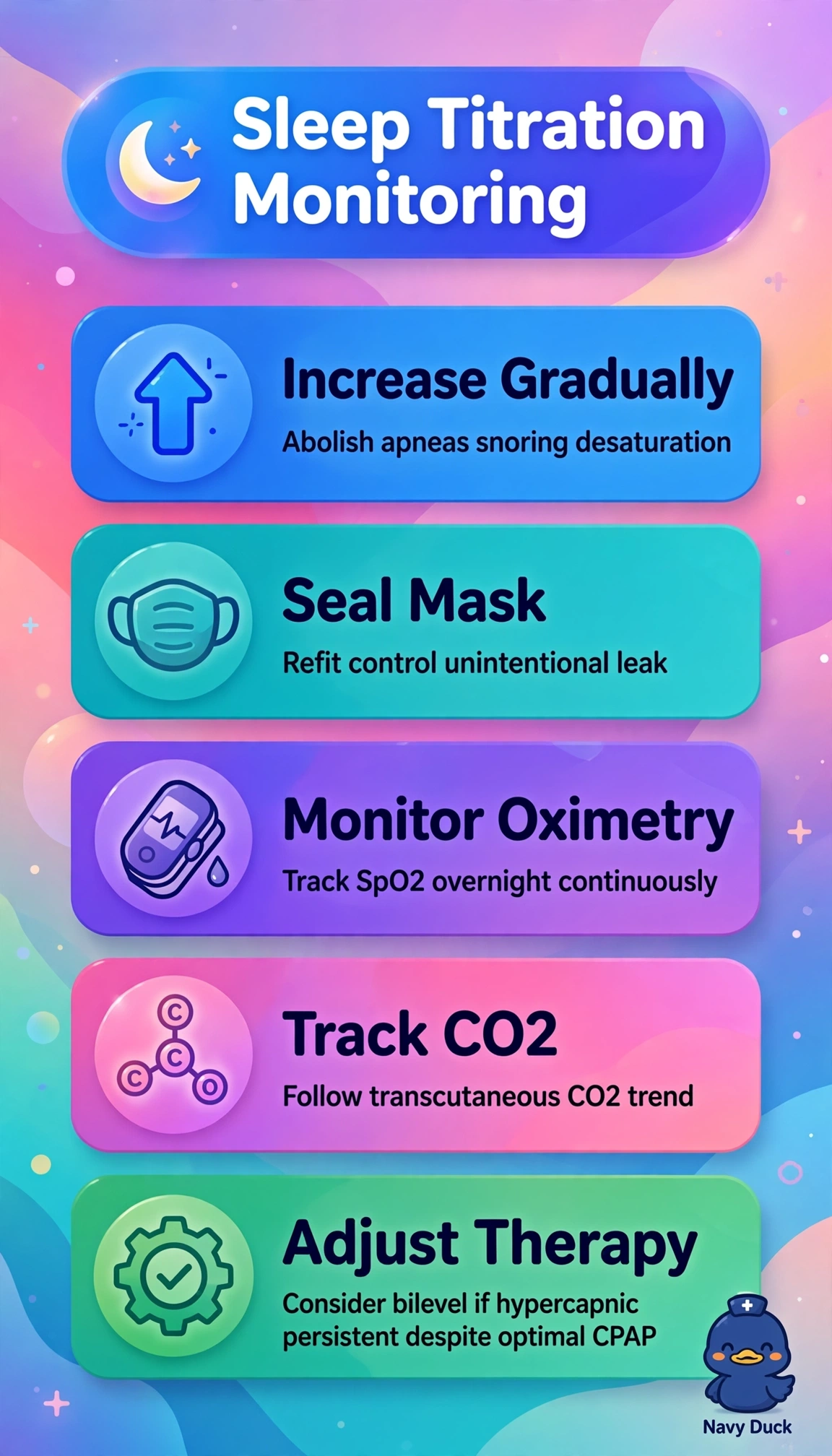
You can optimize the titration by raising CPAP stepwise until events resolve and refitting the mask to control leak. Track SpO2 and transcutaneous CO2 together so gas exchange is assessed, not just oxygenation.
Full Explanation
With loud snoring, witnessed apneas, daytime sleepiness, baseline hypoxemia, and hypercapnia, you need to address obstruction, leak, and gas exchange together. Raising CPAP stepwise to abolish events, refitting the mask, and monitoring SpO2 plus transcutaneous CO2 is appropriate: higher pressure restores pharyngeal patency, a good seal preserves delivered pressure and signal quality, and CO2 monitoring can reveal persistent hypoventilation that oximetry alone may miss. Tracking continuous overnight oximetry alone fails conceptually because normal SpO2 does not rule out rising PaCO2 or sleep hypoventilation, particularly with TcCO2 already at 52 mm Hg; hypercapnia and a need for bilevel escalation could be missed. Holding CPAP at 8 cm H2O fails because residual events indicate inadequate pressure, so obstruction, arousals, and intermittent desaturation may persist despite correcting the leak. Starting bilevel NPPV immediately is premature: correct the leak and complete CPAP titration first, since immediate escalation adds complexity, asynchrony risk, and cost without establishing CPAP failure or persistent hypoventilation despite optimal CPAP. Exam caveat: distinguish residual obstruction, which calls for higher CPAP, from persistent hypercapnia after events are abolished, which suggests hypoventilation and may call for bilevel with a backup rate. Practical check: confirm leak is below the manufacturer threshold, observe resolution of events and flow limitation with stable SpO2 and falling or stable TcCO2, then finalize pressure and plan follow-up arterial blood gas and adherence review.