
A 29-year-old with severe traumatic brain injury is intubated with ICP 24 mm Hg, MAP 88, CPP 64, PaCO2 46, PaO2 72, and SpO2 93% on assist-control ventilation. The head is flat, suctioning is prolonged, and fever is present. Which ventilation strategy best controls intracranial pressure while maintaining cerebral perfusion after brain injury?
Select an answer to reveal the explanation.
Short Explanation
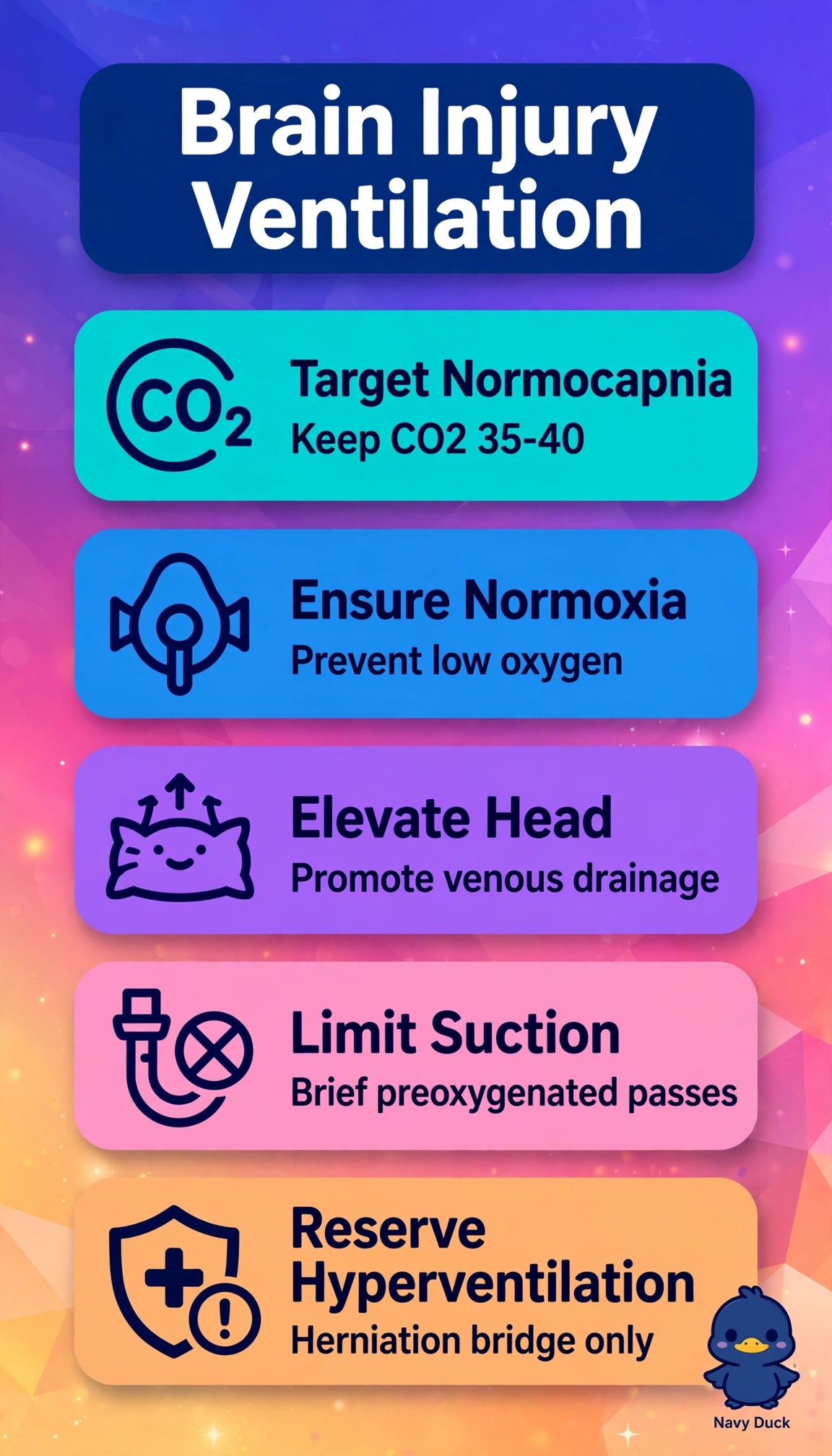
You've got to keep your brain's air just right, like airing out a stuffy room without throwing the windows wide open. That's why you'll aim for normocapnia and good oxygen with your head up, saving brief hyperventilation only for herniation.
Full Explanation
The correct strategy addresses concurrent intracranial hypertension, hypercapnia, hypoxemia and impaired venous drainage while preserving perfusion, because PaCO2 46 causes cerebral vasodilation that increases blood volume and ICP, while PaO2 72 with SpO2 93% risks secondary ischemic injury, so targeting normocapnia near 35-40 mm Hg and normoxia with head elevation to improve jugular outflow, adequate sedation to reduce metabolic demand and dyssynchrony, fever control, brief suctioning with preoxygenation, and CPP 60-70 preserves MAP and lowers ICP. The permissive hypercapnia approach fails by cerebrovascular concept because retained carbon dioxide dilates arterioles and raises ICP despite being lung-protective in isolated ARDS without brain injury. The continuous hyperventilation approach fails by ischemia concept because sustained hypocapnia causes vasoconstriction that transiently lowers ICP but reduces cerebral blood flow and risks infarction, so guidelines reserve brief hyperventilation only as a temporizing bridge for acute herniation. The flat positioning with prolonged suctioning approach fails by venous drainage concept because despite correct gas targets, flat head position, suction-related intrathoracic pressure spikes, cough and fever all elevate ICP and threaten perfusion. Exam caveat is to distinguish brain-protective from lung-protective ventilation and avoid selecting prophylactic hyperventilation or permissive hypercapnia when ICP is elevated and CPP is at goal. Practical check is to confirm arterial gases and capnography, SpO2, 30-degree head elevation with neck midline, temperature, MAP with CPP trend, and ICP response after any ventilator adjustment or airway suctioning.