
A 26-year-old nursing student with prior BCG vaccination had close classroom exposure to active pulmonary tuberculosis, has no cough, fever, or weight loss, and has a normal chest radiograph. Which TB test should the therapist recommend to screen for latent infection in this BCG-vaccinated contact?
Select an answer to reveal the explanation.
Short Explanation
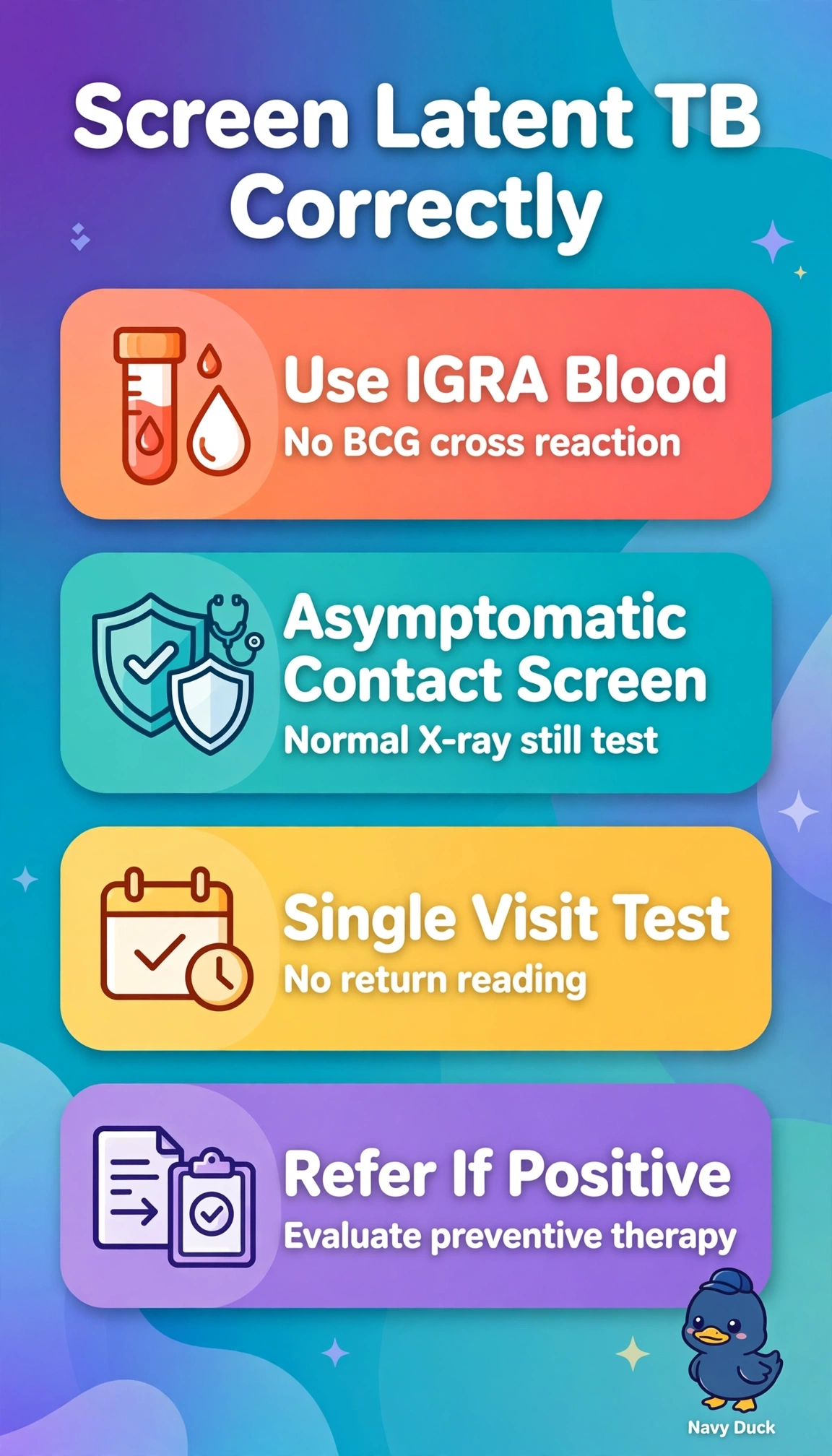
You're dodging a false alarm from an old vaccine. Blood testing sidesteps that cross-reaction like caller ID for true infection, so IGRA is the cleanest screen here.
Full Explanation
The correct recommendation is interferon-gamma release assay because this asymptomatic close contact with a normal radiograph needs screening for latent infection after BCG vaccination, and IGRA uses Mycobacterium tuberculosis-specific antigens ESAT-6 and CFP-10 absent from BCG strains so specificity remains high without cross-reactivity and a blood draw avoids skin-test boosting on serial testing. Recommending tuberculin skin testing for initial screening fails by specificity concept because purified protein derivative shares antigens with BCG and many nontuberculous mycobacteria, causing false-positive reactions in BCG-vaccinated adults that complicate interpretation and contact management. Recommending sputum nucleic acid amplification testing fails by disease-state concept because molecular assays detect mycobacterial DNA in respiratory specimens to diagnose active pulmonary disease, which is inappropriate with no cough, no productive sputum and normal imaging, and a negative result cannot establish or exclude latent infection. Recommending repeat chest radiography fails by modality concept because radiographs detect parenchymal manifestations or sequelae of active disease but cannot detect immunologic memory of latent infection, so stable films would falsely reassure while untreated infection persists. An exam caveat is that neither IGRA nor tuberculin testing distinguishes latent infection from active disease, so any positive screen with symptoms or abnormal imaging still requires active-disease workup before preventive therapy. A practical check is to confirm last exposure timing, obtain IGRA eight to ten weeks after exposure, arrange prompt referral for evaluation and preventive therapy discussion if positive, and document BCG history and occupational health follow-up.