
A 68-year-old with severe COPD on 2 L home oxygen is referred to pulmonary rehabilitation after two exacerbations, reports avoiding walking for fear of breathlessness, demonstrates poor metered-dose inhaler technique without a spacer, and asks how rehab will help daily life. Which pulmonary rehabilitation education strategy best supports COPD self-management and functional improvement for this patient?
Select an answer to reveal the explanation.
Short Explanation
You'll help this patient move without fear by linking skills and movement. Rehab works because self-management pairs breathing control with safe, graded activity every day.
Full Explanation
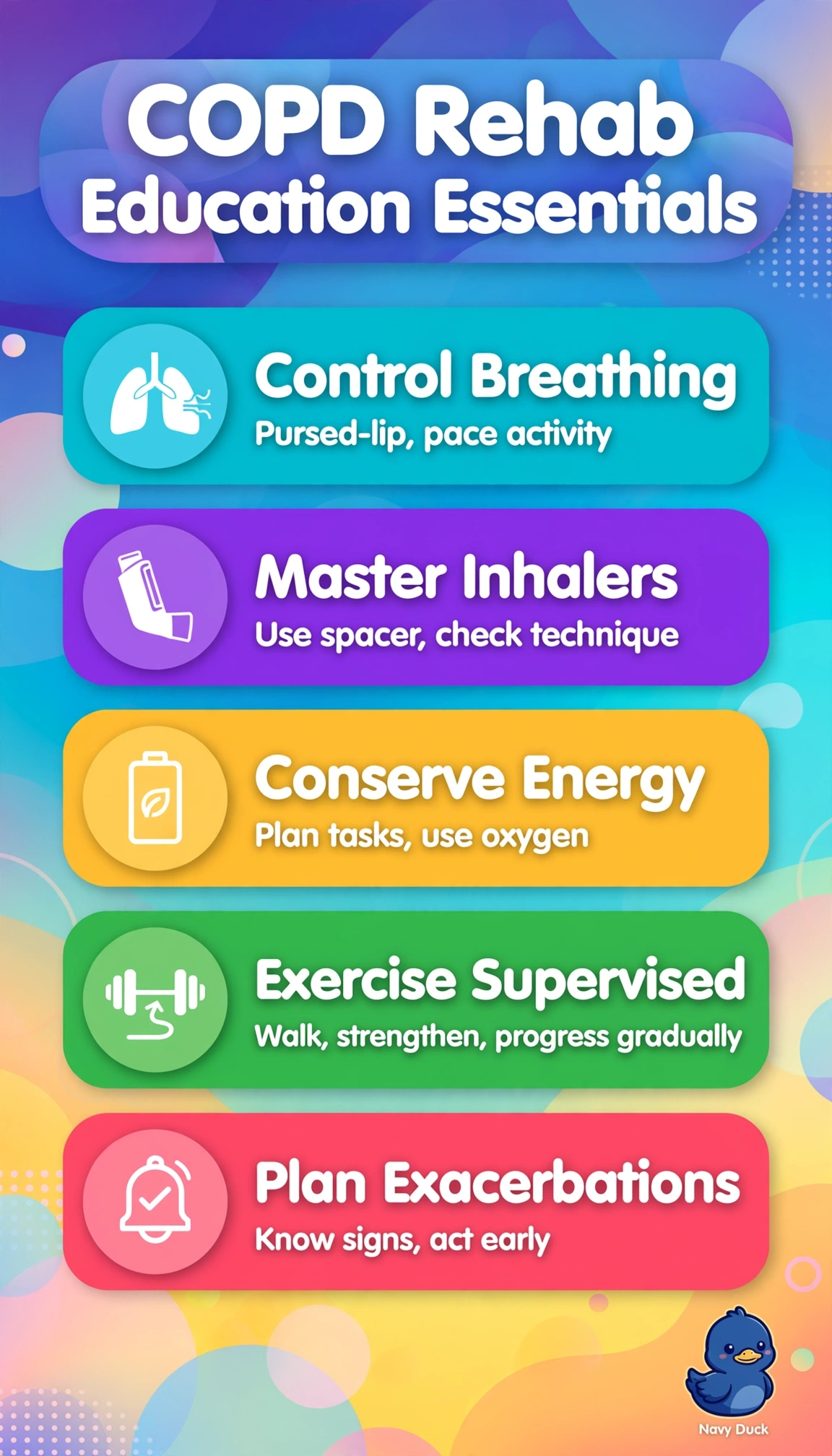
Effective pulmonary rehabilitation for severe COPD integrates breathing retraining, energy conservation, correct inhaler use, supervised exercise, and exacerbation planning to interrupt dyspnea-avoidance while ensuring safety on home oxygen. Pursed-lip breathing reduces air trapping and exertional panic, pacing and energy conservation make daily tasks feasible, spacer training corrects the observed critical technique error to improve deposition, and supervised graded exercise with monitoring builds tolerance, confidence, and functional capacity after repeated exacerbations, while collaborative action planning enables early recognition and treatment. A comprehensive program that omits exacerbation action planning fails the recurrence concept because two recent exacerbations make written rescue planning essential to limit hospitalization. A program offering breathing training, monitored exercise, and action planning without inhaler review fails the delivery concept because continued poor technique without a spacer leaves obstruction poorly controlled despite conditioning. A program offering breathing, inhaler, and action education with only unsupervised home walking fails the supervision concept because severe hypoxemia, oxygen dependence, and fear avoidance require monitored progression for safety and adherence. Exam caveat is to choose what fits all stated vulnerabilities rather than any generally sound COPD intervention. Practical check is to verify exercise saturation targets, use teach-back for spacer technique, and confirm the patient holds a written exacerbation plan.