
A 14-month-old former 26-week, 780-g preterm infant with moderate bronchopulmonary dysplasia attends pulmonary clinic on 0.5 L/min home oxygen. The child is active, taking solids, gaining weight along the curve, with mild tachypnea, clear lungs, and 97% SpO2 awake on oxygen. Parents ask to stop oxygen for travel. Which evaluation should the therapist recommend first to guide oxygen weaning for chronic lung disease of prematurity?
Select an answer to reveal the explanation.
Short Explanation
You've got a happy, growing kid who looks great awake — that's exactly when BPD hides dips during feeds and naps. A full oximetry run catches those silent drops like a night-shift security camera before you pull the oxygen.
Full Explanation
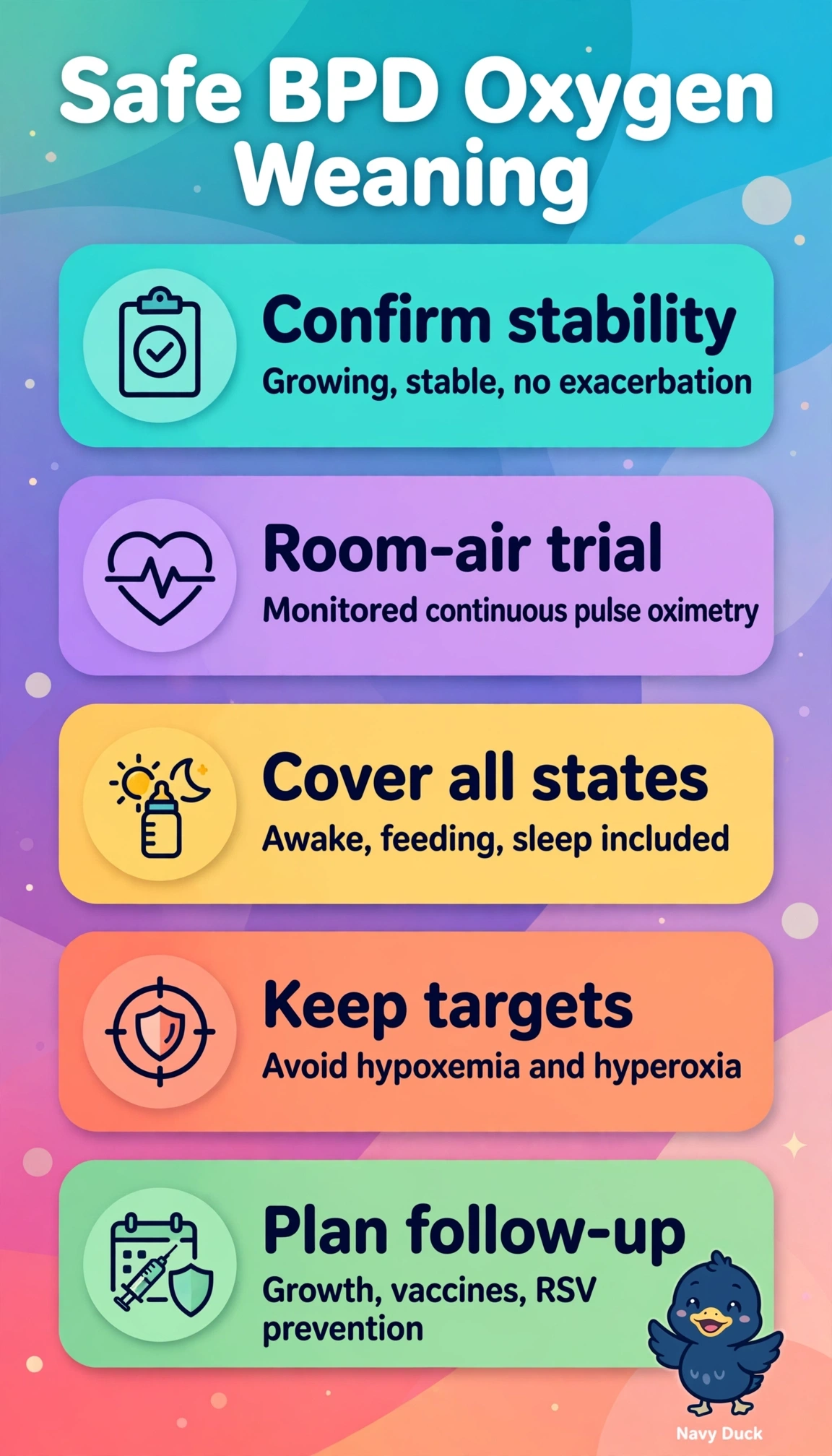
In moderate bronchopulmonary dysplasia after extreme prematurity, awake saturation of 97% on 0.5 L/min does not establish that room-air gas exchange is sufficient, because low alveolar surface, ventilation-perfusion mismatch, airway disease, and immature respiratory control cause intermittent desaturation when metabolic demand rises during activity, ventilation pauses during feeding, and drive and functional residual capacity fall during sleep. A supervised room-air trial with continuous oximetry through activity, feeding, and sleep therefore gives the complete first physiologic screen, capturing frequency, depth, duration, and recovery of desaturations with rescue oxygen available. Continuous overnight oximetry recorded while remaining on prescribed oxygen usefully quantifies desaturation burden on therapy but conceptually fails to test room-air independence and may falsely suggest readiness. A supervised daytime clinic room-air trial during play and feeding usefully tests awake demand and swallow-breathing coordination but fails by omitting sleep, where prolonged hypoxemia and hypoventilation most often persist and delay weaning. Formal room-air polysomnography definitively characterizes sleep apnea and hypoventilation but fails as the first evaluation because it does not assess daytime activity and feeding performance and adds delay, cost, and access burden. Examinations often test that spot awake saturation cannot exclude feeding or sleep desaturation and that weaning decisions require sustained continuous data. Practically, use a motion-tolerant infant sensor with good plethysmographic waveform, include a full feed and active and quiet sleep when possible, apply established saturation thresholds and stopping rules, and restore prescribed oxygen promptly for sustained, profound, or symptomatic desaturation.