
A 64-year-old ventilated two days after coronary bypass remains on a propofol infusion, RASS -4, hypotensive requiring norepinephrine, with no spontaneous efforts and no awakening trial. The team wants to assess readiness to wean. Which sedative adjustment should the therapist recommend to facilitate weaning evaluation?
Select an answer to reveal the explanation.
Short Explanation
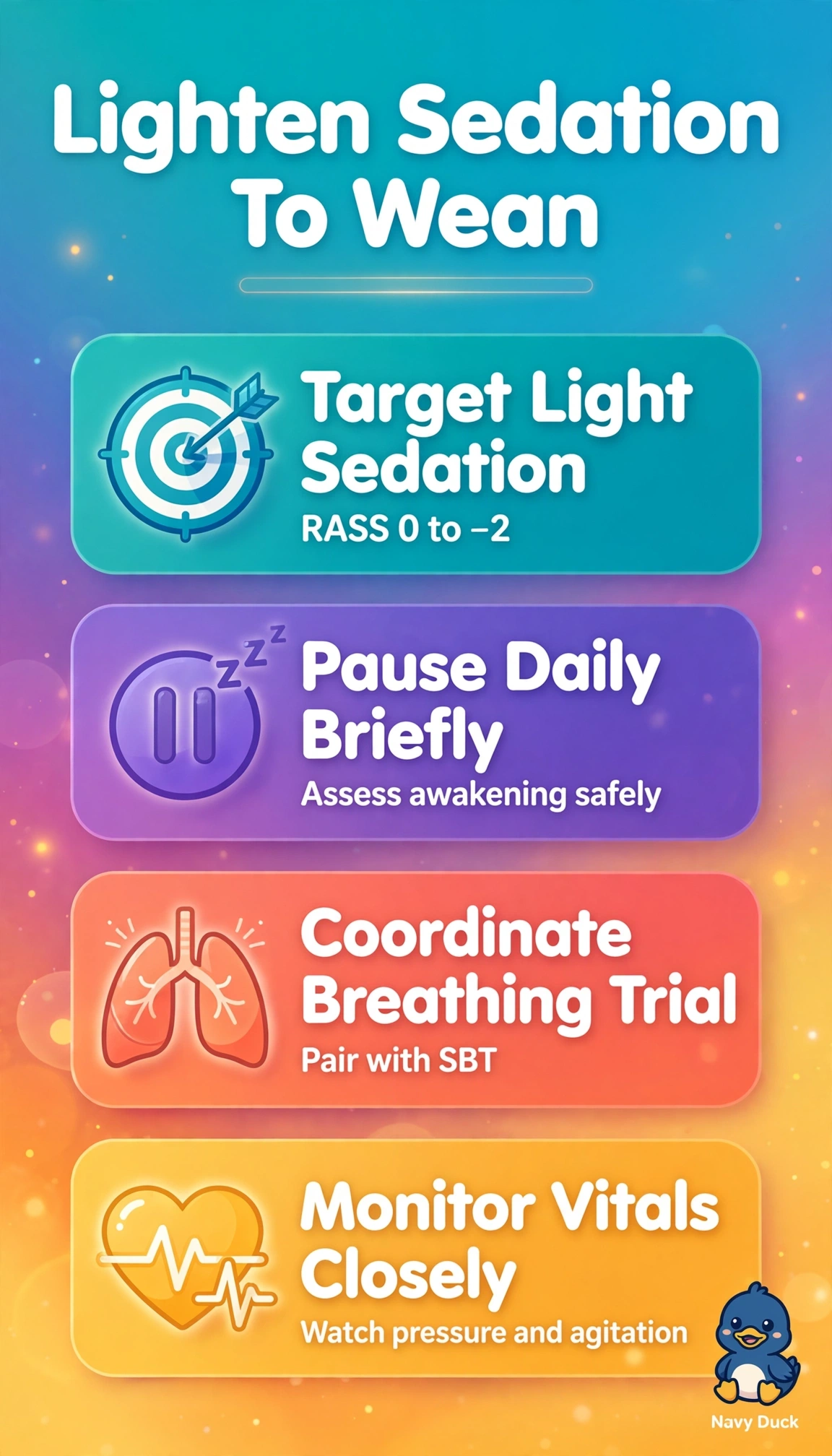
You're letting the patient peek out just enough to show readiness. Easing sedation briefly works like opening curtains in the morning, so awakening trials reveal weaning potential safely.
Full Explanation
The correct recommendation reflects guideline-based readiness evaluation requiring reduction of prolonged deep sedation to achieve a cooperative, lightly sedated state with a daily awakening trial, because RASS -4 after two days of propofol abolishes spontaneous effort and prevents assessment of drive, pattern, cough, and mentation needed two days after coronary bypass, while propofol's short context-sensitive half-life permits rapid titration and awakening for screening. Maintaining deep propofol sedation while proceeding directly to a breathing trial fails on physiology because drive-dependent weaning parameters cannot be interpreted when sedation suppresses triggering and synchrony, yielding an invalid trial. Switching to dexmedetomidine for cooperative light sedation fails on hemodynamics because sympatholysis with bradycardia and vasodilation risks worsening hypotension in a patient already requiring norepinephrine, despite its otherwise favorable weaning profile. Changing to intermittent lorazepam to maintain light sedation fails on pharmacokinetics because accumulation, prolonged effect, and increased delirium risk delay awakening and prolong ventilation compared with titratable short-acting propofol suited to daily interruption. The exam caveat is to prioritize vignette-provided hemodynamic and sedation-depth constraints over otherwise ideal agent selection for stable weaning, since cooperativeness alone does not override vasopressor dependence or deep-sedation physiology. The practical check is to confirm an awake, calm target with stable perfusion, adequate spontaneous triggers, cough strength, and resolved surgical indication for deep sedation before initiating a formal spontaneous breathing trial with continuous monitoring.