
A 42-year-old with Guillain-Barre syndrome shows progressive weakness, vital capacity falling from 38 to 18 mL/kg over six hours, MIP weakening to -22 cm H2O, tachypnea, weak cough, and ABG pH 7.32 with PaCO2 52. Swallow is impaired and secretions pool despite coaching. Which monitoring and ventilation timing decision best manages impending neuromuscular respiratory failure?
Select an answer to reveal the explanation.
Short Explanation
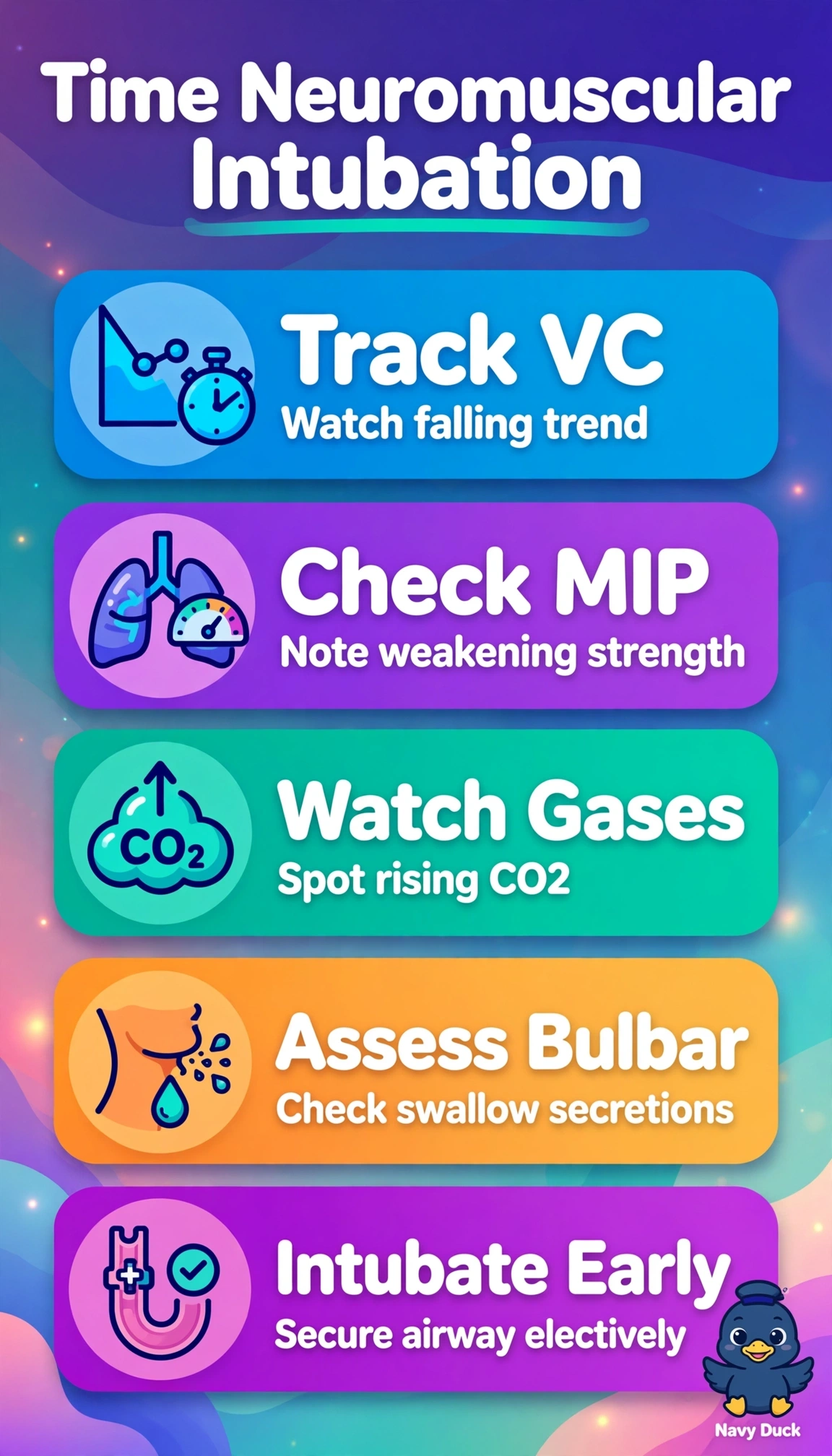
Weak pumps fade quietly until they quit. Vital capacity trends plus gases tell you to secure the airway before an emergency.
Full Explanation
Progressive Guillain-Barre syndrome with vital capacity falling from 38 to 18 mL/kg in six hours, MIP of -22 cm H2O, weak cough, tachypnea, pH 7.32 with PaCO2 52, plus impaired swallow with pooling secretions defines impending neuromuscular pump failure with loss of airway protection, so close tracking of serial vital capacity, inspiratory strength, gases and bulbar function with timely elective intubation before crisis is indicated because vital capacity below 20, MIP weaker than -30, rapid decline and new hypercapnic acidosis predict inability to sustain ventilation and elective control avoids emergent hypoxic arrest. The bilevel ventilation with cough assistance strategy fails on airway protection because that support helps selected neuromuscular weakness without bulbar dysfunction, but pooled secretions, dysphagia and worsening hypercapnia signal high aspiration and failure risk requiring a secured airway. The strategy of waiting for overnight trend confirmation fails on timing because intubation criteria are already met and decline is nonlinear, so further observation invites fatigue, mucus plugging, aspiration and difficult emergency airway management. The oximetry and pattern monitoring strategy without serial vital capacity and inspiratory force fails on early detection because saturation can remain preserved while hypoventilation progresses, making desaturation a late sign compared with falling vital capacity and rising PaCO2. For examinations remember that noninvasive ventilation favored in COPD exacerbation does not transfer to Guillain-Barre syndrome with bulbar involvement, and at the bedside verify upright vital capacity every two to four hours with MIP, cough strength, swallow and secretion burden, gas trends and autonomic signs while preparing suction and an experienced airway team.