
A night-shift therapist notes a postoperative patient with rising respiratory rate from 18 to 30, increased work of breathing and SpO2 89% on 4 L after being stable at 94%. The nurse is busy and the rapid response criteria are nearly met. Which handoff and escalation communication should the therapist initiate to address this deteriorating respiratory status?
Select an answer to reveal the explanation.
Short Explanation
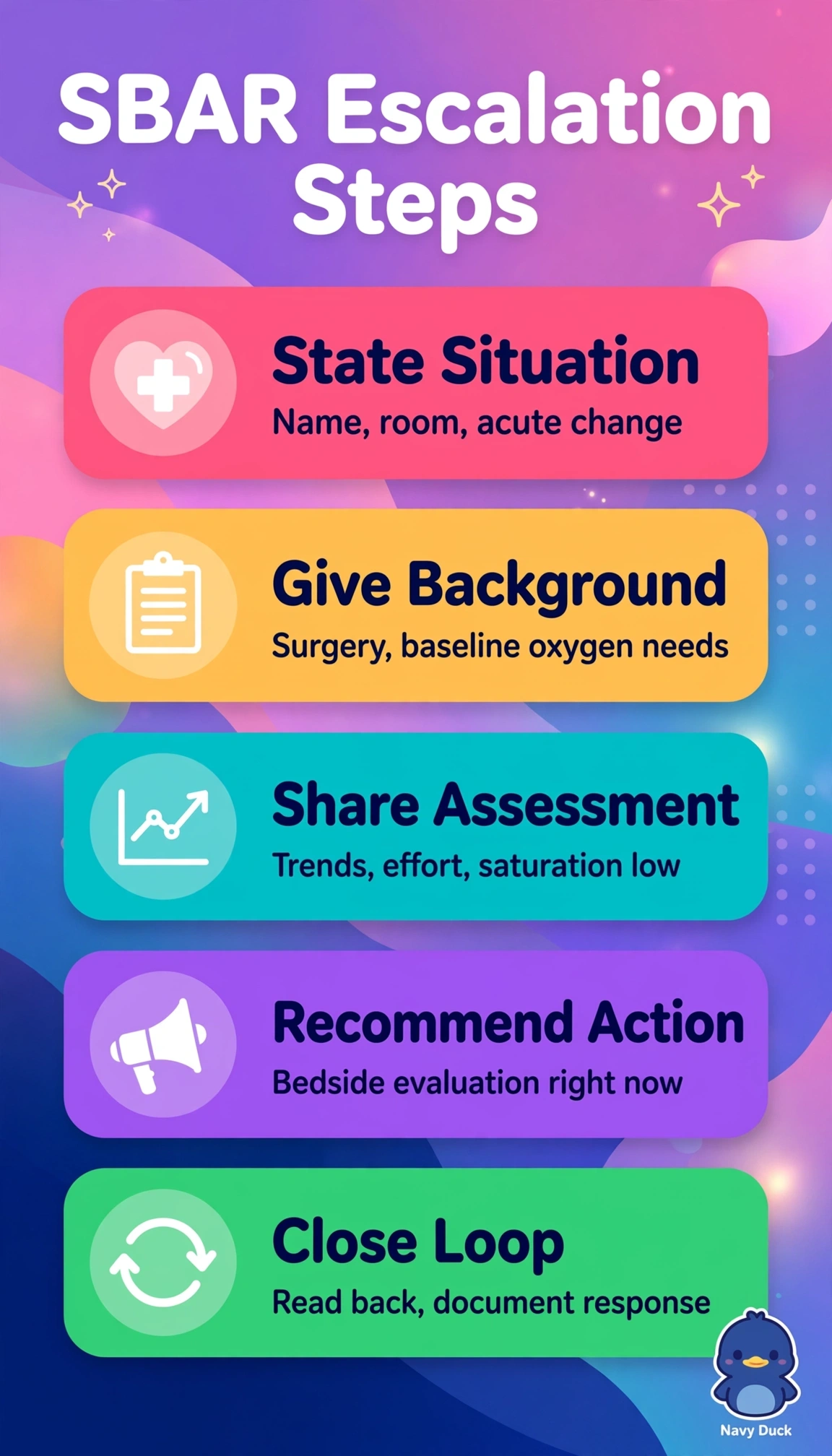
Worried counts as a vital sign when trends turn ugly. A concise SBAR with what changed and what you need turns concern into escalation instead of a chart note nobody sees.
Full Explanation
The correct communication is required because this postoperative patient demonstrates acute deterioration with respiratory rate rising from 18 to 30, increased work of breathing, and SpO2 falling to 89% on 4 L after stability at 94%, which together indicate impending respiratory failure and nearly meet rapid response criteria despite the nurse being busy, so structured SBAR with explicit trends plus a clear request for urgent bedside evaluation now creates shared understanding, assigns accountability, and triggers timely rescue. Requesting routine review when available preserves SBAR structure and trend reporting but fails on urgency, violating escalation principles where tachypnea, increased effort, and hypoxemia on oxygen demand immediate evaluation rather than queuing behind workload. Summarizing current values only while requesting urgent evaluation preserves structure and urgency but fails on trajectory, because without the 18-to-30 and 94%-to-89% trends the receiver cannot judge velocity, postoperative risk, or proximity to rapid response thresholds essential for prioritization. Providing SBAR at shift handoff while maintaining vigilant monitoring preserves structure, trends, and surveillance but fails on escalation ownership, substituting continuity for rescue and leaving a hypoxemic labored patient to independent observation instead of activating bedside help. An exam caveat is to separate stable-patient handoff, where routine SBAR and monitoring are appropriate, from deteriorating-patient escalation, where stems emphasizing worsening trends, increased work, desaturation despite oxygen, and nearly met criteria require an explicit now request. A practical check is to verbalize SBAR, state rate trend, effort change, SpO2 and oxygen flow, name the needed urgent bedside evaluation with timeframe, confirm acceptance, and document deterioration and notification.