
A term newborn at 1 minute has heart rate 95, slow irregular respirations, some flexion of extremities, grimace to suction, and blue extremities with pink trunk. At 5 minutes tone and color improve with routine care. Which clinical assessment correctly interprets APGAR, gestational age, and cardiopulmonary status?
Select an answer to reveal the explanation.
Short Explanation
Add the five signs slowly and you land in the middle. A midrange APGAR in a term infant calls for watchful support, not code measures. Over- or under-scoring changes the whole response.
Full Explanation
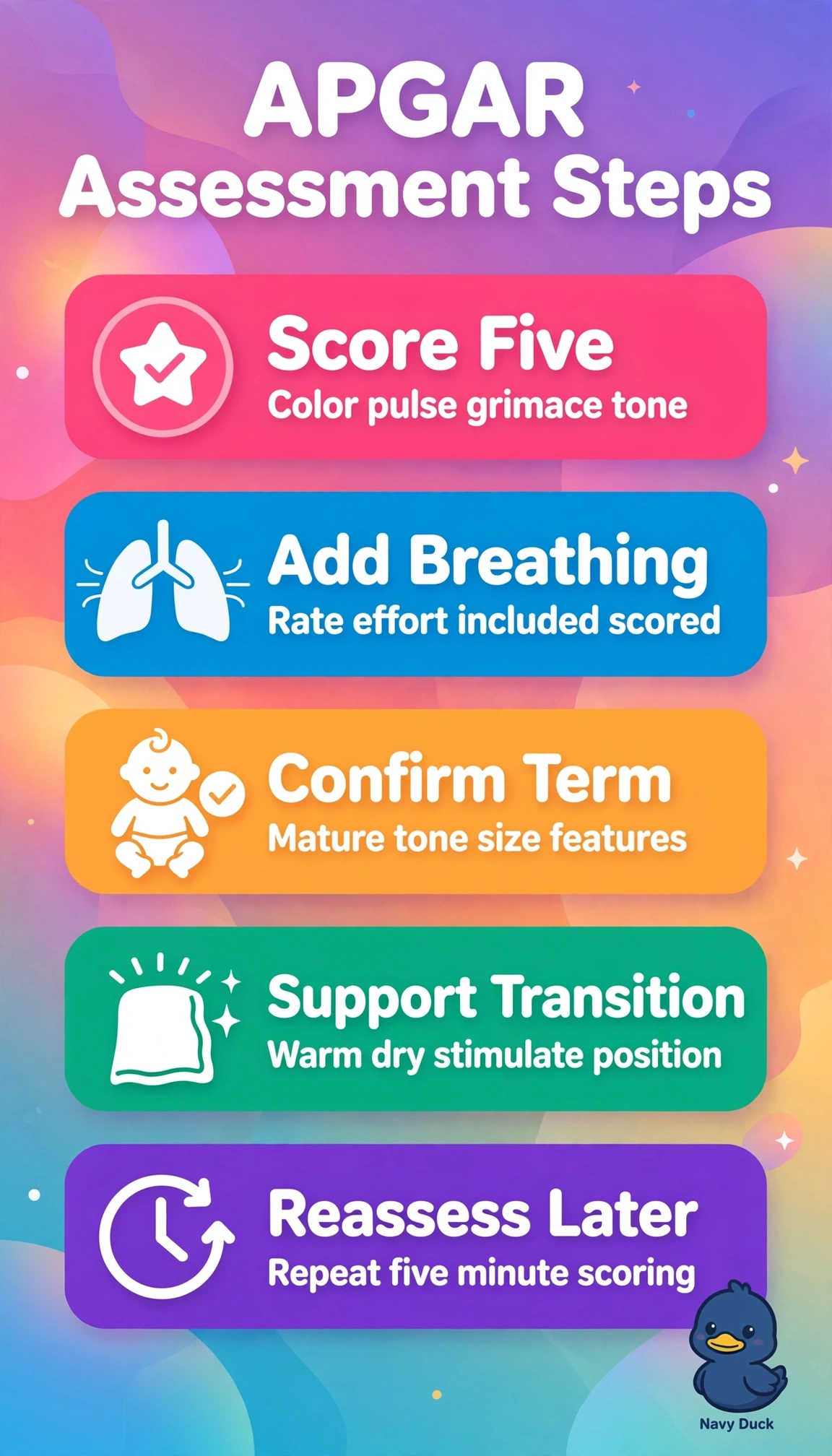
The 1-minute findings sum to five because heart rate 95 earns one, slow irregular respirations earn one, some flexion earns one, grimace earns one, and pink trunk with blue extremities earns one for acrocyanosis, indicating moderate transitional depression in a term infant whose improved tone and color by five minutes with routine care signal effective transition requiring continued observation with cardiopulmonary reassessment. The six-point interpretation correctly identifies term features and monitoring but fails on precise scoring by adding an extra point, typically by miscrediting heart rate below 100 as normal or acrocyanosis as fully pink, underscoring strict cutoff adherence. The five-point interpretation that defers reassessment until discharge correctly scores and identifies term status but fails on surveillance physiology because transition remains dynamic and mandates formal five-minute scoring plus ongoing heart rate, respiratory, perfusion, and tone checks. The five-point interpretation invoking late-preterm features correctly scores and plans monitoring but fails on maturity assessment because the stem specifies term findings, and mislabeling gestation distorts expectations for tone, reflexes, thermoregulation, and feeding. An exam caveat is that APGAR describes transition retrospectively and never delays resuscitation, which is driven by real-time heart rate, apnea, and tone. As a practical check, recount components while verifying heart rate by stethoscope and oximetry, document one- and five-minute scores, maintain warmth with routine care, and repeat cardiopulmonary examination to confirm sustained stability.