
A 48-year-old intubated for 5 days is triggering the ventilator and the team requests spontaneous ventilation parameters to assess weaning readiness. The patient is alert, afebrile, hemodynamically stable and on minimal pressure support. Which measurement technique should the therapist use to obtain a reliable maximum inspiratory pressure for weaning assessment?
Select an answer to reveal the explanation.
Short Explanation
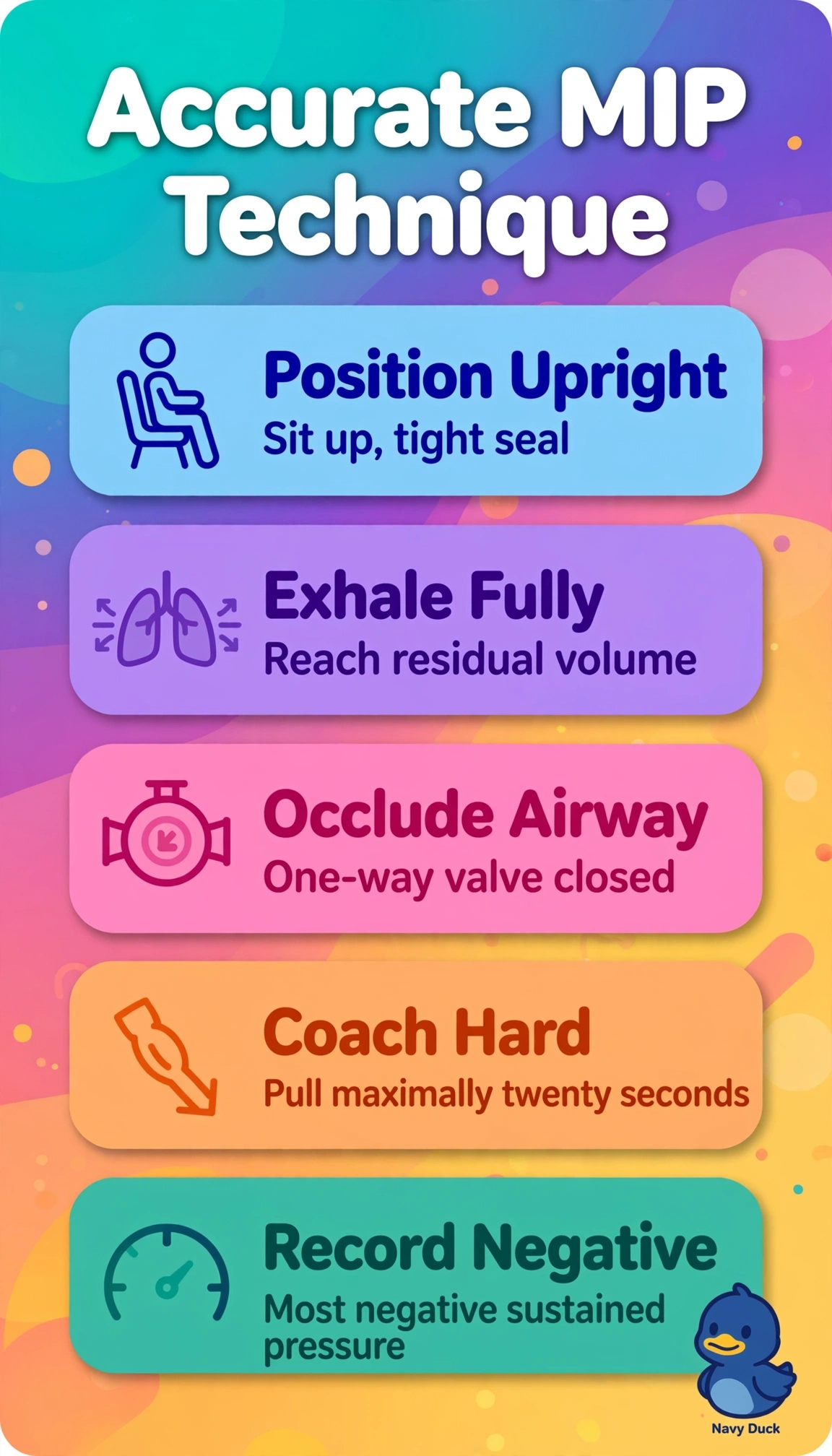
Strength shows when lungs start empty and you pull hard. Occluding near residual volume lengthens the diaphragm for maximal force, making the 20-second occlusion your most reproducible strength test.
Full Explanation
Maximum inspiratory pressure reflects global inspiratory muscle strength and is length-tension dependent, so occlusion near residual volume after full exhalation with a one-way exhalation valve over 15 to 20 seconds of maximal coaching captures the most negative pressure from functional residual capacity mechanics. Occluding at total lung capacity with a brief 2-second effort places the diaphragm at mechanical disadvantage on a shortened, flattened curve and under-samples effort, falsely suggesting weakness. Recording pressure during resting tidal breathing without occlusion measures elastic and resistive work of quiet breathing, not maximal voluntary force, and cannot predict ability to sustain spontaneous ventilation. Estimating effort from ventilator trigger sensitivity reflects synchrony and trigger work, not calibrated muscle pressure, and varies with bias flow, auto-PEEP, and sensitivity settings. Exam caveat: measure MIP separately from vital capacity and minute ventilation, each with its own posture, seal, and coaching standard. Practical check: sit the patient upright, ensure tight seal without leaks, coach forcefully, and record the most negative sustained value with units.