
A 58-year-old intubated for pneumonia after 9 days has improving infiltrates, FiO2 0.35, PEEP 5, hemodynamic stability, strong cough, minimal secretions, and passed a 30-minute spontaneous breathing trial with RSBI 68, negative inspiratory force -28 cm H2O, and alert mentation. The cuffed endotracheal tube shows minor cuff leak. Which care-plan change best advances artificial airway liberation and extubation?
Select an answer to reveal the explanation.
Short Explanation
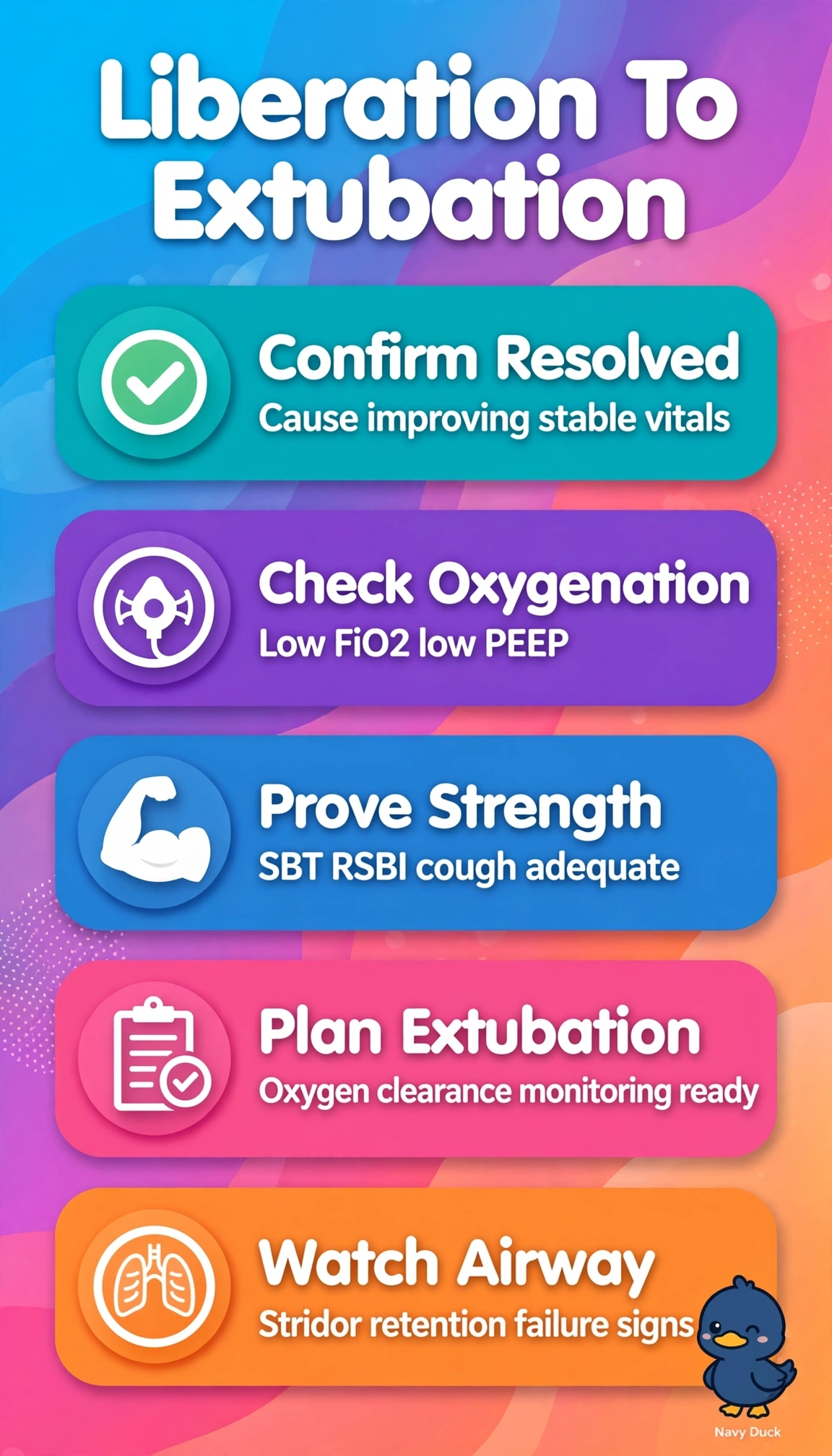
You have reassuring signs of readiness across breathing, strength, airway clearance, and mentation. Timely extubation to supplemental oxygen, with an airway-clearance plan and close monitoring for stridor, fits your progress. Continuing ventilation overnight, choosing tracheostomy based only on nine days, or adding prophylactic bilevel support would not improve this low-risk plan.
Full Explanation
The improving pneumonia, FiO2 0.35, PEEP 5, hemodynamic stability, strong cough, minimal secretions, alert mentation, and successful 30-minute spontaneous breathing trial with RSBI 68 and negative inspiratory force of -28 cm H2O support timely extubation. Supplemental oxygen and an airway-clearance plan support oxygenation and secretion management; close monitoring is appropriate because the minor cuff leak may signal laryngeal edema and risk of post-extubation stridor. Continuing full ventilation overnight to repeat an already passed trial delays liberation without a new physiologic reason and adds risks such as weakness, infection, and longer stay. Elective tracheostomy can help with prolonged weaning, but nine days of intubation alone does not justify it when breathing-trial tolerance and airway competence are demonstrated. Prophylactic bilevel ventilation can benefit selected high-risk patients, such as those with hypercapnia or heart failure, but this patient’s strong cough, manageable secretions, and alertness do not support routine use; it may add interface and aspiration concerns. An exam caveat is that passing a breathing trial does not by itself establish extubation readiness: cough, secretions, mentation, and upper-airway patency still matter. At bedside, confirm the oxygen device and flow, suction availability, voice and breathing, and reassessment for stridor or increased work of breathing; identify the reintubation threshold, equipment, and personnel.