
A 4-year-old with known moderate persistent asthma presents to the emergency department with 2 days of rhinorrhea and wheezing after a viral cold, now with accessory muscle use, SpO2 91% on room air, and poor response to home albuterol. Lungs have diffuse expiratory wheezes without stridor or focal crackles. Which pediatric asthma exacerbation management approach best stabilizes airway obstruction and oxygenation?
Select an answer to reveal the explanation.
Short Explanation
You're calming both the squeeze and the swelling at once. Early steroids plus bronchodilation reopen twitchy airways faster than either alone. You'll hear less wheeze once inflammation and spasm ease together.
Full Explanation
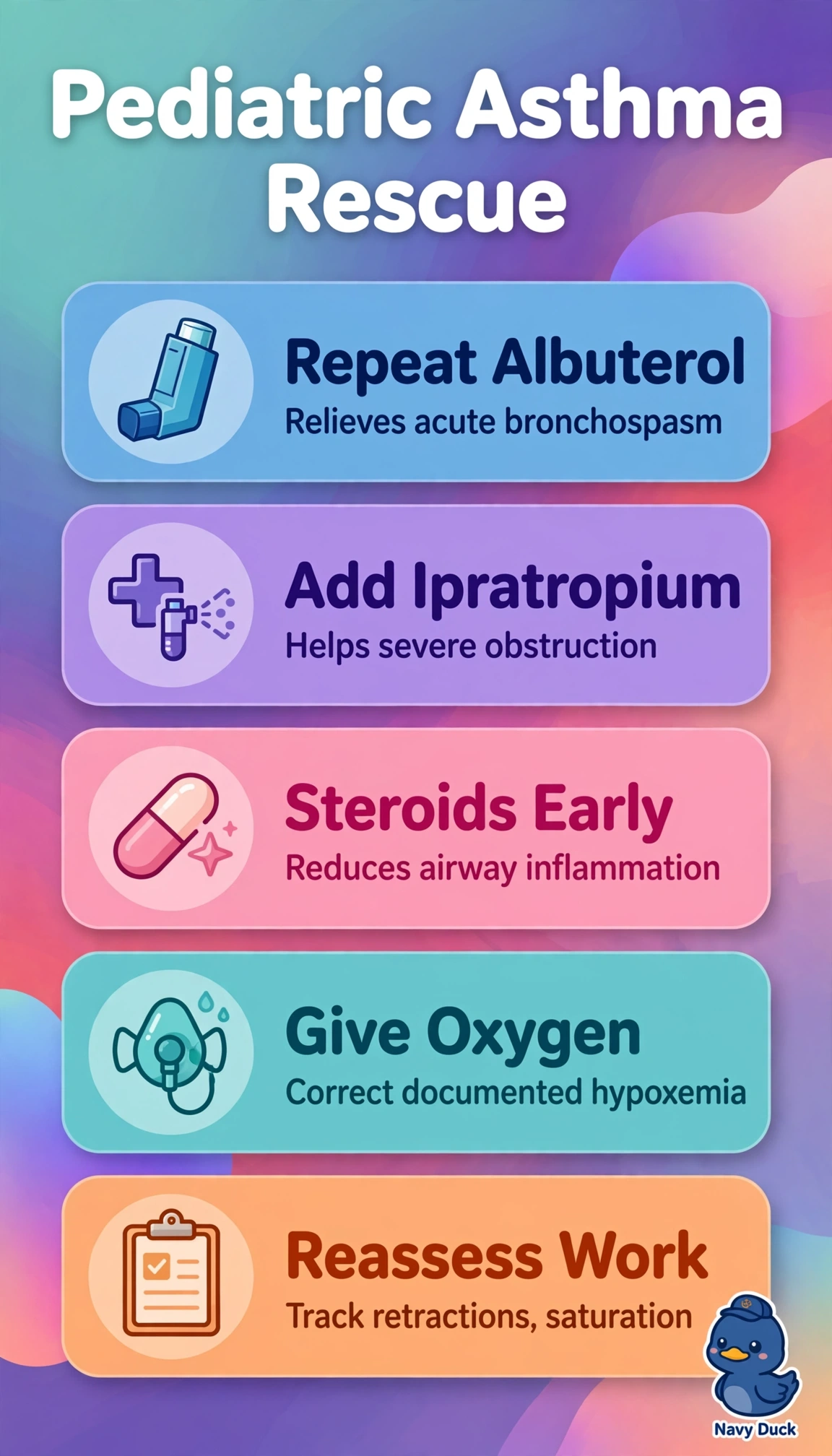
This child has a moderate to severe asthma exacerbation precipitated by viral upper respiratory infection, evidenced by known moderate persistent asthma, 2 days of progressive wheezing despite home albuterol, accessory muscle use, hypoxemia to 91%, and diffuse expiratory wheezes, which together indicate ongoing airway inflammation, smooth-muscle bronchoconstriction, and mucosal edema that will not resolve with bronchodilation alone. The stabilizing approach combines early weight-based systemic corticosteroids to suppress airway inflammation and prevent progression, repeated inhaled albuterol for rapid beta-2 mediated bronchodilation, added ipratropium for synergistic anticholinergic bronchodilation specifically indicated with severe features, hypoxia, or poor initial response, plus supplemental oxygen to correct hypoxemia and support work of breathing. The strategy using high-dose inhaled corticosteroids without systemic therapy fails by acuity concept because inhaled maintenance therapy cannot achieve the rapid systemic anti-inflammatory effect needed for an exacerbation with hypoxia and accessory muscle use despite prior reliever use. The strategy using systemic steroids with repeated albuterol and oxygen but no ipratropium fails by severity-stratification concept because guidelines add multiple doses of ipratropium to albuterol for moderate-severe pediatric exacerbations to improve lung function and reduce hospitalization. The strategy using only a single albuterol treatment with steroids, ipratropium, oxygen, and prompt discharge fails by intensity and monitoring concept because poor response to home albuterol plus persistent distress and hypoxemia requires repeated bronchodilator dosing with observation rather than a mild-exacerbation single-dose pathway. An exam caveat is that viral rhinorrhea, absence of fever with focal crackles, and pure expiratory wheezing without stridor should not divert to antibiotics, antihistamines, or croup therapy when asthma history and obstructive physiology are clear. A practical check is to reassess respiratory rate, retractions, air entry and wheeze intensity, SpO2 on therapy, ability to speak or play, and peak flow if age-appropriate after steroids, bronchodilators, and oxygen to determine need for continued nebulizations, magnesium, or escalation.