
A 34-year-old rescued from a house fire is confused with headache, SpO2 94% by pulse oximeter, ABG pH 7.40, PaCO2 38, PaO2 96 on room air, calculated SaO2 97%, and CO-oximetry showing COHb 29%, MetHb 0.8%, O2Hb 68%. Carboxyhemoglobin is markedly high while PaO2 appears normal. Which interpretation best explains these arterial blood gas and CO-oximetry findings?
Select an answer to reveal the explanation.
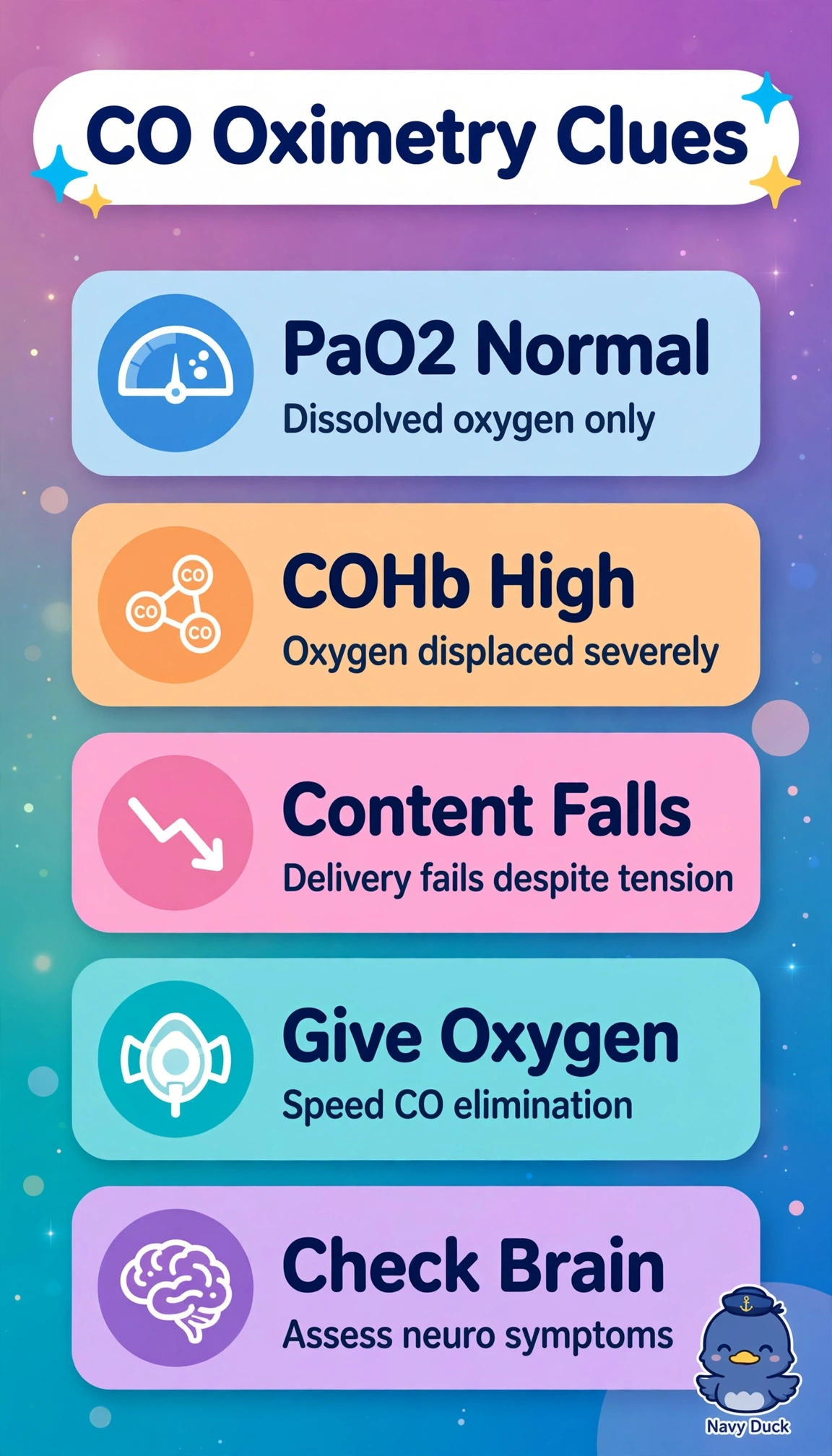
Short Explanation
Your meter reads full, but the delivery trucks are hijacked. Carboxyhemoglobin keeps PaO2 normal while starving tissues of usable oxygen.
Full Explanation
The correct interpretation recognizes that PaO2 reflects only dissolved oxygen and remains normal in carbon monoxide poisoning because alveolar gas exchange is intact, while COHb 29% markedly reduces oxygen-carrying capacity, left-shifts the dissociation curve, and explains headache, confusion, and measured O2Hb of only 68% despite PaO2 96 and calculated SaO2 97%, since calculators estimate saturation from PaO2 assuming normal hemoglobin. The hypoxemic respiratory failure interpretation fails on gas-exchange physiology because normal PaO2 on room air with normal PaCO2 and pH proves adequate alveolar transfer, so shunt or diffusion limitation cannot explain reduced O2Hb when dissolved oxygen is preserved. The concurrent cyanide-acidosis interpretation fails on metabolic physiology because cyanide impairs cellular utilization and typically causes severe lactic acidosis with low pH and compensatory changes, whereas pH 7.40 with PaCO2 38 shows no acid-base disturbance. The combined methemoglobinemia interpretation fails on oximetry physiology because MetHb 0.8% is normal and cannot explain symptoms or low O2Hb, as clinically significant methemoglobinemia usually requires much higher levels with refractory saturation gap. Exam caveat is that pulse oximetry and calculated SaO2 are falsely reassuring in dyshemoglobinemia and only multi-wavelength CO-oximetry reporting O2Hb, COHb, and MetHb is reliable. Practical check is to remove from exposure, give 100% normobaric oxygen to shorten CO half-life, monitor neurology and cardiac ischemia, check lactate, ECG, and serial COHb, and seek hyperbaric consultation for severe neurologic, cardiac, or pregnancy features.