
A 58-year-old with right lower lobe pneumonia is hypoxemic at 88% on 4-L nasal cannula, alert, with coarse crackles and thick sputum he cannot clear, and chest x-ray shows dense right basal opacity without pneumothorax. Turning is tolerated and hemodynamics are stable. Which positioning and airway clearance strategy best minimizes hypoxemia from retained secretions and mismatch?
Select an answer to reveal the explanation.
Short Explanation
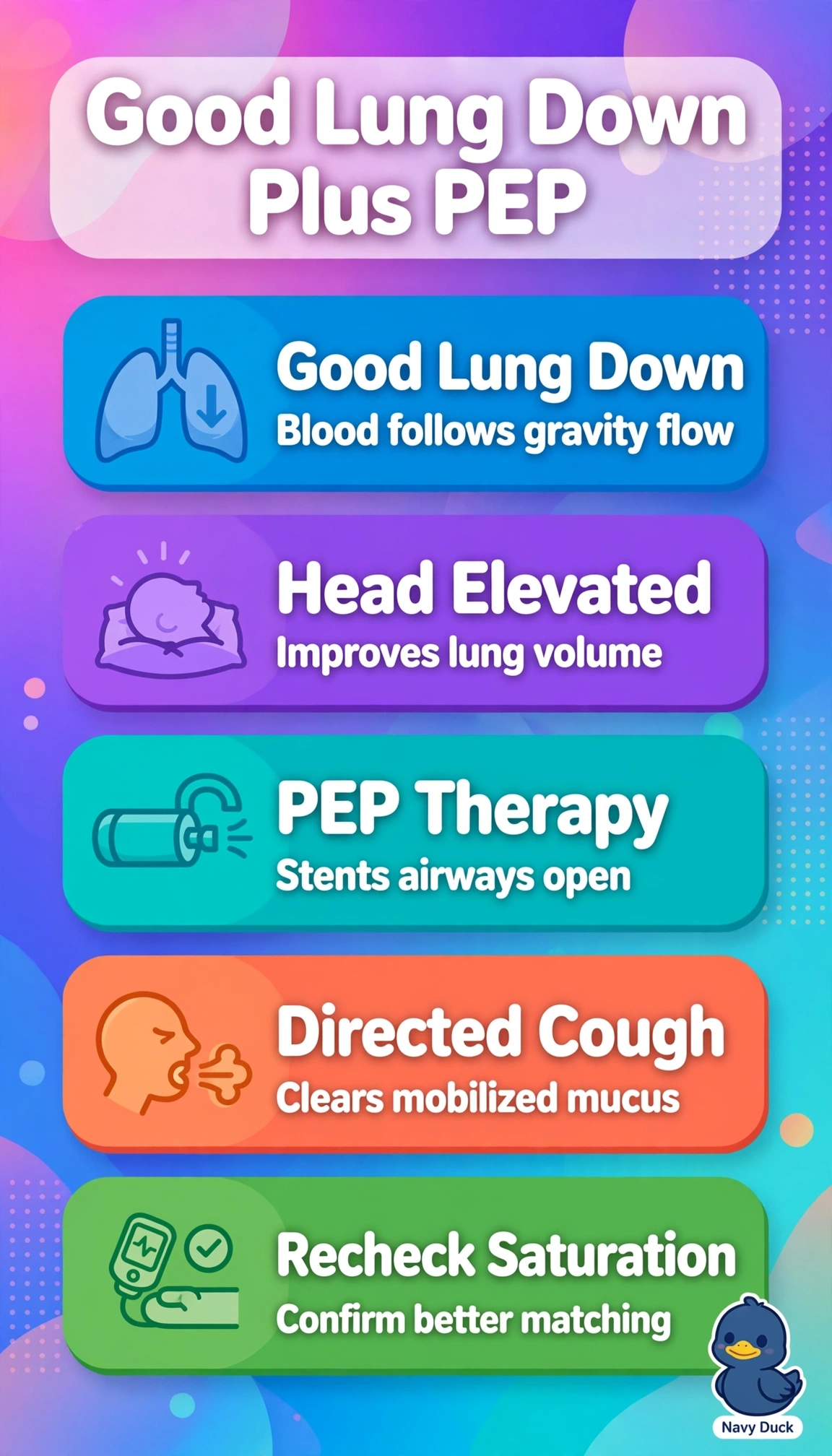
You've got to send blood where the air actually goes. Positioning with dependent good lung boosts matching while PEP moves that plug. You'll watch saturation climb as ventilation and perfusion finally agree.
Full Explanation
The correct strategy succeeds because left-lung-dependent positioning directs perfusion to better-ventilated alveoli, reducing shunt from the dense right basal consolidation, while head elevation preserves functional residual capacity and lowers aspiration risk, and directed coughing with PEP creates expiratory shear and airway splinting to mobilize thick sputum the patient cannot clear. Placing the involved right lung dependent with head elevation and cough plus PEP is wrong on two counts: postural drainage actually positions the involved segment uppermost, and with the diseased lung dependent, gravity-directed perfusion of consolidated lung increases shunt and worsens hypoxemia at 88% on 4-L. Using good-lung-dependent positioning with head elevation but incentive spirometry for expansion is standard atelectasis prevention, but fails by secretion mechanics because sustained inspiration lacks expiratory flow bias to shear thick mucus, leaving obstruction and mismatch. Staying upright sitting with cough and PEP but without lateral positioning aids ventilation, but fails by positional perfusion because blood still traverses the poorly ventilated right base. An exam caveat is to separate hypoxemic pneumonia, where good lung down improves saturation, from chronic bronchiectasis drainage, where diseased segment up is prioritized despite transient desaturation. A practical check is to maintain 30-45 degree elevation, verify side-lying tolerance, coach PEP with huff-cough, then recheck SpO2, breathing effort, sputum output, and crackles.