
A 68-year-old admitted with community-acquired pneumonia has fever, purulent sputum, right lower lobe crackles and SpO2 91% on 2 L. The patient is alert, coughs weakly and retains thick secretions despite hydration and antibiotics. Which secretion clearance intervention should the therapist recommend to improve mobilization in this pneumonia patient?
Select an answer to reveal the explanation.
Short Explanation
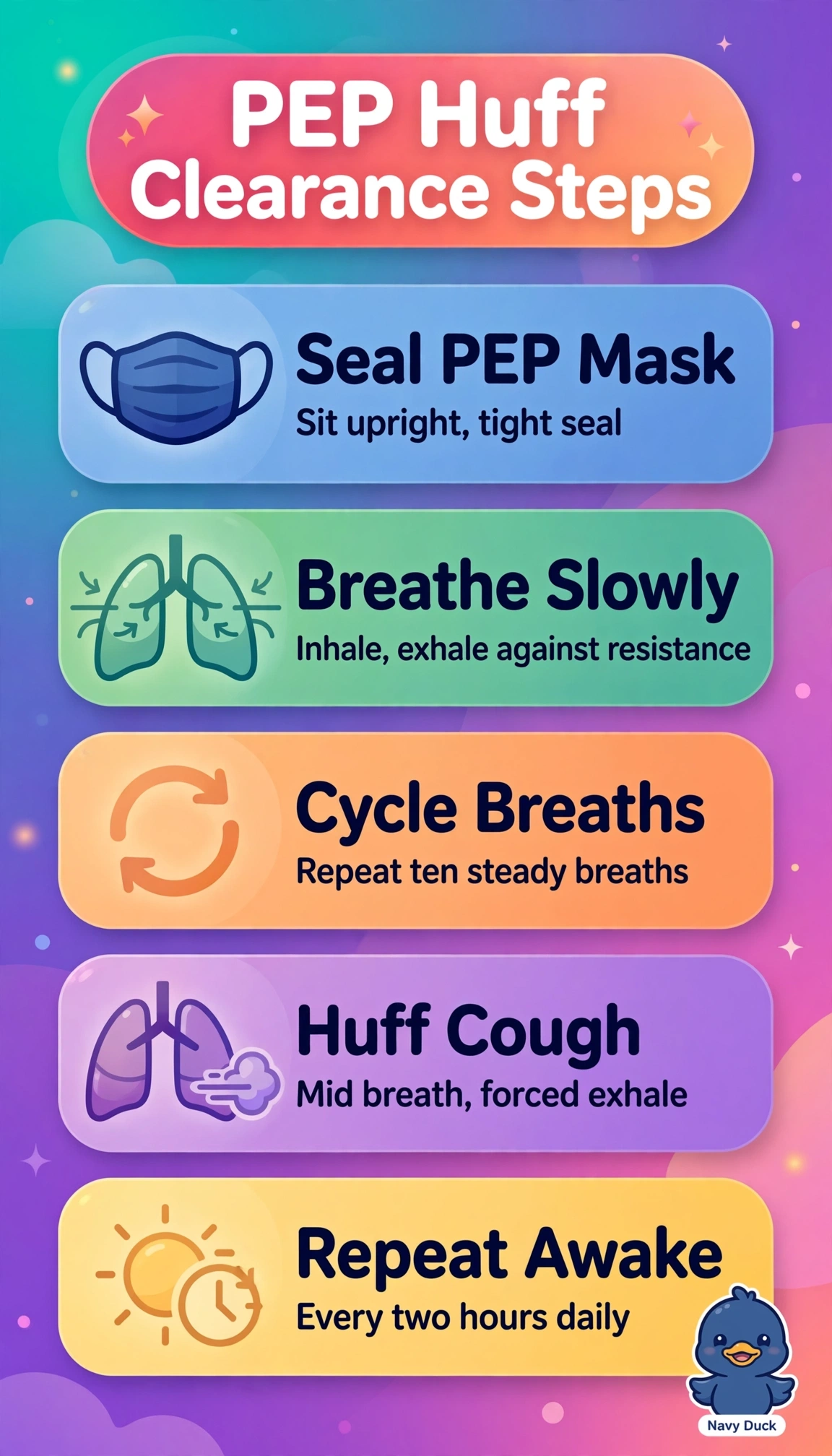
You’re helping sticky mucus move uphill without wearing them out. PEP holds airways open behind secretions so a huff-cough can shear them upward for a stronger, controlled clear.
Full Explanation
Thick purulent secretions in lobar pneumonia increase airway resistance and shunt, and positive expiratory pressure stents collapsible airways to let air get behind mucus while huff coughing creates high expiratory shear with less glottic closure and fatigue than repeated hard coughs. Incentive spirometry encourages sustained maximal inspiration to prevent atelectasis but does not provide expiratory stenting or assisted shear for retained purulent sputum, so it misses the mobilization requirement. Trendelenburg postural drainage with percussion can mobilize secretions but is poorly tolerated, risks desaturation and aspiration in an alert older adult with focal pneumonia, and is not first-line when the patient can cooperate with PEP. Routine nasotracheal suctioning removes upper airway secretions but is invasive, stimulates vagal responses, does not reach distal consolidated segments, and fails to teach independent clearance. Exam caveat: choose active, cooperative clearance over passive or invasive suction when the patient is alert and can follow coaching. Practical check: verify PEP pressure and seal, coach a mid-volume huff then strong cough, and reassess sputum volume, breath sounds, and SpO2 after the session.