
A 62-year-old with COPD is scheduled for open upper-abdominal surgery tomorrow, smokes daily, and has weak cough with thick secretions. Vitals are stable and SpO2 is 93% on room air. The surgeon requests preoperative optimization to limit atelectasis. Which pre- and post-operative respiratory care plan best prevents atelectasis after upper-abdominal surgery?
Select an answer to reveal the explanation.
Short Explanation
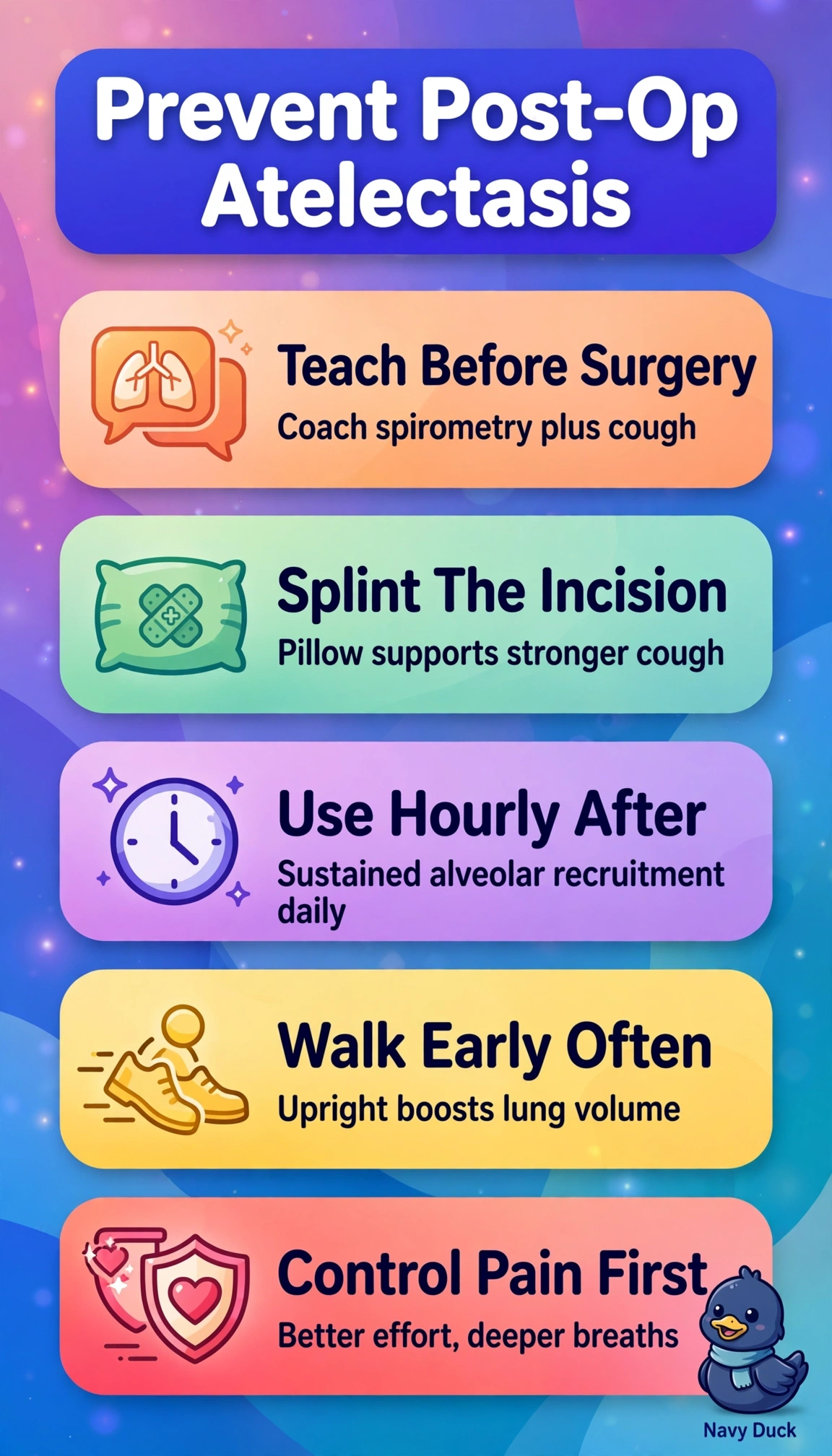
You're stacking prevention before and after the insult, not chasing it. Proactive coaching plus atelectasis prevention keeps alveoli open when pain and sedation tempt shallow breathing. That's how you beat post-op collapse to the punch.
Full Explanation
The correct plan works because open upper-abdominal surgery reduces diaphragmatic movement, functional residual capacity and cough effectiveness through anesthesia and incisional pain, risks amplified by COPD, active smoking, weak cough, thick secretions and SpO2 93%, so preoperative teaching of sustained-maximal inspiration with incentive spirometry plus incision-supported splinted coughing establishes skill before pain impairs learning, and hourly postoperative use with early ambulation maintains recruitment, mobilizes secretions and prevents rapid atelectasis. The bronchodilator-hydration approach fails on timing of instruction because optimizing airways is sensible in COPD, but first teaching incentive spirometry after surgery means learning the maneuver while painful and sedated, so target volumes and effective cough are not achieved; preoperative education is the recommended practice. The three-times-daily supervision approach fails on dose because correct techniques at low frequency allow alveolar collapse between sessions, whereas high-risk laparotomy requires hourly expansion and mandated ambulation rather than as-tolerated effort. The pursed-lip-diaphragmatic approach fails on clearance because dyspnea-control techniques for stable COPD do not generate lung-expansion volumes or protected expulsive force needed for thick secretions and splinting. Exam caveat is not to select chronic COPD management over acute perioperative recruitment and to recognize upper-abdominal surgery as mandating preemptive teaching, splinting and intensity. Practical check is to confirm preoperative return demonstration to volume goal, ensure splint pillow and timely analgesia, then track hourly spirometry volumes, cough productivity, ambulation distance, SpO2 and work of breathing.