
A 62-year-old postoperative patient on mechanical ventilation develops sudden right-sided chest pain, absent breath sounds on the right, tracheal shift left, hypotension, and SpO2 84%. Chest x-ray confirms large right tension pneumothorax with mediastinal shift. Labs show K+ 2.8 mEq/L and ionized Ca++ low. Which care-plan change best addresses tension pneumothorax with electrolyte disturbance?
Select an answer to reveal the explanation.
Short Explanation
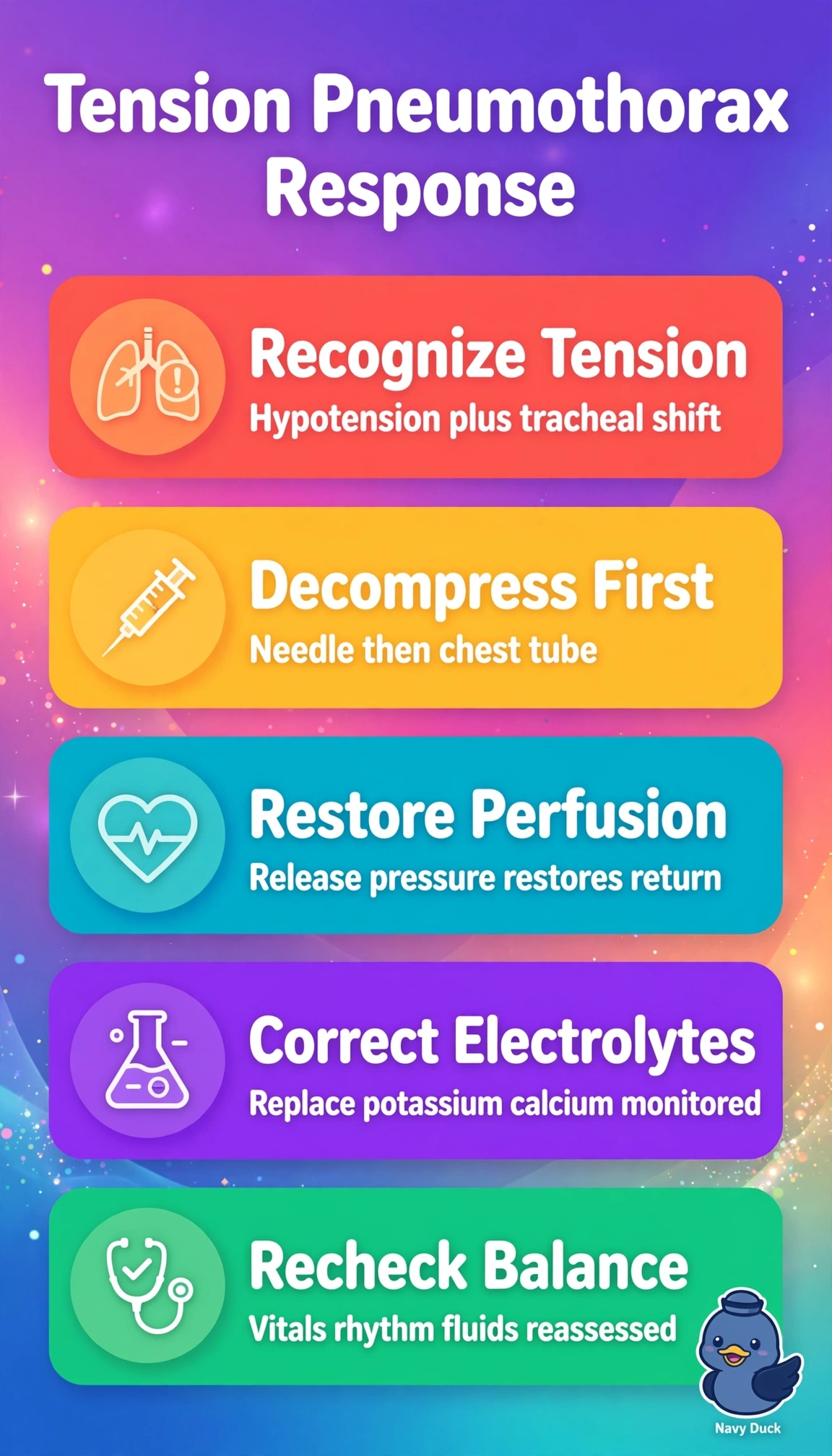
You recognized a pressure emergency that cannot wait for fluids or electrolyte replacement alone. Immediate needle decompression followed by tube thoracostomy restores venous return, while repletion of potassium and calcium addresses the documented electrolyte risks. You need both rapid pressure relief and definitive drainage.
Full Explanation
Tension pneumothorax with mediastinal shift, tracheal deviation, absent breath sounds, hypotension, and severe hypoxemia is obstructive shock from impaired venous return. Immediate needle decompression releases intrathoracic pressure, and prompt tube thoracostomy provides definitive drainage, re-expands the lung, and permits continued positive-pressure ventilation. Potassium of 2.8 mEq/L and low ionized calcium raise the risks of ventricular arrhythmia, impaired contractility, and muscle weakness, so replace both per protocol with cardiac monitoring and serial labs. Needle decompression followed by tube thoracostomy with potassium replacement alone leaves the documented hypocalcemia untreated and its cardiac risks unresolved. Urgent tube thoracostomy without needle decompression delays emergency pressure relief in an unstable patient. Needle decompression alone is temporary; without tube thoracostomy, recurrence and persistent air leak are likely during positive-pressure ventilation. Exam caveat: in this presentation, hypotension and mediastinal shift signal tension physiology, so electrolyte correction must not delay decompression and drainage. Practical check: assess for a rush of air and improved blood pressure and saturation after decompression, verify tube position by tidaling and repeat imaging, and recheck potassium, ionized calcium, magnesium, and ECG before adjusting ventilation.