
A 62-year-old with pneumonia develops moderate-severe ARDS with PaO2/FiO2 118 on FiO2 0.70, bilateral opacities, plateau 29 cm H2O on 6 mL/kg predicted body weight and PEEP 12 cm H2O. No contraindication to positioning exists. Which lung-protective strategy with proning and recruitment best manages ARDS?
Select an answer to reveal the explanation.
Short Explanation
You keep the lungs open gently while prolonged prone sessions improve ventilation-perfusion matching. Low stretch plus proning helps recruit the back of the lungs safely.
Full Explanation
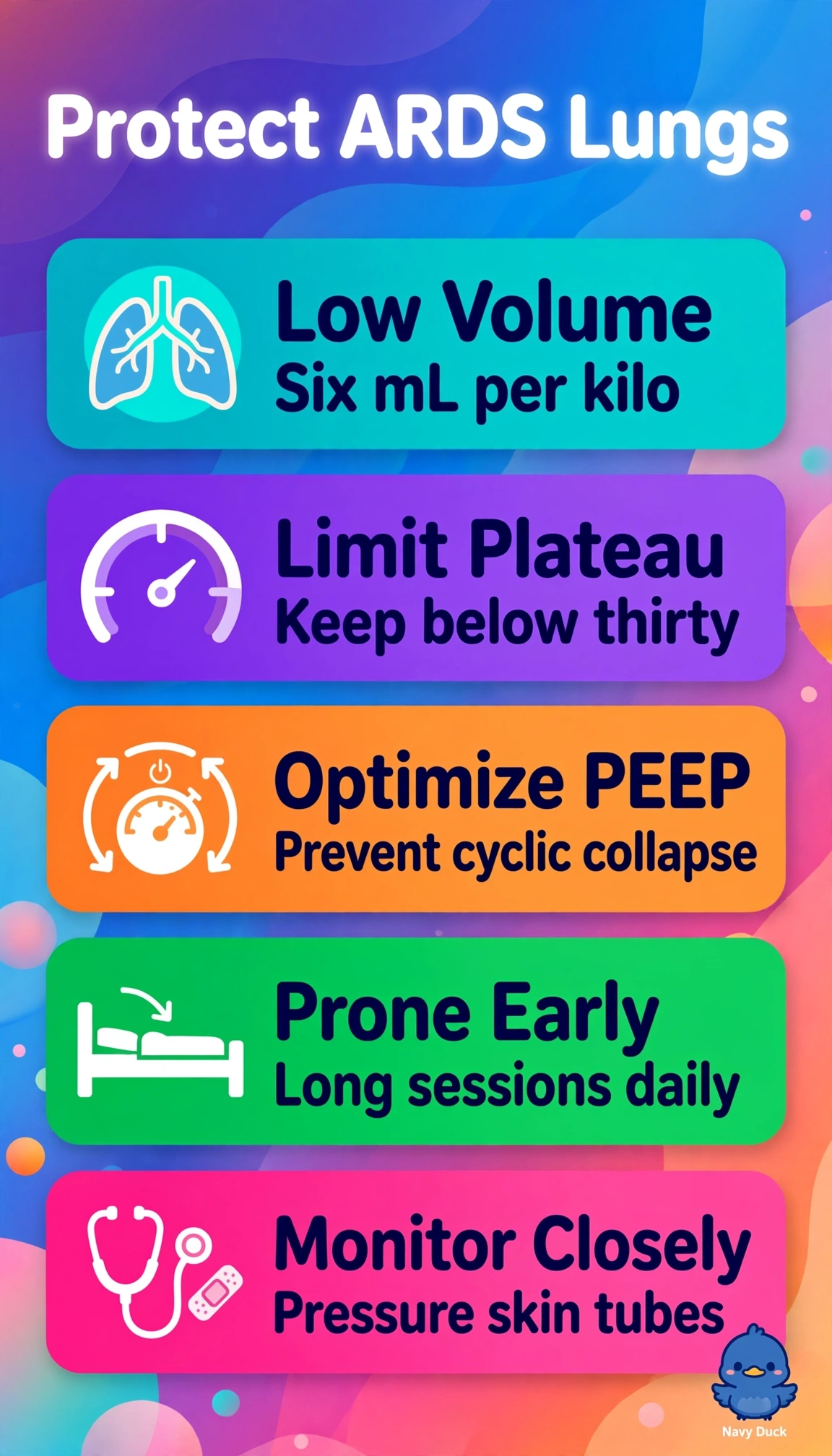
For moderate-severe ARDS, maintain 4–6 mL/kg predicted body weight, limit plateau pressure, optimize titrated PEEP, and initiate prolonged prone sessions: PaO2/FiO2 118 on FiO2 0.70 with bilateral opacities meets criteria for proning, which improves ventilation-perfusion matching, dorsal recruitment, and survival when no contraindication exists. Maintaining low tidal volume and PEEP while continuing supine care with scheduled repositioning preserves ventilation goals but misses the positioning benefit: PaO2/FiO2 below 150 indicates prone therapy, and routine turns do not replicate prolonged proning. Brief prone periods of one to two hours daily recognize the indication but provide insufficient duration to sustain recruitment or the survival advantage. Raising tidal volume toward 8–9 mL/kg while optimizing PEEP and proning preserves positioning but violates lung-protective ventilation; greater strain raises plateau and driving pressure and increases ventilator-induced injury despite potentially faster CO2 clearance. An exam caveat is to distinguish guideline-concordant prolonged proning from brief positioning or sustained high-pressure recruitment holds. A practical check is to verify predicted body weight, plateau and driving pressure, SpO2 and blood gas response, hemodynamic tolerance, airway security, and skin and eye protection before and during each session.