
A 41-year-old with Guillain-Barre syndrome shows progressive ascending weakness, vital capacity falling from 38 to 18 mL/kg over 8 hours, negative inspiratory force weakening from -45 to -22 cm H2O, tachypnea, weak cough, and difficulty handling secretions. Blood gases show borderline hypercapnia, the patient is alert, and bulbar signs are emerging. Which neuromuscular monitoring and ventilation timing decision should the therapist recommend?
Select an answer to reveal the explanation.
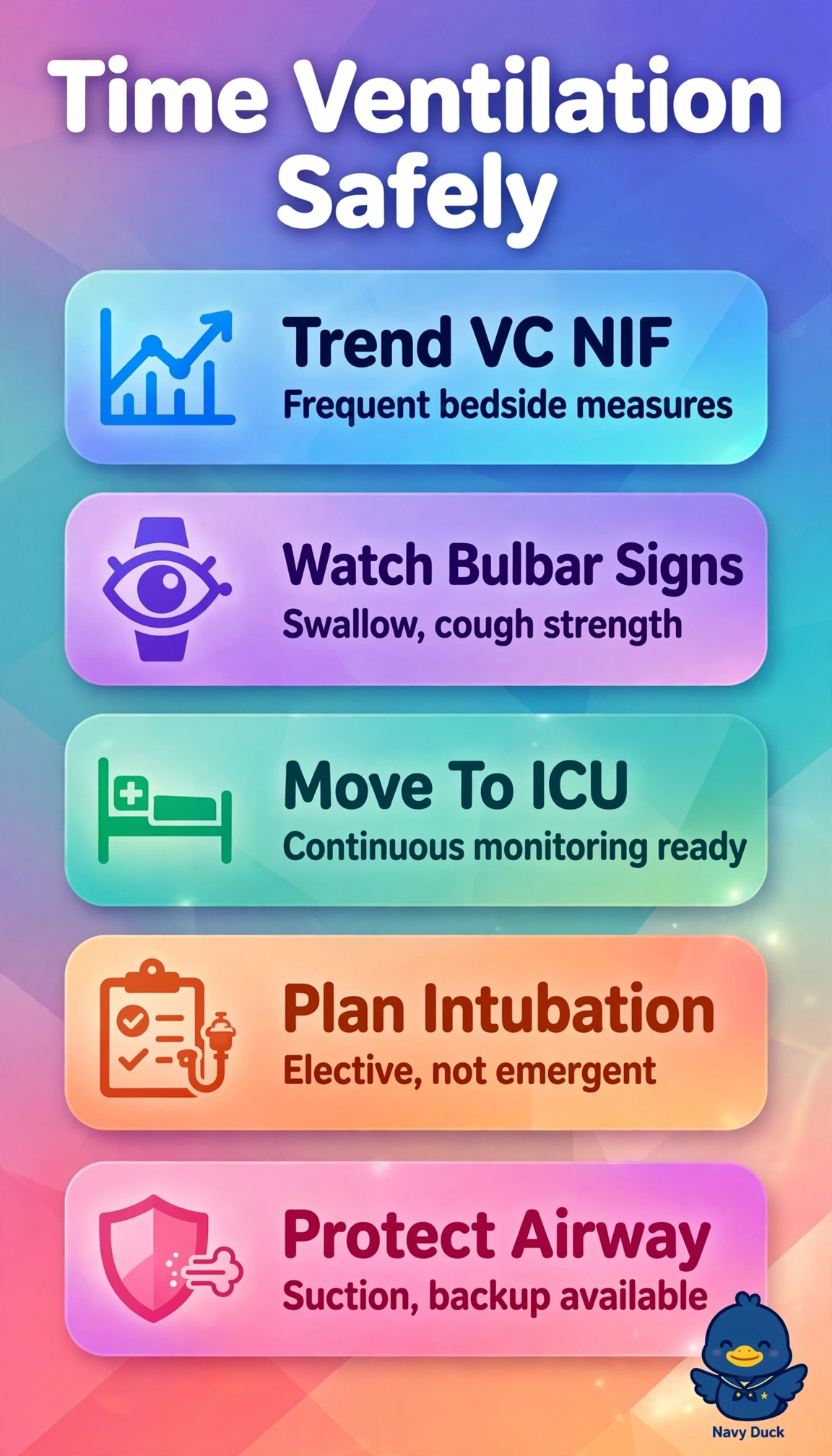
Short Explanation
You are watching the numbers slide and acting before crisis hits. Trending VC and NIF is like watching fuel gauges on a long flight. Early action relies on serial-threshold monitoring to time intubation safely.
Full Explanation
This rapid VC fall from 38 to 18 mL/kg with NIF weakening from -45 to -22 cm H2O plus tachypnea, weak cough, difficulty handling secretions, borderline hypercapnia and emerging bulbar signs signals impending neuromuscular pump failure where elective intubation under controlled conditions is safer than emergent intubation after arrest, so prompt ICU transfer allows hourly serial VC and NIF trending, bulbar and cough assessment, secretion management and airway planning. The monitored nocturnal NIV strategy fails by airway protection concept because weak cough, retained secretions and emerging bulbar dysfunction predict NIV failure, aspiration and inability to clear secretions, and NIV does not reverse progressive Guillain-Barre weakness so it dangerously delays definitive airway. The ward-based monitoring strategy fails by level-of-care concept because the velocity of decline over 8 hours, borderline hypercapnia and bulbar involvement require ICU staffing, suctioning, rapid response and immediate airway capability rather than floor observation. The oximetry plus capnography strategy fails by monitoring sensitivity concept because oxygen saturation is preserved by supplementation until late and capnography is unreliable with tachypnea and variable effort, while serial VC below 20 and NIF weaker than -30 are earlier validated triggers in neuromuscular disease. Exam caveat: do not wait for severe refractory hypercapnia, acidosis or depressed consciousness when trend, weak cough and bulbar signs already predict failure. Practical check: repeat upright VC, NIF, cough peak flow, secretion burden and bulbar exam frequently, keep difficult airway equipment at bedside, and set explicit thresholds for action with the ICU team and patient.